


























Views
Downloads

Synonyms Crossword Worksheet | Grade 1 ELA Printable
Paste this activity's link or code into your existing LMS (Google Classroom, Canvas, Teams, Schoology, Moodle, etc.).
Students can open and work on the activity right away, with no student login required.
You'll still be able to track student progress and results from your teacher account.
This Grade 1 ELA worksheet helps young learners master synonyms by matching words with similar meanings. Students expand their vocabulary and improve reading comprehension through engaging puzzle formats. By connecting related words, children build a stronger foundation for expressive writing and clear communication in the classroom.
At a Glance
- Grade: 1 · Subject: ELA
- Standard:
CCSS.ELA-LITERACY.L.1.5— Understand word relationships and nuances in meanings- Skill Focus: Synonyms
- Format: 3 pages · 17 problems · Answer key included · PDF
- Best For: Independent practice and vocabulary building
- Time: 15–20 minutes
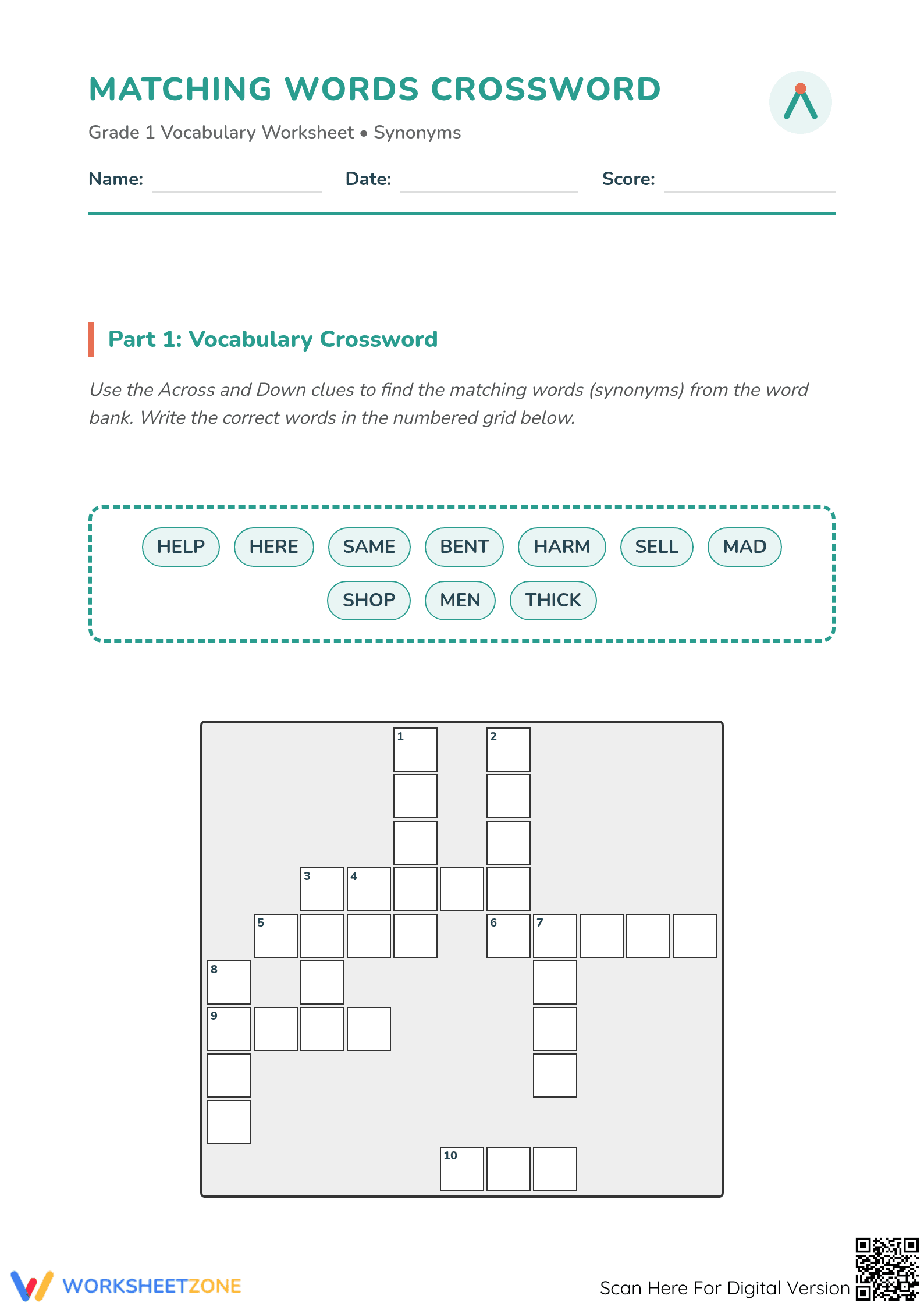
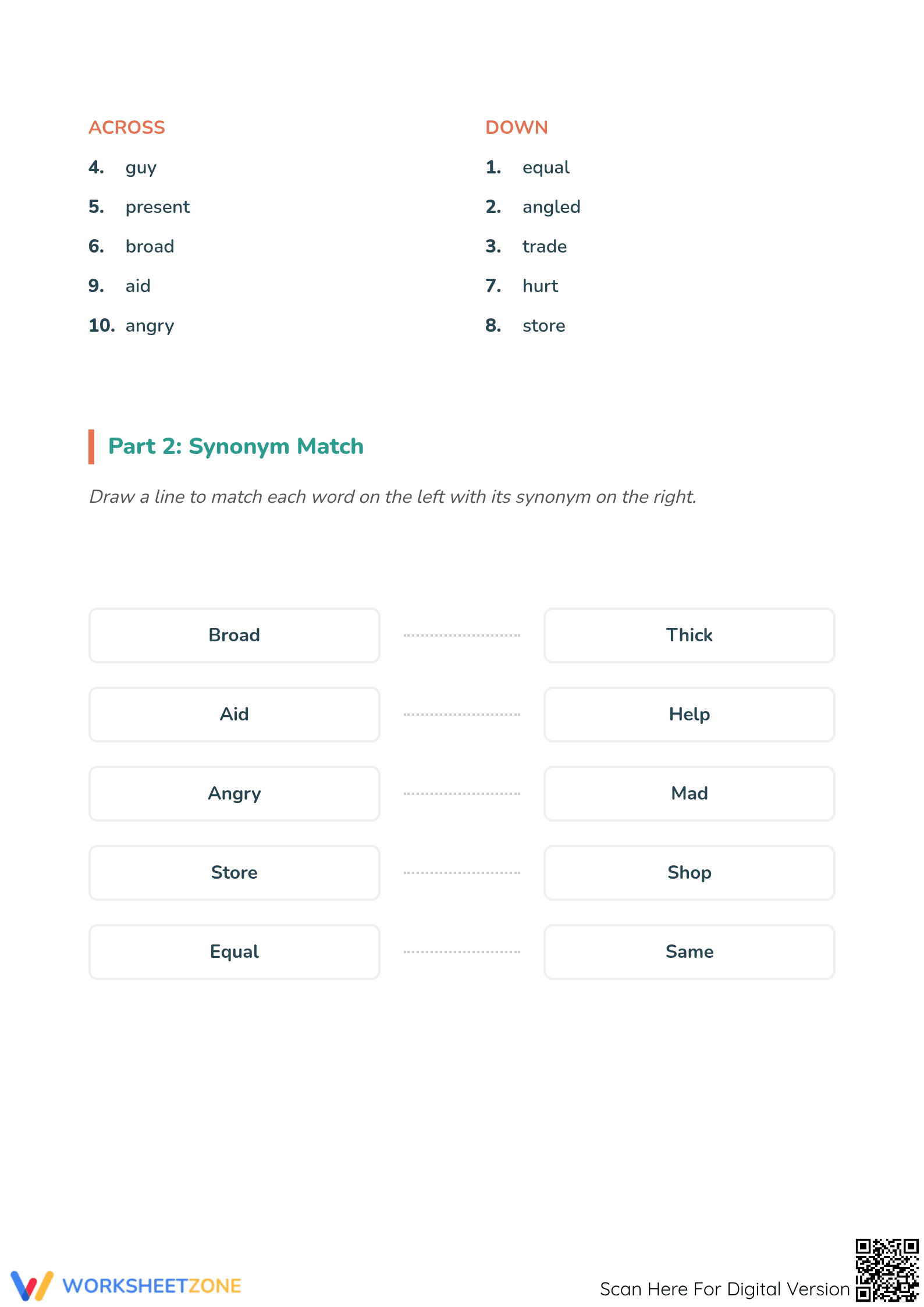
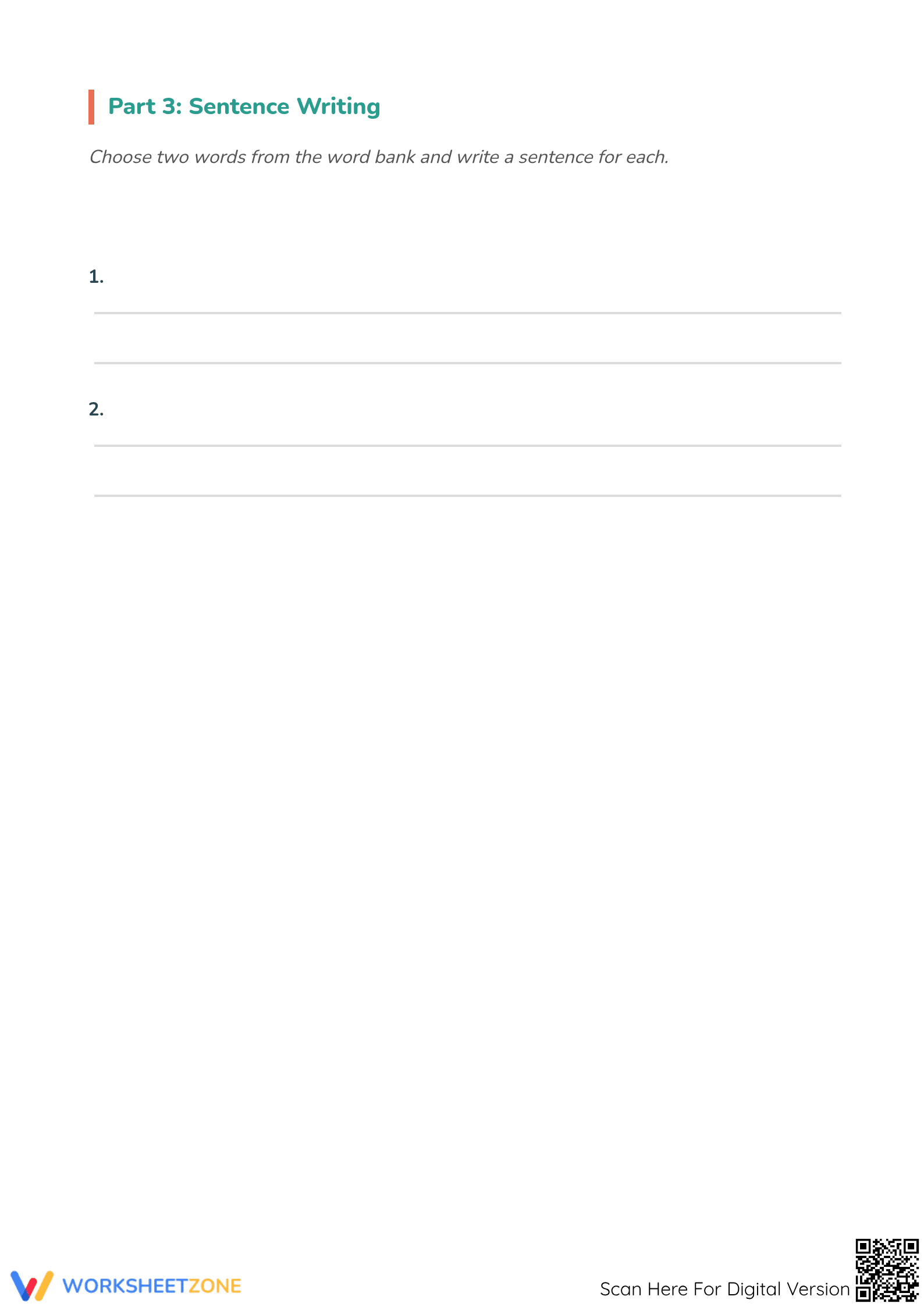
This comprehensive resource features three distinct pages of vocabulary activities. The first two pages contain a ten-word crossword puzzle with a supportive word bank and a five-question synonym matching activity. The final page provides a sentence writing task where students select two words from the bank to compose original sentences. A complete answer key is provided for quick grading.
This worksheet follows a clear gradual-release model to build student confidence:
- Guided practice: The crossword puzzle provides high support, using a word bank and intersecting letters to help students identify the correct synonyms.
- Supported practice: The matching section removes the puzzle clues but keeps the options limited to five direct pairs, reinforcing the vocabulary connections.
- Independent practice: The sentence writing task requires students to apply their newly practiced words in original contexts without structural scaffolds.
This I Do, We Do, You Do progression ensures students internalize the vocabulary effectively.
Aligned to CCSS.ELA-LITERACY.L.1.5, this resource requires students to demonstrate understanding of word relationships and nuances in word meanings. It specifically targets the ability to identify real-life connections between words and their use. Both standard codes can be copied directly into lesson plans, IEP goals, or district curriculum mapping tools.
Deploy this worksheet during independent literacy centers after a direct instruction lesson on synonyms. It also serves as an excellent morning work assignment to activate prior knowledge. While students complete the sentence writing portion, teachers can use this as a formative assessment to observe whether children understand the contextual application of the vocabulary, not just the definitions. Expect students to complete all three pages in 15 to 20 minutes.
This resource is designed for first-grade students developing foundational vocabulary skills. It is also appropriate for second-grade students needing targeted review or English Language Learners requiring structured word-meaning practice. To support struggling readers, pair this worksheet with a visual anchor chart displaying common synonym pairs before they begin the crossword puzzle.
Mastering synonyms is a critical component of early literacy development. When students practice CCSS.ELA-LITERACY.L.1.5 to understand word relationships and nuances in meanings, they directly improve their reading comprehension and expressive writing capabilities. According to Fisher & Frey (2014), explicit vocabulary instruction that includes categorizing and connecting related words significantly increases student retention and application of new terms. By moving from structured recognition tasks, like crossword puzzles, to generative tasks, like sentence writing, learners solidify their semantic networks. This multi-modal approach ensures that vocabulary acquisition moves beyond rote memorization into functional language use. Providing young learners with varied exposures to similar meanings builds the cognitive flexibility required for advanced reading tasks in later grades, making targeted synonym practice an essential element of the primary English Language Arts curriculum.


