


























Views
Plays
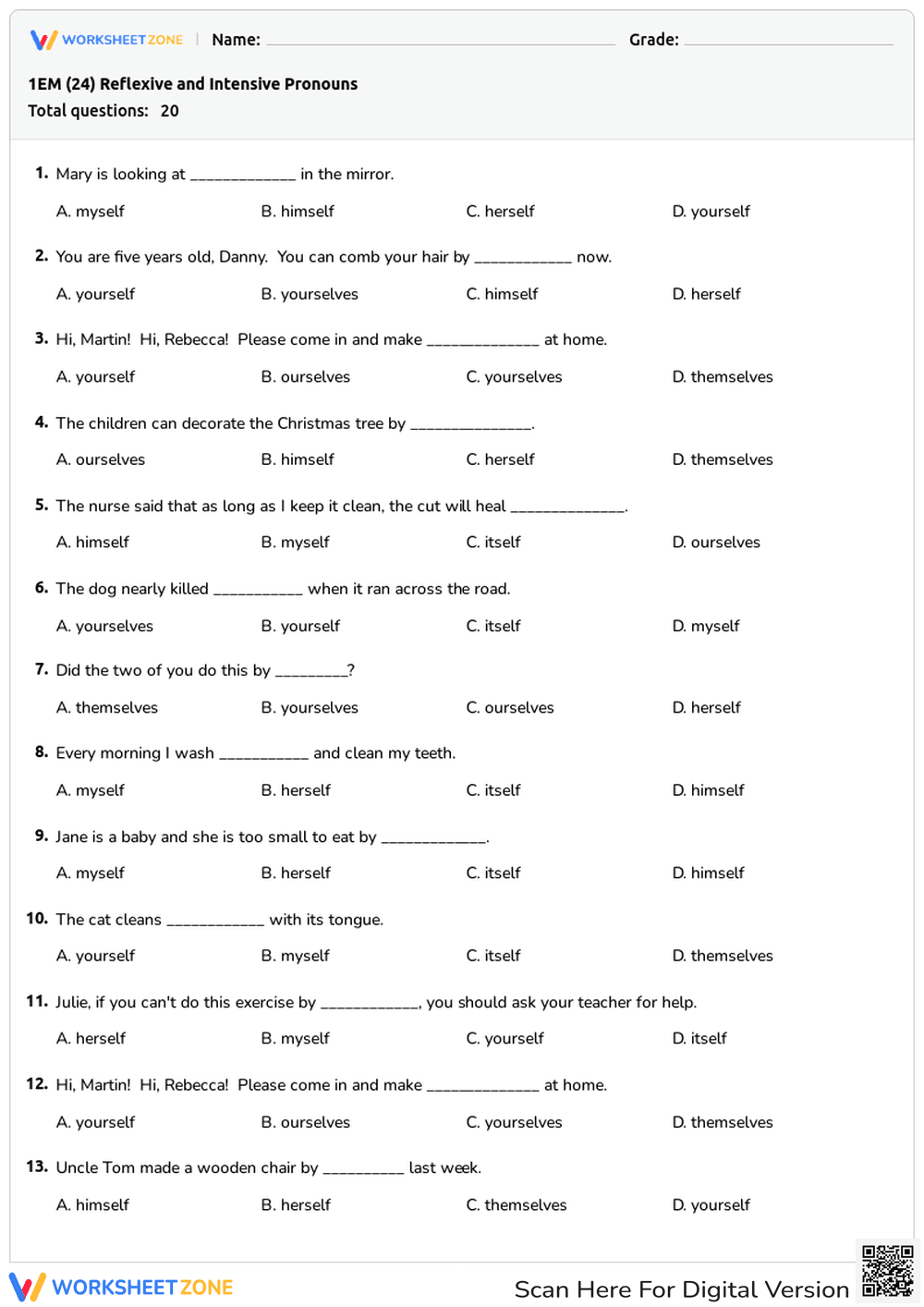


Reflexive Pronouns Worksheet | Grade 2 Essential
Paste this activity's link or code into your existing LMS (Google Classroom, Canvas, Teams, Schoology, Moodle, etc.).
Students can open and work on the activity right away, with no student login required.
You'll still be able to track student progress and results from your teacher account.
Master the use of reflexive pronouns with this comprehensive practice set. Students will identify the correct pronoun to complete 20 different sentences, ensuring they understand how pronouns refer back to the subject. This resource provides immediate reinforcement for grammar and sentence structure skills in early elementary language arts.
At a Glance
- Grade: 2 · Subject: English Language Arts
- Standard:
CCSS.ELA-LITERACY.L.2.1.C— Use reflexive pronouns such as myself, ourselves, and themselves correctly- Skill Focus: Reflexive Pronoun Agreement
- Format: 2 pages · 20 problems · Answer key included · PDF
- Best For: Independent practice or quick formative assessment
- Time: 15–20 minutes
This two-page PDF contains 20 multiple-choice questions designed to test pronoun-antecedent agreement. Each question provides a clear context sentence followed by four options, such as myself, himself, herself, and yourself. The layout is clean and distraction-free, featuring a dedicated space for student names and grades at the top of the first page for easy organization.
Zero-Prep Workflow
- Print: Generate the two-page set in under 30 seconds for your entire class.
- Distribute: Hand out the worksheets for a 15-minute independent work session or center activity.
- Review: Grade or review the answers using the provided key in less than 5 minutes.
This resource is an ideal choice for emergency sub plans or morning work because it requires no teacher setup or additional materials.
Standards Alignment
This worksheet aligns with `CCSS.ELA-LITERACY.L.2.1.C`, which requires students to use reflexive pronouns accurately within sentences. By selecting the correct pronoun based on the subject (singular vs. plural, gendered vs. neutral), students demonstrate mastery of foundational grammar rules. Both standard codes can be copied directly into lesson plans, IEP goals, or district curriculum mapping tools.
How to Use It
Use this worksheet as a formative assessment immediately following a direct instruction lesson on pronouns. It also serves as an excellent diagnostic tool; teachers can quickly scan the multiple-choice selections to identify students who struggle with plural vs. singular reflexive forms. Expected completion time ranges from 15 to 20 minutes depending on reading speed.
Who It's For
This practice set is tailored for Grade 2 students but remains highly effective for Grade 3 review or English Language Learners (ELL) who need targeted practice with English pronoun conventions. It pairs naturally with a classroom anchor chart displaying the relationship between subjects and their reflexive counterparts. It is also suitable for literacy centers or homework assignments.
According to the RAND AIRS 2024 report, high-quality instructional materials that provide focused, repetitive practice on discrete grammar skills like CCSS.ELA-LITERACY.L.2.1.C significantly improve student writing fluency. This worksheet addresses the specific skill of reflexive pronoun agreement through 20 contextualized examples, allowing students to internalize the logic of self-referential language. By isolating the pronoun choice within a multiple-choice format, the resource reduces cognitive load, enabling learners to focus entirely on the relationship between the subject and the reflexive object. Research from Fisher & Frey (2014) suggests that such scaffolded independent practice is a critical component of the gradual release of responsibility model, ensuring that students can move from guided instruction to mastery with confidence. This resource provides the necessary volume of practice to ensure long-term retention of essential ELA standards.


