


























Views
Downloads

Grade 1-2 -ed Pronunciation — Printable No-Prep Worksheet
Paste this activity's link or code into your existing LMS (Google Classroom, Canvas, Teams, Schoology, Moodle, etc.).
Students can open and work on the activity right away, with no student login required.
You'll still be able to track student progress and results from your teacher account.
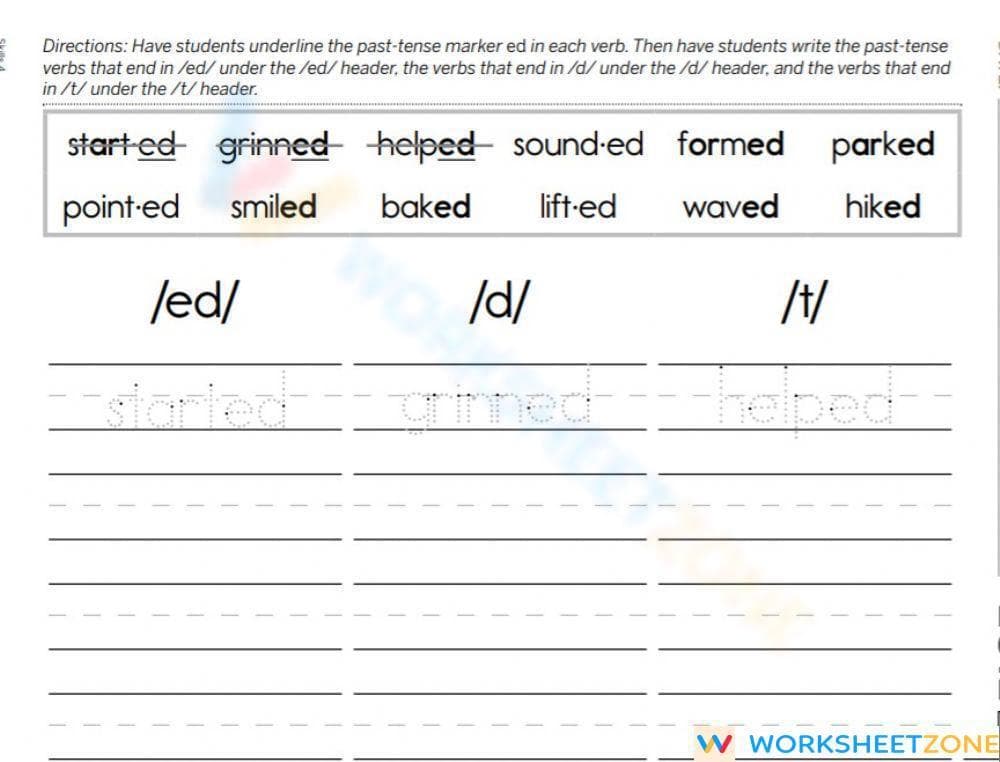
This Grade 1-2 phonics worksheet helps students master the three distinct sounds of the past-tense suffix -ed. Students accurately categorize verbs into /ed/, /d/, and /t/ pronunciation groups. By sorting 12 common action words, learners develop the phonetic awareness necessary for fluent reading and natural speech patterns.
At a Glance
- Grade: 1–2 · Subject: ELA / Phonics
- Standard:
CCSS.ELA-LITERACY.RF.1.3.F— Read words with frequently occurring inflectional endings- Skill Focus: Past-tense -ed pronunciation sorting
- Format: 1 page · 12 problems · Answer key included · PDF
- Best For: Literacy centers and independent phonics practice
- Time: 15–20 minutes
What's Inside
The worksheet features a student-friendly layout designed for immediate use. It has a word bank of 12 past-tense verbs like "started," "grinned," and "helped," showcasing the three phonetic variations of the -ed marker. Three columns provide space for sorting, with traced examples for scaffolding. The single-page PDF and comprehensive answer key allow for easy distribution and rapid grading.
A True Zero-Prep Workflow
This resource is engineered for maximum teacher efficiency with a total prep time under two minutes. The workflow is simple:
- 1. Print: The single-page PDF format makes printing a class set fast and economical.
- 2. Distribute: With clear directions, the worksheet is ready for immediate student use at desks or in literacy centers.
- 3. Review: Use the included answer key for quick grading, peer-review, or student self-correction.
Its straightforward design makes it an ideal resource for an emergency substitute plan or a quiet morning work activity that requires no teacher setup.
Standards-Aligned Foundational Skills Practice
This activity aligns with CCSS.ELA-LITERACY.RF.1.3.F, requiring students to read words with inflectional endings. By focusing on the -ed suffix, students learn how grammatical markers change phonetically based on the preceding sound. This skill supports decoding in Grade 1 and word analysis in Grade 2. The standard code can be copied directly into lesson plans, IEP goals, or district curriculum mapping tools.
How to Use This Worksheet
Use this worksheet during independent practice after a direct instruction lesson on past-tense verbs. Have students complete the sort to reinforce their understanding. For formative assessment, listen to students whisper-read as they sort; misplacing words like 'baked' indicates a need for targeted intervention on voiceless consonant endings. The activity takes about 15 to 20 minutes.
Who It's For
Designed for first and second-graders developing phonological awareness, this resource also benefits English Language Learners struggling with English verb endings. For differentiation, pair this worksheet with an anchor chart of voiceless and voiced consonants as a visual cue. It pairs naturally with a short reading passage containing high-frequency past-tense verbs for contextual practice.
The systematic sorting of inflectional endings is a proven strategy for developing orthographic mapping and phonetic decoding skills. According to research by Fisher & Frey (2014), gradual release of responsibility models are most effective when the practice task directly mirrors the targeted standard. This worksheet addresses CCSS.ELA-LITERACY.RF.1.3.F by providing specific instances of past-tense -ed markers, allowing students to internalize pronunciation rules through active categorization. By isolating the phonetic element from complex sentence structures, students can focus exclusively on the phoneme-grapheme relationship. This targeted approach ensures foundational literacy skills are reinforced through repetitive, high-success tasks that build student confidence. Such structured sorting activities improve both spelling accuracy and reading fluency in early elementary learners, making them a staple of effective literacy instruction.


