


























Views
Plays
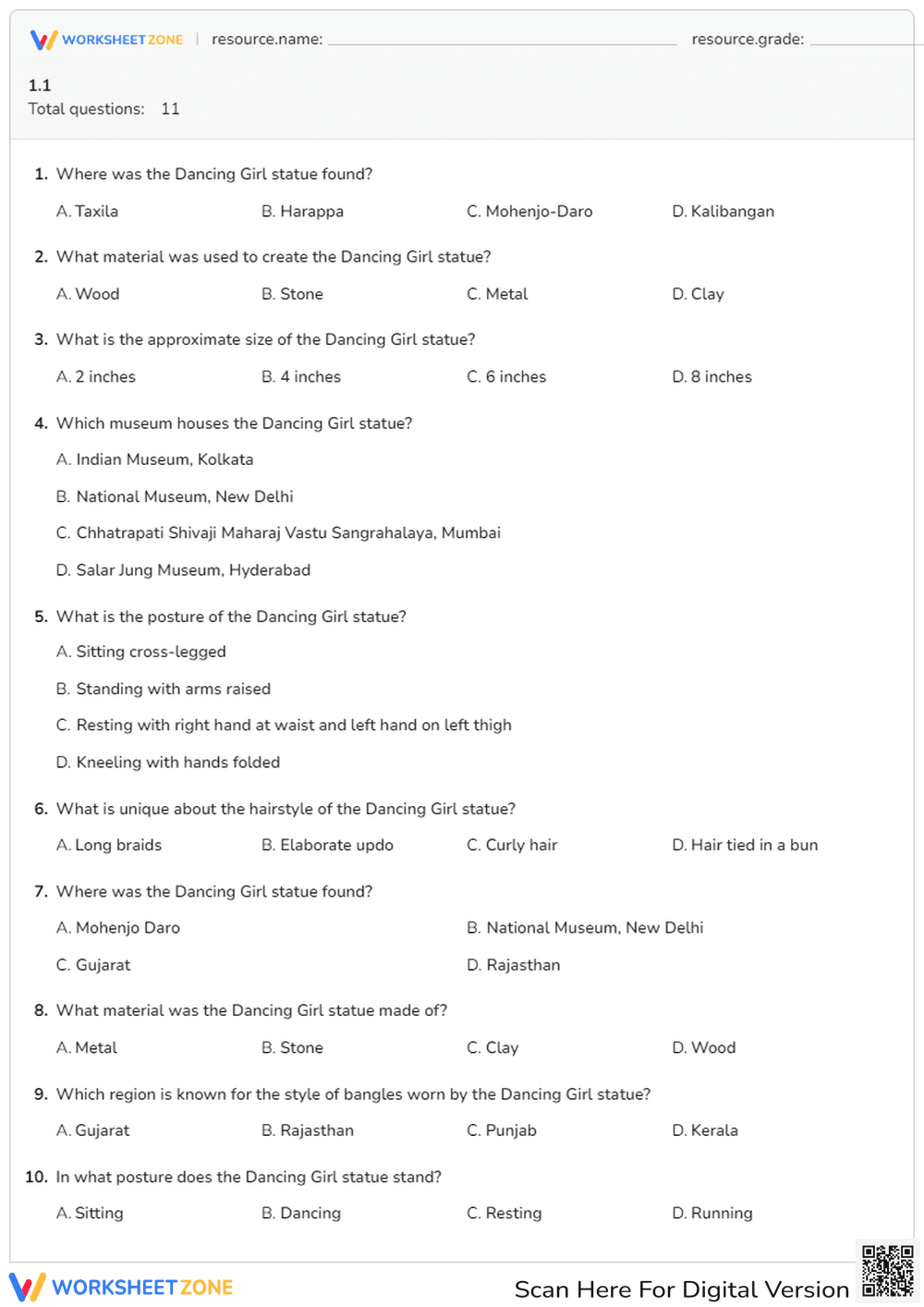


Grade 5 Indian History — Printable No-Prep Worksheet
Paste this activity's link or code into your existing LMS (Google Classroom, Canvas, Teams, Schoology, Moodle, etc.).
Students can open and work on the activity right away, with no student login required.
You'll still be able to track student progress and results from your teacher account.
This Grade 5 Social Studies worksheet assesses student knowledge of the Dancing Girl statue, a pivotal artifact from the Indus Valley Civilization. By engaging with specific historical details, learners demonstrate their ability to recall and analyze archaeological evidence found at Mohenjo-Daro to better understand ancient cultures.
At a Glance
- Grade: 5 · Subject: Social Studies
- Standard:
CCSS.ELA-LITERACY.RI.5.1— Quote accurately from a text when explaining what the text says explicitly.- Skill Focus: Indus Valley Civilization Artifacts
- Format: 2 pages · 11 problems · Answer key included · PDF
- Best For: Quick formative assessment or history review
- Time: 15–20 minutes
The resource contains 11 multiple-choice questions spread across two pages. It focuses exclusively on the Dancing Girl statue, covering its discovery site, material composition, physical dimensions, and current location. The clear layout ensures students can focus on the content without visual distractions, making it an effective tool for checking comprehension of specific historical facts.
This worksheet is designed for a zero-prep classroom environment. Teachers can print the two-page PDF in less than 30 seconds. Distribution takes approximately one minute, and the multiple-choice format allows for a rapid five-minute peer-review or teacher-led grading session. It serves as an ideal sub-plan or end-of-unit check for busy educators.
Standards Alignment
Aligned to `CCSS.ELA-LITERACY.RI.5.1`, this quiz requires students to identify explicit details regarding historical artifacts. While primarily a history resource, it reinforces the literacy skill of identifying specific facts within informational contexts. This standard code can be copied directly into lesson plans, IEP goals, or district curriculum mapping tools.
How to Use It
Use this quiz as a "Do Now" activity to activate prior knowledge before a lecture on ancient India. Alternatively, assign it as an exit ticket to gauge mastery of the Mohenjo-Daro excavations. Teachers should observe if students struggle with the specific measurements or locations, indicating a need for visual aids. Expected completion time is 15 to 20 minutes.
Who It's For
This resource is perfect for 4th and 5th-grade students studying world history or ancient civilizations. It provides accessible practice for general education students and can be used as a scaffolded assessment for English Language Learners. It pairs naturally with a virtual museum tour of the National Museum in New Delhi or an anchor chart detailing Harappan culture.
According to research from RAND AIRS (2024), structured retrieval practice through low-stakes quizzing significantly improves long-term retention of historical facts in upper elementary students. This worksheet facilitates that retrieval by focusing on the CCSS.ELA-LITERACY.RI.5.1 standard, which emphasizes accuracy in identifying informational details. By isolating a single artifact like the Dancing Girl, students build a concrete mental model of the Indus Valley Civilization. This targeted approach aligns with evidence-based instructional strategies that favor depth over breadth in introductory history units. Educators can use the 11-question data set to identify specific gaps in student understanding of archaeological evidence. This resource provides a reliable method for assessing foundational knowledge before moving into complex historical analysis, ensuring that all learners have a firm grasp of the primary evidence discovered at Mohenjo-Daro.


