


























Views
Downloads

Word Ladder Printable Worksheet | Grades 1-2 Essential
Paste this activity's link or code into your existing LMS (Google Classroom, Canvas, Teams, Schoology, Moodle, etc.).
Students can open and work on the activity right away, with no student login required.
You'll still be able to track student progress and results from your teacher account.
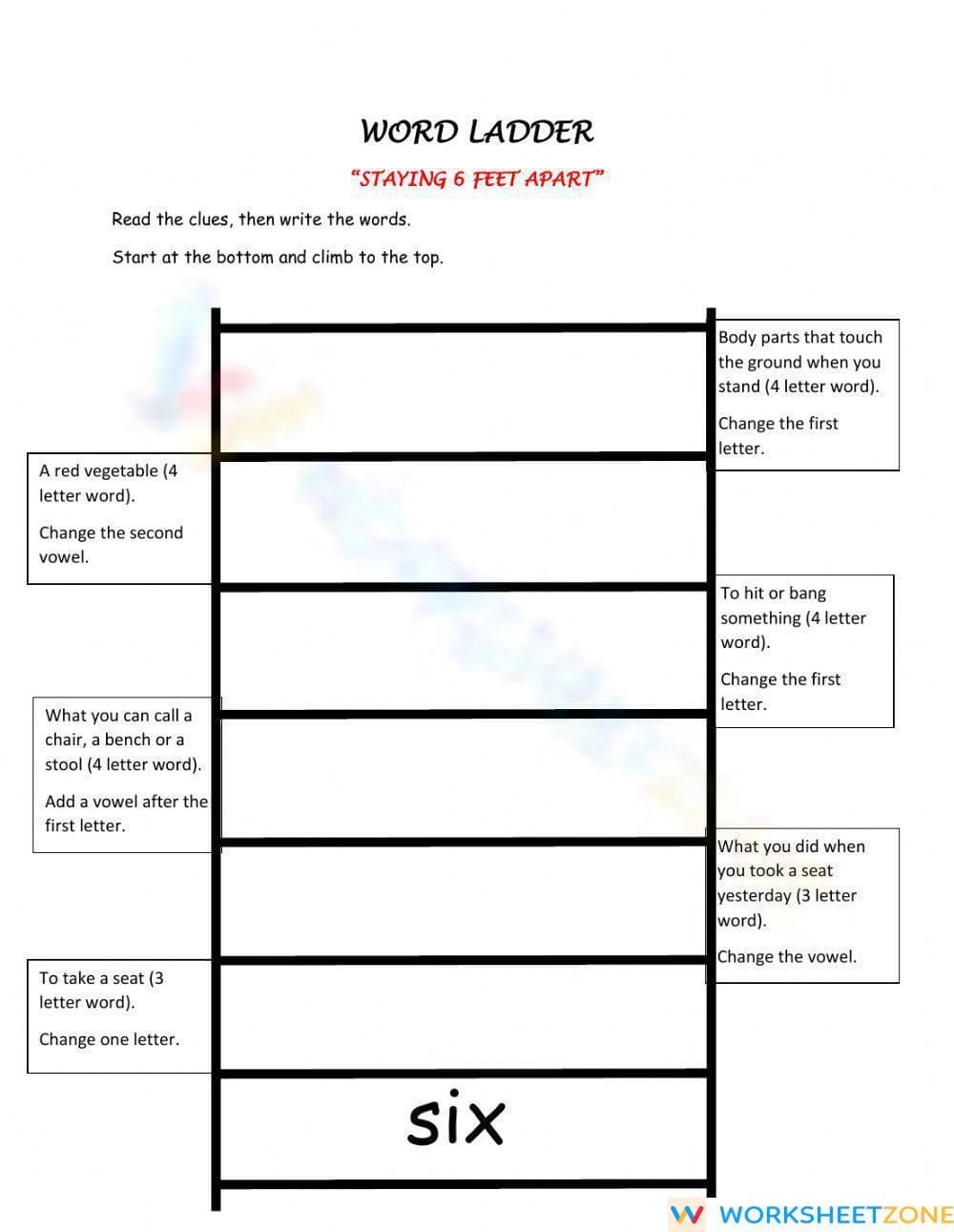
Students master vocabulary through structured word manipulation in this engaging "Staying 6 Feet Apart" word ladder. By analyzing clues and changing letters, learners strengthen their understanding of spelling patterns and word families. This worksheet provides an interactive way to build literacy skills while maintaining a fun, thematic connection to measurement concepts.
At a Glance
- Grade: 1-2 · Subject: ELA
- Standard:
CCSS.ELA-LITERACY.RF.2.3— Know and apply grade-level phonics and word analysis skills when decoding and spelling new words- Skill Focus: Phonics and Word Manipulation
- Format: 1 page · 6 problems · Answer key included · PDF
- Best For: Literacy center rotations, morning work, or emergency sub plans
- Time: 10–15 minutes
This comprehensive one-page PDF features a vertical word ladder consisting of six progressive steps. Starting with the base word "six," students follow specific linguistic instructions to transform words, such as changing a vowel or adding a letter. Each rung is paired with a clear definition clue to support vocabulary acquisition. The layout is clean and intuitive, ensuring students can work independently with minimal teacher intervention.
The zero-prep design allows teachers to implement this activity in under two minutes. Step 1: Print the single-page PDF for your entire class (30 seconds). Step 2: Distribute the worksheets during your literacy block or morning work session (30 seconds). Step 3: Review the completed ladders using the included answer key for immediate feedback (60 seconds). This streamlined process makes it an ideal resource for emergency substitute teacher folders or transition periods where quiet, focused work is required.
Standards Alignment
This resource is primarily aligned to CCSS.ELA-LITERACY.RF.2.3, which requires students to know and apply grade-level phonics and word analysis skills in decoding words. By requiring students to "change the vowel" or "add a vowel," the worksheet reinforces specific spelling-sound correspondences. Supporting standards include CCSS.ELA-LITERACY.L.1.2.E, focusing on using conventional spelling for words with common patterns. Both standard codes can be copied directly into lesson plans, IEP goals, or district curriculum mapping tools.
How to Use It
Use this worksheet as a formative assessment during your phonics unit to observe how students handle vowel shifts and letter substitutions. It works exceptionally well as a "Do Now" activity to settle the class at the start of an ELA period. Teachers should look for students who struggle with the transition from three-letter to four-letter words, as this often indicates a need for additional support in phonemic awareness and blending.
Who It's For
This activity is designed for first and second-grade students who are developing their decoding fluency. It is also suitable for third-grade learners who require remedial practice with basic spelling patterns. The inclusion of clear clues and letter-count hints provides built-in differentiation, supporting English Language Learners as they connect definitions to word structures. Pair this with a shared reading passage to reinforce the newly discovered vocabulary in context.
Research indicates that structured word manipulation activities like word ladders significantly improve orthographic mapping and spelling retention in early elementary students. By forcing students to focus on individual phonemes and their corresponding graphemes within the CCSS.ELA-LITERACY.RF.2.3 framework, this worksheet effectively bridges the gap between simple decoding and fluent reading. The cognitive load required to solve definitions while simultaneously applying complex spelling rules creates a much deeper neural connection than rote memorization alone. Educational experts emphasize that these "brain-teaser" formats increase student engagement and motivation, leading to higher completion rates compared to traditional drill-and-kill spelling worksheets. Teachers can confidently integrate this evidence-based tool into their daily literacy routines to foster long-term reading success and phonetic mastery across primary grades.


