


























Views
Downloads
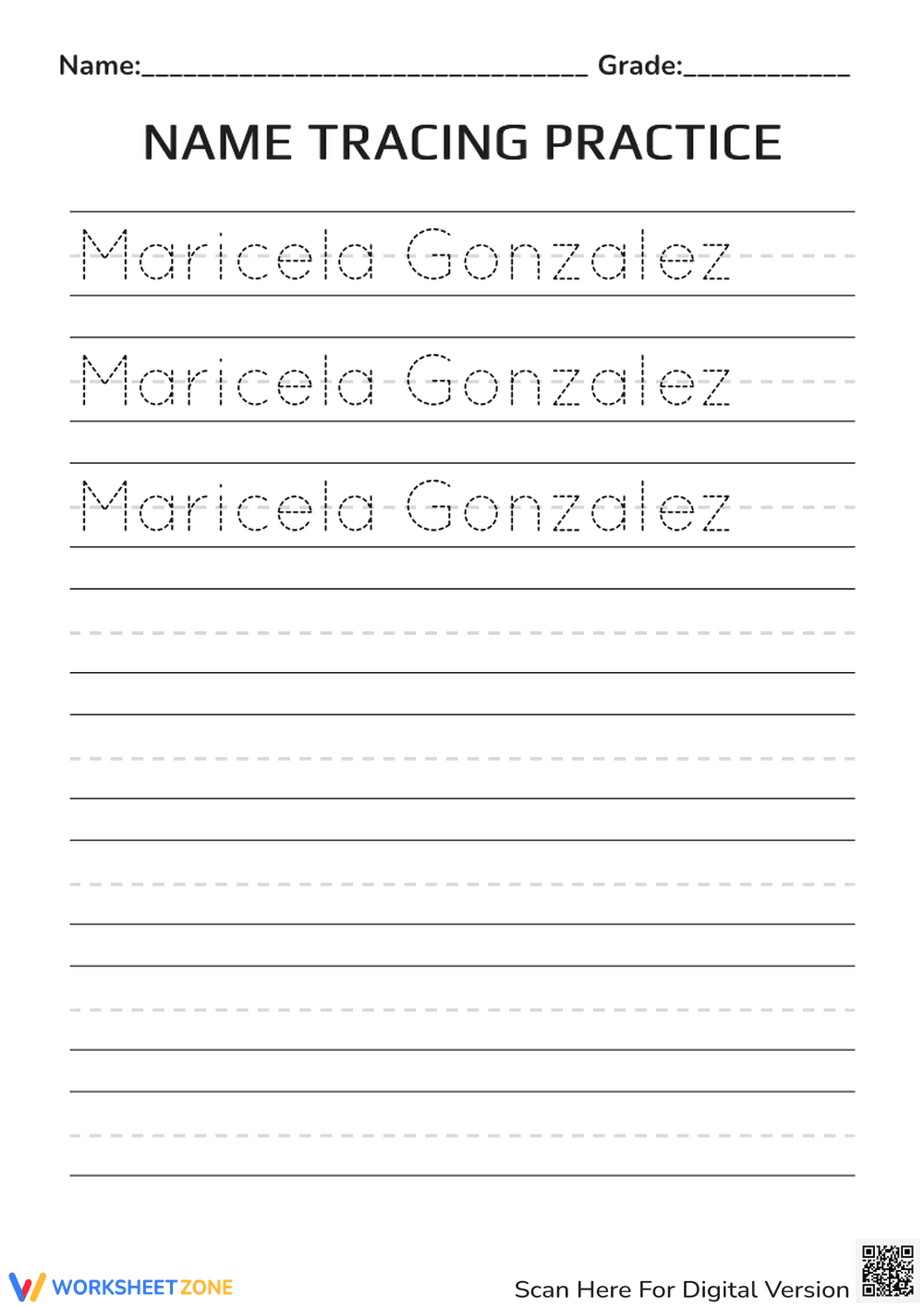

Printable Name Tracing Worksheet | Grade K-1 Handwriting
Paste this activity's link or code into your existing LMS (Google Classroom, Canvas, Teams, Schoology, Moodle, etc.).
Students can open and work on the activity right away, with no student login required.
You'll still be able to track student progress and results from your teacher account.
This printable handwriting worksheet provides early learners with targeted name tracing practice to build fine motor control and letter formation skills. By transitioning from guided tracing to independent writing, students develop the muscle memory required for legible, confident handwriting in their daily classroom activities.
At a Glance
- Grade: K · Subject: Handwriting
- Standard:
CCSS.ELA-LITERACY.L.K.1.A— Print upper- and lowercase letters- Skill Focus: Name Tracing
- Format: 1 page · 8 practice lines · No answer key · PDF
- Best For: Morning work and centers
- Time: 10–15 minutes
This single-page resource features a clean, distraction-free layout designed specifically for early writers. It includes three lines of dashed-line tracing for the name "Maricela Gonzalez," followed by five blank primary-lined spaces for independent practice. The standard primary lines include a dashed middle line to help students properly size their uppercase and lowercase letters.
Zero-Prep Workflow
This worksheet is designed for immediate classroom implementation with absolutely no teacher setup required.
- Print (1 minute): Simply download the PDF and print the required number of copies. The black-and-white design saves ink.
- Distribute (1 minute): Hand out to students during morning routines or literacy centers.
- Review (3 minutes): Quickly scan completed sheets to check for proper letter sizing and spacing.
With a total teacher prep time of under two minutes, this resource is highly suitable for emergency sub plans or spontaneous skill reinforcement.
Standards Alignment
This handwriting practice aligns directly with CCSS.ELA-LITERACY.L.K.1.A, which requires students to print many upper- and lowercase letters. It also supports foundational fine motor development necessary for early literacy. Both standard codes can be copied directly into lesson plans, IEP goals, or district curriculum mapping tools.
How to Use It
Deploy this worksheet as a morning work activity as students settle into the classroom, or assign it as a focused station during literacy centers. For a formative assessment observation tip, watch students as they transition from the tracing lines to the blank lines; note whether they maintain proper pencil grip and start their letters from the top down. Expected completion time ranges from 10 to 15 minutes depending on the student's fine motor proficiency.
Who It's For
This resource is primarily designed for Kindergarten and first-grade students mastering basic letter formation and name recognition. To differentiate, teachers can highlight the bottom baseline with a green marker for students struggling with spatial awareness, or provide a pencil grip for those needing ergonomic support. It pairs naturally with an alphabet anchor chart or a direct instruction mini-lesson on proper letter strokes.
Research consistently demonstrates that explicit handwriting instruction significantly impacts broader literacy outcomes, including reading fluency, spelling accuracy, and overall written expression. According to a comprehensive EdReports 2024 analysis, foundational skills practice must include dedicated, structured time for physical letter formation to build essential automaticity in early learners. When students practice printing upper- and lowercase letters, as explicitly outlined in the CCSS.ELA-LITERACY.L.K.1.A standard, they effectively reduce the cognitive load required for basic transcription. This reduction frees up critical mental resources for higher-order tasks like idea generation and reading comprehension. This specific name tracing activity directly supports that developmental goal by providing structured, repetitive practice that gradually transitions into independent execution. By integrating this targeted fine motor work into daily classroom routines, educators ensure students develop the physical stamina, spatial awareness, and accuracy necessary for long-term academic success across all subject areas.


