


























Views
Downloads

Community Helpers Worksheet | Grade 2 Essential
Paste this activity's link or code into your existing LMS (Google Classroom, Canvas, Teams, Schoology, Moodle, etc.).
Students can open and work on the activity right away, with no student login required.
You'll still be able to track student progress and results from your teacher account.
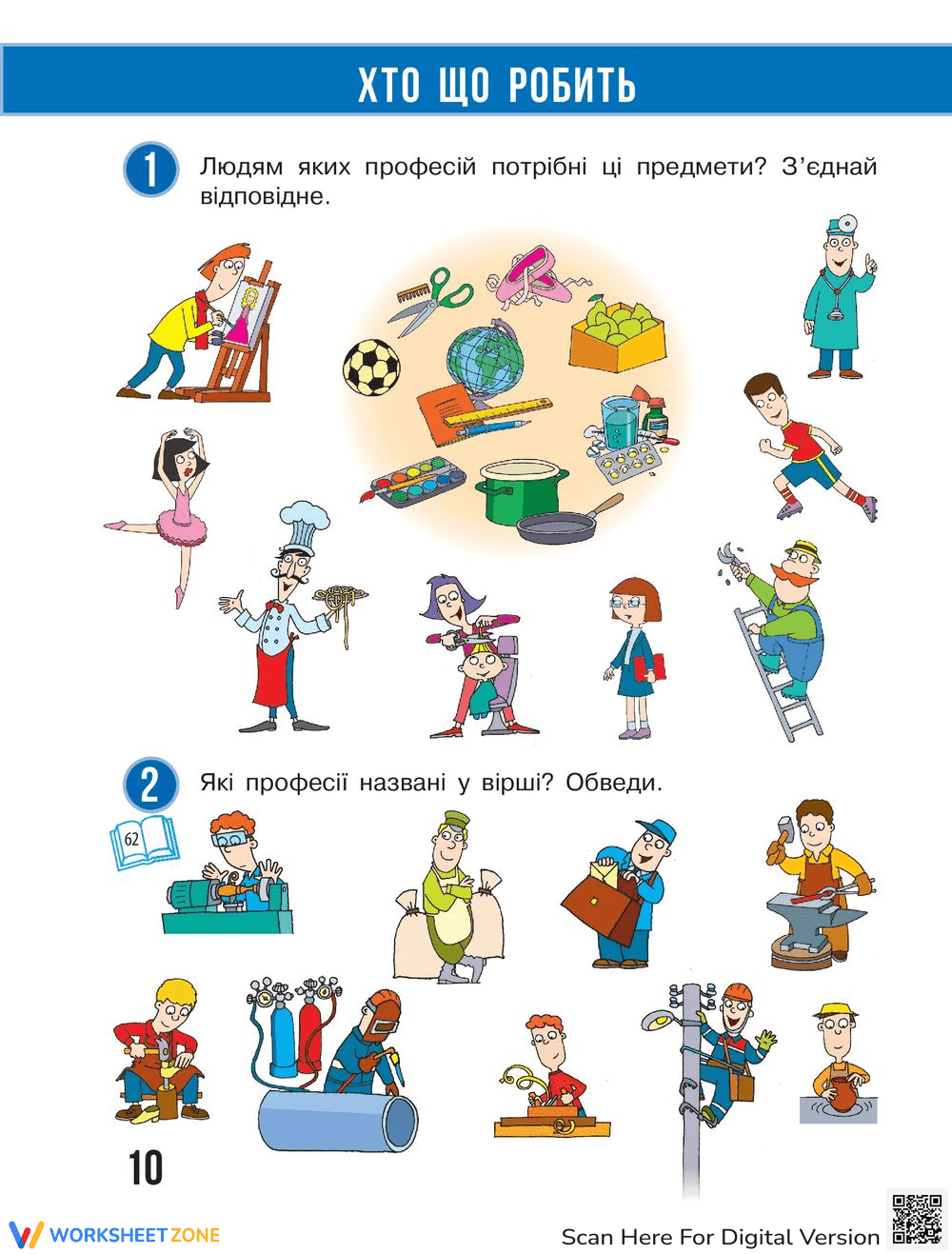
This Grade 2 community helpers worksheet helps students identify various professions and the specific tools required for each job. By connecting visual cues to social roles, learners develop a deeper understanding of how different members of a community contribute to society. It provides a structured way to build essential vocabulary and observational skills.
At a Glance
- Grade: 2 · Subject: Social Studies
- Standard:
CCSS.ELA-LITERACY.RI.2.1— Ask and answer who, what, where, when, why, and how to demonstrate understanding.- Skill Focus: Community Helpers & Tools
- Format: 1 page · 2 problems · Answer key included · PDF
- Best For: Social studies units and vocabulary building
- Time: 15–20 minutes
What's Inside: This single-page PDF features two distinct activities. The first task requires students to match a central cluster of professional tools—including a soccer ball, scissors, and a globe—to the correct community helper. The second task presents a variety of workers, such as a mail carrier and a welder, asking students to identify specific roles based on a provided text or poem.
Zero-Prep Workflow: This resource is designed for immediate classroom implementation. Teachers can print the worksheet in less than 1 minute. Distribution takes approximately 30 seconds, and the clear visual layout allows students to begin working immediately without complex instructions. Reviewing the answers as a whole group takes roughly 5 minutes, making this an ideal sub plan or warm-up activity.
Standards Alignment: The primary focus is `CCSS.ELA-LITERACY.RI.2.1`, which requires students to identify the "who" and "what" within a text or visual representation. By matching tools to people, students demonstrate an understanding of key details in informational contexts. This standard code can be copied directly into lesson plans, IEP goals, or district curriculum mapping tools.
How to Use It: Use this worksheet during a community helpers unit after introducing different jobs. It serves as an excellent formative assessment to see if students can distinguish between similar roles. Alternatively, assign it as a morning work task to spark discussion about what students want to be when they grow up. Completion typically takes 15 to 20 minutes.
Who It's For: This resource is tailored for Grade 2 students but is also highly effective for English Language Learners (ELL) who benefit from the strong visual-to-word associations. It pairs naturally with community helper anchor charts or informational picture books about neighborhood workers.
According to the RAND AIRS 2024 report, visual-spatial matching tasks in early elementary education significantly improve long-term retention of categorical vocabulary. This worksheet leverages those findings by requiring students to link specific objects to professional identities, reinforcing the CCSS.ELA-LITERACY.RI.2.1 standard. By focusing on the who and what of community roles, the activity builds a foundation for more complex informational text analysis. Research from Fisher & Frey (2014) supports this gradual release of responsibility, where visual identification precedes complex writing tasks. This worksheet provides the necessary scaffolding for second-grade learners to master community-based vocabulary while meeting state and national social studies benchmarks. The inclusion of diverse professions ensures that students see a wide representation of community contributions, which is essential for social-emotional development and career awareness in early childhood education.


