




























Views
Downloads

Animal Matching Worksheet | Essential Kindergarten Ready

Paste this activity's link or code into your existing LMS (Google Classroom, Canvas, Teams, Schoology, Moodle, etc.).
Students can open and work on the activity right away, with no student login required.
You'll still be able to track student progress and results from your teacher account.
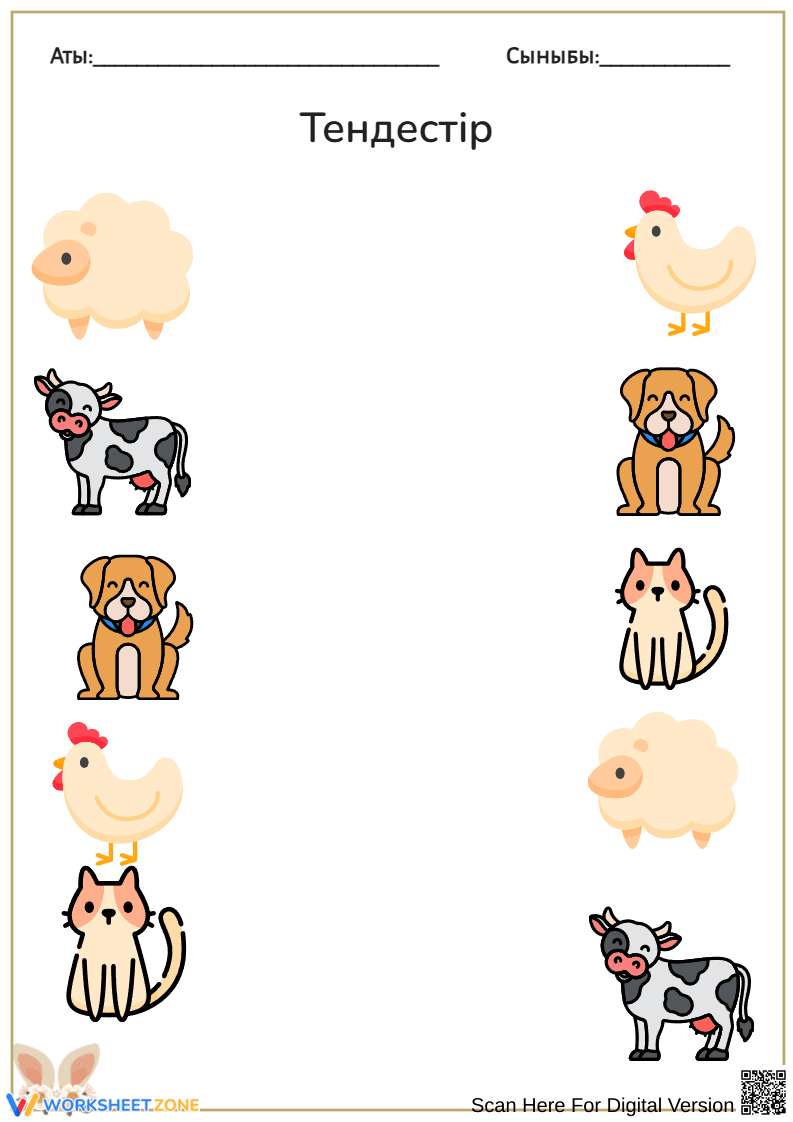
This Kindergarten animal matching worksheet provides immediate practice for early learners to develop critical visual discrimination skills. By identifying and connecting identical animal illustrations, students strengthen their ability to recognize patterns and details, which is a foundational step for letter recognition and reading readiness. This activity promotes focus and precision.
At a Glance
- Grade: Kindergarten · Subject: Early Learning
- Standard:
K.MD.B.3— Classify objects into categories and count the number of objects in each category- Skill Focus: Visual Discrimination
- Format: 1 page · 5 problems · Answer key included · PDF
- Best For: Morning work or early finishers
- Time: 5–10 minutes
This single-page PDF features five distinct, high-contrast animal illustrations including a sheep, cow, dog, chicken, and cat. Each animal is presented in a column on the left and rearranged in a column on the right. The layout is clean and uncluttered, specifically designed for young children who are still developing their focus and fine motor control.
Zero-Prep Workflow
- Print: Generate the single-page PDF and print copies for your class in under 30 seconds.
- Distribute: Hand out the sheets during morning arrival or as a transition activity between subjects (1 minute).
- Review: Quickly check for accuracy by having students name the animals they connected (1 minute).
Total teacher preparation time is under 2 minutes, making it an ideal sub-plan or emergency filler for early childhood classrooms.
Standards Alignment
The primary standard addressed is `CCSS.MATH.CONTENT.K.MD.B.3`, which involves classifying objects into given categories. A supporting standard is `CCSS.ELA-LITERACY.RF.K.1.D`, as visual discrimination of images is a precursor to letter recognition. Both standard codes can be copied directly into lesson plans, IEP goals, or district curriculum mapping tools.
How to Use It
Use this worksheet during the independent practice phase of a lesson on animals or as a warm-up for a fine motor skills session. It is particularly effective as a formative assessment tool; observe if students can track from left to right and if they can distinguish between similar shapes. Completion typically takes 5 to 10 minutes depending on the student's motor proficiency.
Who It's For
This resource is tailored for Kindergarten students, though it is also suitable for Pre-K learners or students in special education programs focusing on basic cognitive skills. It pairs naturally with an animal-themed anchor chart or a direct instruction lesson on same vs. different. This worksheet is a versatile addition to any early childhood curriculum.
Research from RAND AIRS 2024 emphasizes that visual discrimination tasks, such as matching identical images, are essential precursors to formal literacy instruction. By training the eye to notice subtle differences and similarities in shapes and figures, students build the neural pathways required to distinguish between similar-looking letters like 'b' and 'd'. This worksheet provides 5 specific opportunities for students to engage in this high-frequency cognitive exercise. According to the NAEP framework, early mastery of these foundational skills correlates with higher reading achievement in later primary grades. The use of familiar animal icons reduces cognitive load, allowing the student to focus entirely on the spatial task of matching. This structured approach ensures that learners are not overwhelmed while they develop the hand-eye coordination necessary for drawing straight lines between targets. This resource supports the K.MD.B.3 standard by requiring students to identify and group identical visual categories.


