


























Views
Downloads
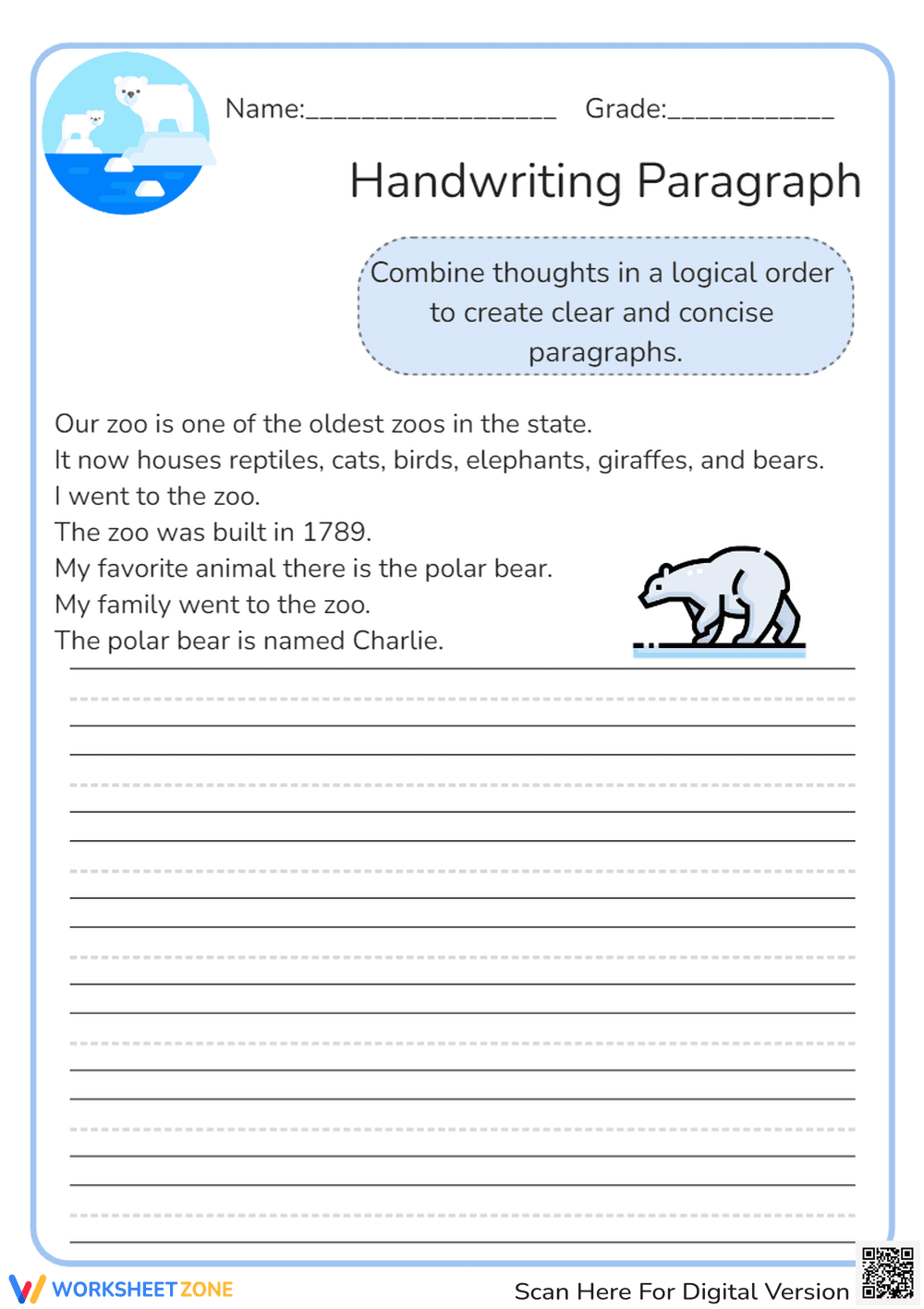

Zoo Paragraph Handwriting | Printable Grade 3 Worksheet
Paste this activity's link or code into your existing LMS (Google Classroom, Canvas, Teams, Schoology, Moodle, etc.).
Students can open and work on the activity right away, with no student login required.
You'll still be able to track student progress and results from your teacher account.
This zoo-themed handwriting worksheet helps students practice organizing disjointed sentences into a cohesive paragraph while refining their penmanship. By reordering facts about a polar bear named Charlie, young writers develop logical sequencing skills and produce clear, legible text on primary dashed lines.
At a Glance
- Grade: 3 · Subject: ELA
- Standard:
CCSS.ELA-LITERACY.W.3.4— Organize writing appropriate to task and purpose- Skill Focus: Paragraph sequencing and handwriting
- Format: 1 page · 1 problem · No answer key · PDF
- Best For: Independent writing practice
- Time: 15–20 minutes
This single-page resource features seven out-of-order sentences about a trip to the zoo and a specific polar bear. Below the sentences, students are provided with ample primary dashed writing lines. The layout is clean and distraction-free, focusing entirely on the dual tasks of logical sentence sequencing and neat handwriting execution. No answer key is required; logical flow is easily assessed.
This resource is designed for immediate classroom implementation with a zero-prep workflow:
- Print (1 minute): Generate the PDF and print a class set directly from your computer.
- Distribute (1 minute): Hand out the single-page worksheet during morning work or a dedicated writing block.
- Review (3 minutes): Quickly scan student paragraphs to ensure logical order and legible letter formation.
With under two minutes of total teacher prep time, this activity is highly suitable for emergency sub plans or quick transitions between subjects.
This activity aligns with CCSS.ELA-LITERACY.W.3.4, requiring students to produce writing in which the development and organization are appropriate to task and purpose. By forcing students to evaluate the chronological and logical flow of provided facts before writing, it reinforces foundational composition skills. Both standard codes can be copied directly into lesson plans, IEP goals, or district curriculum mapping tools.
Deploy this worksheet as independent morning work to settle students while reinforcing ELA concepts. Alternatively, use it during a small-group writing center where students can collaboratively debate the best sentence order before committing it to paper. As a formative assessment observation tip, watch how students handle the physical act of writing on the dashed lines; note if they struggle with letter sizing or spacing while copying the text. Expected completion time ranges from 15 to 20 minutes.
This worksheet is designed for third and fourth-grade students needing targeted practice with paragraph organization and handwriting stamina. It serves as an excellent intervention tool for students who struggle to generate their own ideas but still need to practice the mechanics of writing. Pair this resource with a mini-lesson on transition words or a classroom anchor chart detailing the components of a strong paragraph.
Integrating handwriting practice with cognitive tasks like paragraph sequencing yields significant benefits for elementary learners. According to a recent ScienceDirect TpT Analysis, combining mechanical writing exercises with organizational challenges improves overall composition fluency. This worksheet targets CCSS.ELA-LITERACY.W.3.4, challenging students to organize writing appropriate to task and purpose. When students physically write out logically ordered sentences, they build muscle memory for both letter formation and narrative structure. The dual-focus approach ensures that instructional time is maximized, addressing both fine motor skills and higher-order thinking simultaneously. By providing a structured prompt about a zoo visit, the cognitive load of idea generation is removed, allowing the student to focus entirely on sequencing and legibility. This method of isolated skill practice is a proven strategy for developing confident, capable young writers who can effectively communicate their thoughts on paper.


