




























Views
Downloads
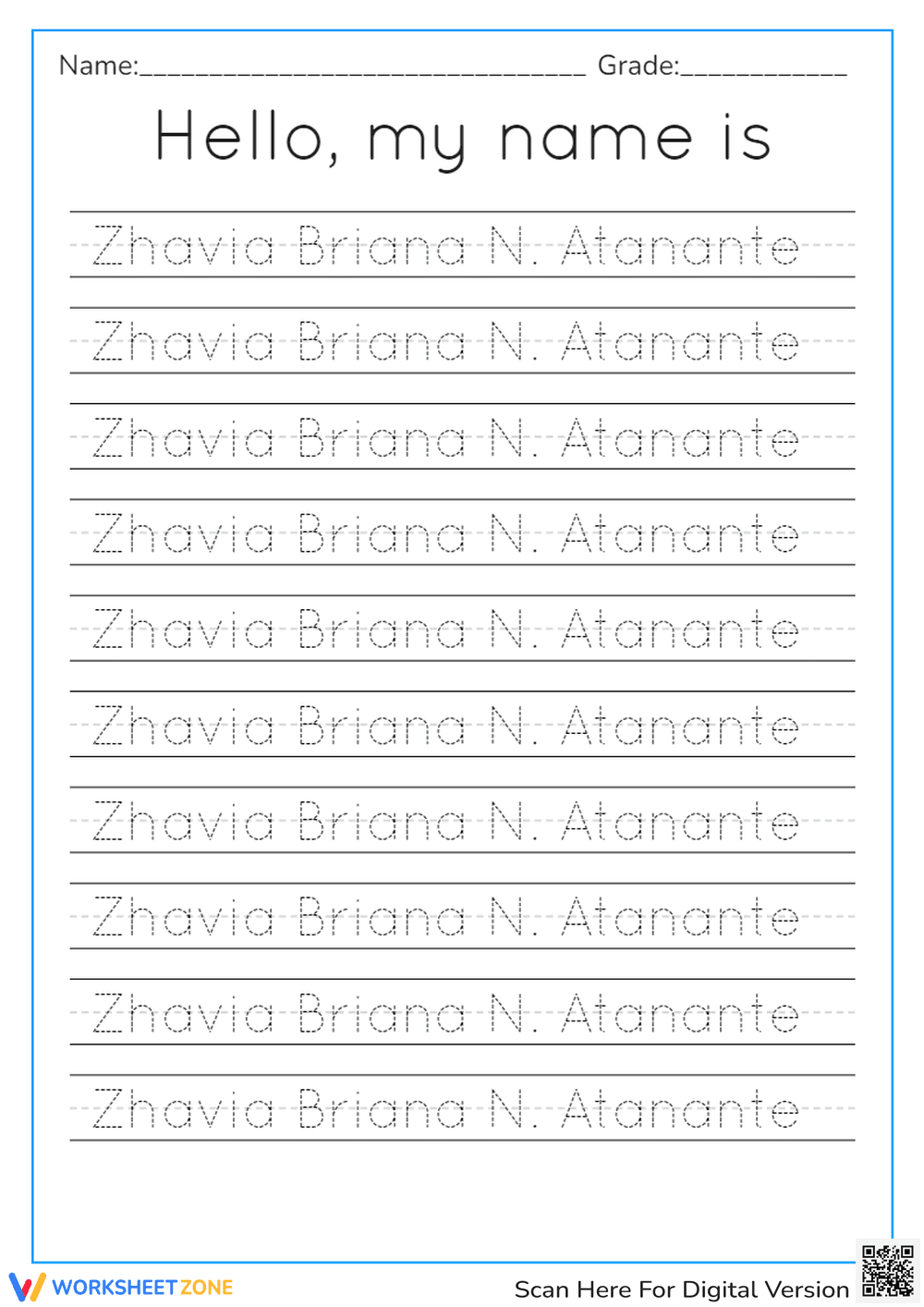

Name Tracing Worksheet | Grade K-1 Printable Ready

Paste this activity's link or code into your existing LMS (Google Classroom, Canvas, Teams, Schoology, Moodle, etc.).
Students can open and work on the activity right away, with no student login required.
You'll still be able to track student progress and results from your teacher account.
This Grade K-1 name tracing worksheet provides immediate practice for students learning to identify and write their own names. By focusing on repetitive letter formation, learners build the muscle memory required for legible handwriting. This resource ensures students master the specific strokes needed for both uppercase and lowercase letters in a structured environment.
At a Glance
- Grade: Kindergarten · Subject: Handwriting
- Standard:
CCSS.ELA-LITERACY.L.K.1.A— Print many upper- and lowercase letters accurately- Skill Focus: Name tracing and letter formation
- Format: 1 page · 10 problems · No answer key needed · PDF
- Best For: Morning work and literacy centers
- Time: 5–10 minutes
The worksheet features a clean, distraction-free layout designed for early learners. It includes 10 identical lines of dashed text for "Zhavia Briana N. Atanante," providing ample repetition. The use of standard primary handwriting lines—including the baseline, midline, and top line—helps students understand spatial relationships between letters. This single-page PDF is ready for immediate printing and requires no additional assembly or teacher preparation.
Teachers can implement this resource in under two minutes. First, print the required number of copies for your small group or whole class (30 seconds). Second, distribute the pages during morning arrival or as a transition activity (30 seconds). Finally, conduct a quick visual sweep to check for proper pencil grip and stroke direction as students complete the 10 lines (1 minute). This streamlined process makes it an ideal choice for emergency sub plans or daily routine reinforcement.
This resource is primary aligned to CCSS.ELA-LITERACY.L.K.1.A, which requires students to print many upper- and lowercase letters. By tracing a full name, students encounter a variety of character shapes and connections. This practice also supports foundational literacy by linking phonemic awareness to grapheme production. Both standard codes can be copied directly into lesson plans, IEP goals, or district curriculum mapping tools.
Use this worksheet as a formative assessment tool during the first weeks of school to gauge baseline fine motor control. Observe students as they work to identify those who struggle with letter orientation or consistent sizing. It also functions well as a quiet-time activity for students who finish other literacy tasks early. Completion typically takes between 5 and 10 minutes depending on the student's developmental level.
This practice page is designed for preschoolers, kindergarteners, and first-grade students who are developing foundational writing skills. It is particularly helpful for English Language Learners (ELLs) who are becoming familiar with the Latin alphabet. Pair this worksheet with a name-tag anchor chart or a tactile sand-tracing activity to provide a multi-sensory learning experience for students requiring additional support.
Research by Fisher & Frey (2014) emphasizes the importance of the gradual release of responsibility, where structured tracing serves as a critical scaffolded phase before independent writing. This worksheet facilitates that transition by providing a clear visual guide for students to follow. According to the NAEP, early mastery of handwriting is a strong predictor of later writing fluency and academic success, as it reduces the cognitive load during the drafting process. By utilizing this CCSS.ELA-LITERACY.L.K.1.A aligned resource, educators provide the repetitive, low-stakes practice necessary for students to internalize letter shapes. This specific name-tracing task helps bridge the gap between letter recognition and functional literacy. The 10-line repetition ensures that students move beyond simple imitation toward consistent, automatic production of their own names, a vital social and academic milestone in early childhood education.


