


























Views
Downloads
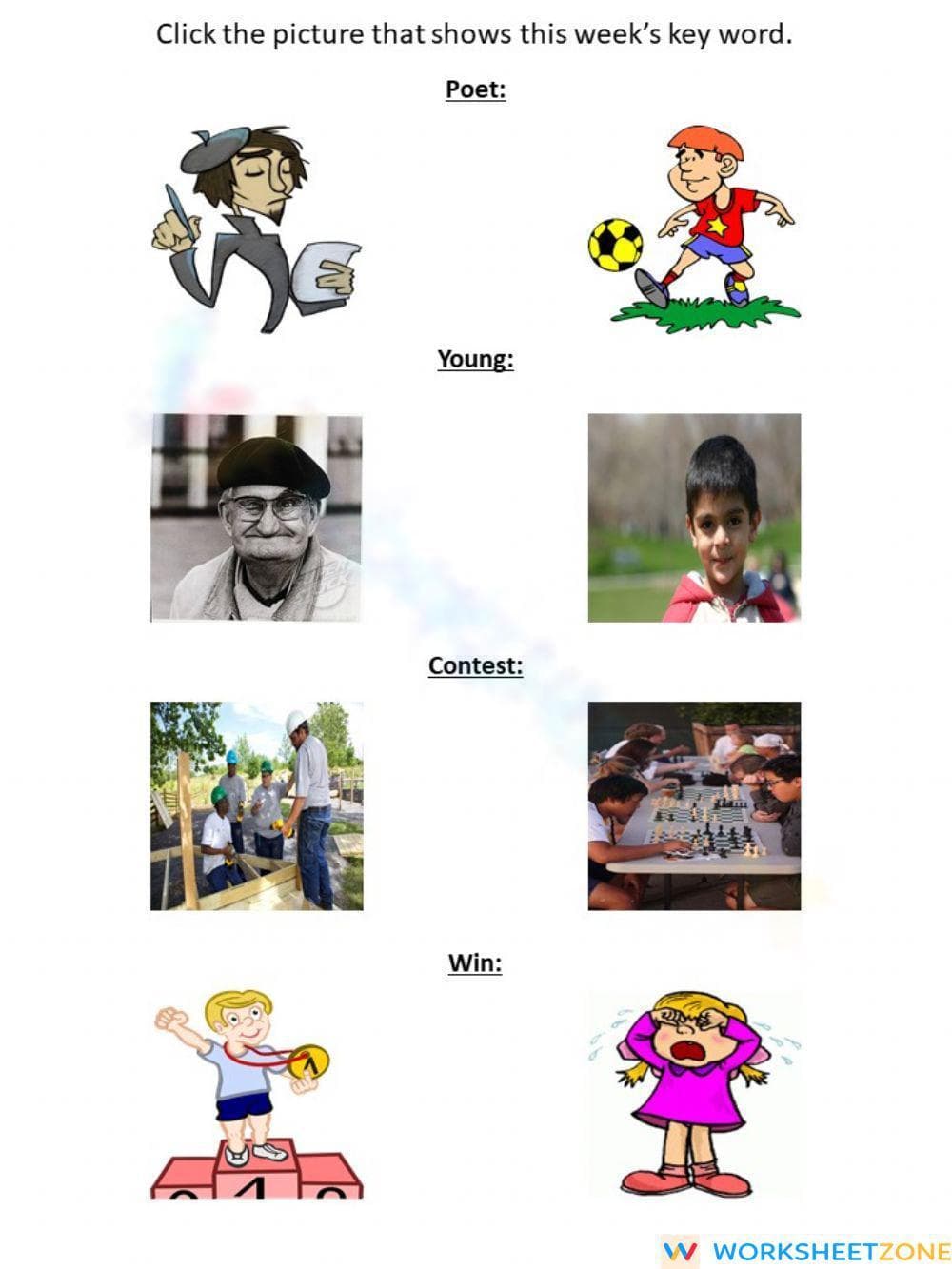

Grade 3 Vocabulary — Printable No-Prep Worksheet
Paste this activity's link or code into your existing LMS (Google Classroom, Canvas, Teams, Schoology, Moodle, etc.).
Students can open and work on the activity right away, with no student login required.
You'll still be able to track student progress and results from your teacher account.
Master Vocabulary with a Simple, Printable Activity
This printable worksheet offers Grade 3 students focused practice in foundational vocabulary recognition. Learners connect key terms—'poet,' 'young,' 'contest,' and 'win'—to corresponding images, distinguishing them from non-examples. It's a direct, effective tool for building word knowledge and visual literacy skills within a single, ready-to-use ELA activity.
At a Glance
- Grade: 3 · Subject: English Language Arts (ELA)
- Standard:
CCSS.ELA-LITERACY.L.3.4— Clarify the meaning of words using visual strategies- Skill Focus: Vocabulary Recognition, Visual Association
- Format: 1 page · 4 problems · Answer key included · PDF
- Best For: Warm-ups, exit tickets, or vocabulary review
- Time: 5–10 minutes
What's Inside
This single-page PDF contains a vocabulary matching activity. For four key words, students see two images: a correct example and a non-example. They must select the picture that represents the word, reinforcing understanding through visual association. An answer key is included for quick verification.
A Zero-Prep Workflow for Busy Teachers
This resource is designed for classroom efficiency, requiring less than two minutes of prep. The workflow is simple:
- 1. Print (30 seconds): The worksheet is a single page ready for immediate printing.
- 2. Distribute (1 minute): Clear on-page instructions allow students to start work independently.
- 3. Review (5 minutes): Use the included answer key for fast grading or peer review.
Its straightforward format makes it an excellent and reliable resource for substitute teacher plans.
Standards Alignment for Your Lesson Plans
This worksheet directly supports CCSS.ELA-LITERACY.L.3.4, which requires students to "Determine or clarify the meaning of unknown and multiple-meaning words...choosing flexibly from a range of strategies." The activity uses visual association as a primary strategy for demonstrating word comprehension. The standard code can be copied directly into lesson plans, IEP goals, or district curriculum maps.
How to Use It in Your Classroom
Use this worksheet as a warm-up before a reading lesson or as an exit ticket after direct instruction to assess comprehension of new terms. For a formative assessment opportunity, observe which non-example a student chooses; this can reveal specific misconceptions about the word's meaning. The entire activity is designed for completion in 5 to 10 minutes, fitting easily into any lesson block.
Who It's For
This activity is ideal for third-grade students building their academic vocabulary. The visual component provides a crucial access point for English Language Learners and students with reading difficulties. Pair this worksheet with a vocabulary anchor chart that includes definitions and sentences to create a more comprehensive learning station for your students.
This visual vocabulary task aligns with research on the effectiveness of non-linguistic representations in learning. It directly addresses CCSS.ELA-LITERACY.L.3.4 by having students clarify word meanings using pictures. According to Fisher & Frey (2014), providing both examples and non-examples is a critical step in effective vocabulary instruction, as it helps define a concept's boundaries. This worksheet operationalizes that principle, asking students to identify not only what a word is but also what it is not. By engaging learners in this comparative analysis, the resource moves beyond simple memorization to support a deeper, more durable understanding of new terms, a foundational skill for all subsequent reading comprehension.


