


























Views
Downloads


Essential Grade 1 Science: Healthy Eating Worksheet
Paste this activity's link or code into your existing LMS (Google Classroom, Canvas, Teams, Schoology, Moodle, etc.).
Students can open and work on the activity right away, with no student login required.
You'll still be able to track student progress and results from your teacher account.
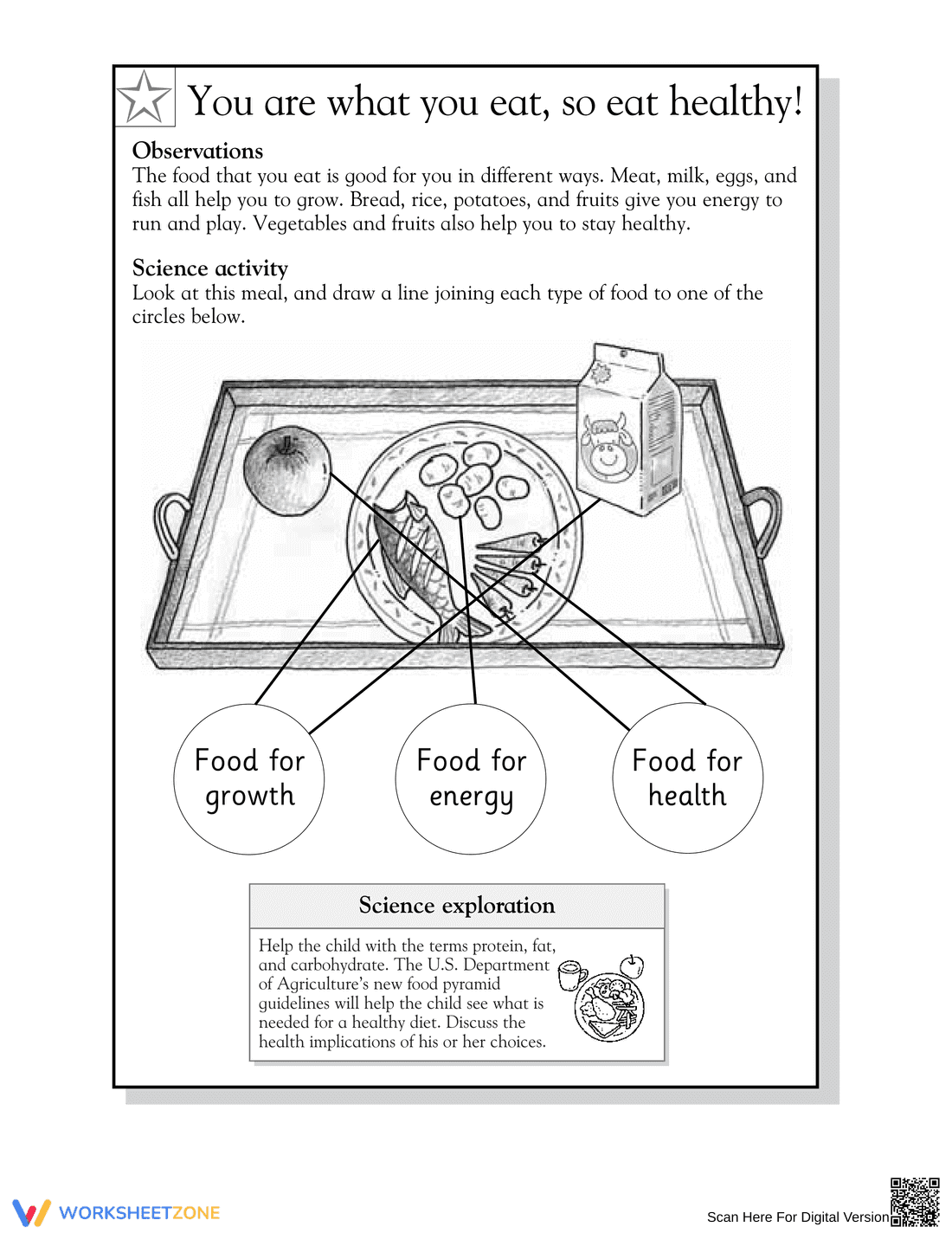
This Grade 1 science worksheet introduces young learners to the fundamental relationship between diet and physical development. By categorizing various foods into functional groups—growth, energy, and health—students gain a foundational understanding of how nutrition supports their bodies. This resource facilitates immediate comprehension through clear observations and interactive matching exercises that reinforce healthy lifestyle choices from an early age.
At a Glance
- Grade: 1 · Subject: Science · Format: Digital or Printable PDF
- Standard:
1-LS1-1— Describe patterns of what humans need to survive and grow- Skill Focus: Nutrition, Diet, and Functional Food Groups
- Components: 1 page · 8 interactive tasks · Full answer key included
- Best For: Introduction to healthy habits and early nutrition science units
- Time: 15–20 minutes of classroom instruction
The worksheet contains a concise informational text titled "Observations" which defines the roles of specific food items like meat, milk, bread, and vegetables. Students analyze an illustrated meal tray featuring various food groups. The primary task requires drawing lines to connect these foods to three core categories: growth, energy, and health. A final reflection section prompts students to evaluate their own eating habits through a structured inquiry.
The zero-prep workflow for this resource is highly efficient for busy educators. First, print the single-page PDF (30 seconds). Second, distribute the worksheets while briefly reading the observation text aloud (1 minute). Third, allow students to complete the matching task and reflection independently. The total teacher preparation time is less than two minutes, making it an ideal choice for emergency sub plans or quick science fillers during transitions.
This activity aligns with `1-LS1-1`, focusing on the basic needs of humans for growth and survival. By identifying which foods provide energy versus structural support, students demonstrate an understanding of external factors influencing health. This standard code can be copied directly into lesson plans, IEP goals, or district curriculum mapping tools for accurate documentation of student progress toward life science benchmarks.
Use this worksheet during a health or life science unit after discussing the concept of "fuel" for the body. It serves as an excellent formative assessment tool; observe if students correctly associate proteins with "growth" and carbohydrates with "energy." The expected completion time is approximately 15 minutes, allowing for a 5-minute follow-up group discussion about the meal tray illustrations and student reflections on their daily meals.
This resource is designed for first-grade students and ESL learners who benefit from visual-heavy assignments. It can be paired naturally with a classroom anchor chart showing real-world food examples. Differentiation is built into the visual tray, providing scaffolding for readers and non-readers alike. It is also suitable for kindergarten extension or second-grade review sessions focused on biological needs and healthy habit formation.
Aligning with research from Fisher & Frey (2014) on the efficacy of visual scaffolding in early childhood science, this worksheet utilizes clear illustrations to bridge the gap between abstract biological needs and concrete dietary choices. The primary focus on standard 1-LS1-1 ensures that students develop a rigorous understanding of what humans require for survival, specifically the role of nutrients in physical growth and energy production. By engaging in a structured categorization task, learners practice evidence-based reasoning, a core competency in modern science education. This resource effectively addresses the plain-English skill of identifying food functions, providing a reliable data point for monitoring student progress toward life science mastery. Educational analysis suggests that connecting personal health reflections to curriculum-aligned tasks increases student engagement and long-term retention of nutritional concepts. This comprehensive approach supports both general education classrooms and specialized instructional settings requiring targeted, high-impact nutrition materials that are ready for immediate use.


