


























Views
Plays

CCSS.ELA-LITERACY.L.2.1 Writing Revision — Essential
Paste this activity's link or code into your existing LMS (Google Classroom, Canvas, Teams, Schoology, Moodle, etc.).
Students can open and work on the activity right away, with no student login required.
You'll still be able to track student progress and results from your teacher account.
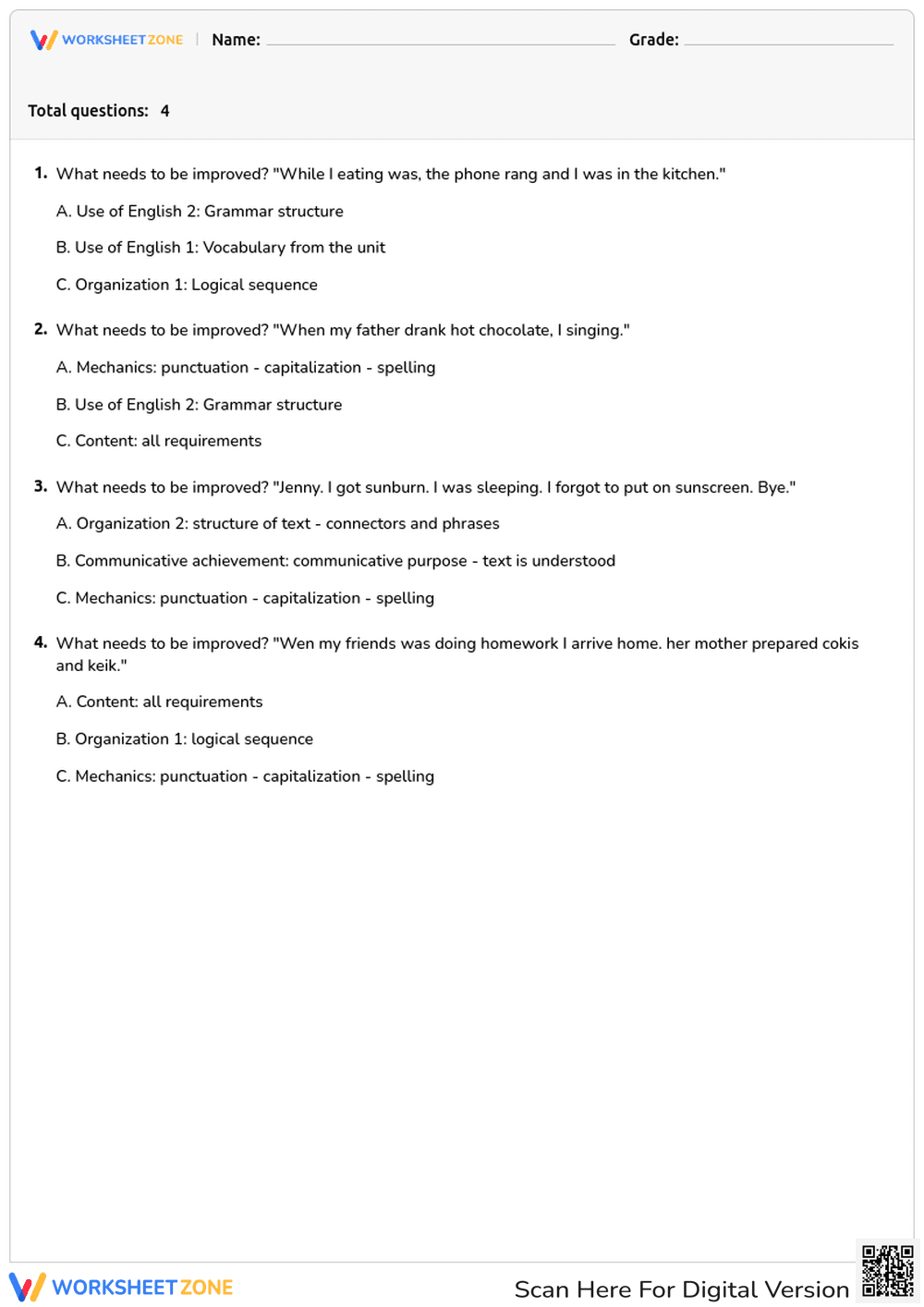
This Grade 2 writing revision worksheet helps students identify specific areas for improvement in written sentences. By analyzing errors in grammar, mechanics, and organization, students develop the critical eye necessary for self-editing. This resource provides immediate practice in applying rubric-based criteria to real-world writing samples to ensure clarity and correctness.
At a Glance
At a Glance
- Grade: 2 · Subject: ELA Writing
- Standard:
CCSS.ELA-LITERACY.L.2.1— Demonstrate command of the conventions of standard English grammar and usage when writing.- Skill Focus: Writing Revision & Rubric Application
- Format: 1 page · 4 problems · Answer key included · PDF
- Best For: Formative assessment and test preparation
- Time: 10–15 minutes
What's Inside
The worksheet features four targeted multiple-choice questions. Each question presents a sentence with a specific flaw—ranging from word order issues to spelling and punctuation errors. Students must select the correct rubric category that describes the necessary improvement, such as Use of English, Mechanics, or Organization. This structural approach mirrors formal writing assessments and helps students internalize scoring criteria.
Mastery Evidence
Each task is mapped to a specific sub-skill of the standard, allowing teachers to gather evidence of mastery. The options provided help categorize student understanding of grammar structures versus mechanical accuracy. Scores can be entered directly into gradebooks or used to inform IEP progress notes regarding a student's ability to recognize and correct errors in conventions. This data-driven approach ensures that instructional interventions are targeted and effective.
Standards Alignment
Primary standard `CCSS.ELA-LITERACY.L.2.1` requires students to demonstrate command of the conventions of standard English grammar and usage. This worksheet specifically targets the ability to recognize when those conventions are not met. Additionally, it supports `CCSS.ELA-LITERACY.W.2.5` by focusing on the revision process. Both standard codes can be copied directly into lesson plans, IEP goals, or district curriculum mapping tools.
How to Use It
Use this worksheet as a ticket out the door after a lesson on the writing process. It serves as an excellent formative assessment to see if students can distinguish between a grammar error and a mechanical error. Alternatively, use it to introduce a formal writing rubric before students begin a narrative project. Completion typically takes 10 to 15 minutes, making it a perfect fit for a small-group rotation or a quick check for understanding.
Who It's For
This resource is designed for Grade 2 students but is highly effective for Grade 1 enrichment or English Language Learners (ELLs) who need explicit practice with English syntax. It pairs naturally with a classroom anchor chart on COPS (Capitalization, Organization, Punctuation, Spelling) or a direct instruction lesson on sentence structure. It is particularly useful for students who struggle with self-editing their own work.
According to Fisher & Frey (2014), the gradual release of responsibility model is most effective when students are given clear criteria for success, such as those found in a structured writing rubric. This worksheet operationalizes that research by asking students to apply rubric categories to specific linguistic errors. By identifying whether a sentence lacks logical sequence or contains grammatical flaws, students internalize the CCSS.ELA-LITERACY.L.2.1 standard through active analysis rather than passive memorization. Research from EdReports 2024 suggests that high-quality instructional materials must provide students with opportunities to engage in the revision process to build long-term writing proficiency. This 4-task assessment provides a focused, evidence-based method for teachers to measure student growth in identifying conventions. The clear alignment between the task and the standard ensures that the data collected is both valid and actionable for future instructional planning in the elementary classroom.


