




























Views
Downloads


Adjective Practice Worksheet | Grade 1 Essential ELA

Paste this activity's link or code into your existing LMS (Google Classroom, Canvas, Teams, Schoology, Moodle, etc.).
Students can open and work on the activity right away, with no student login required.
You'll still be able to track student progress and results from your teacher account.
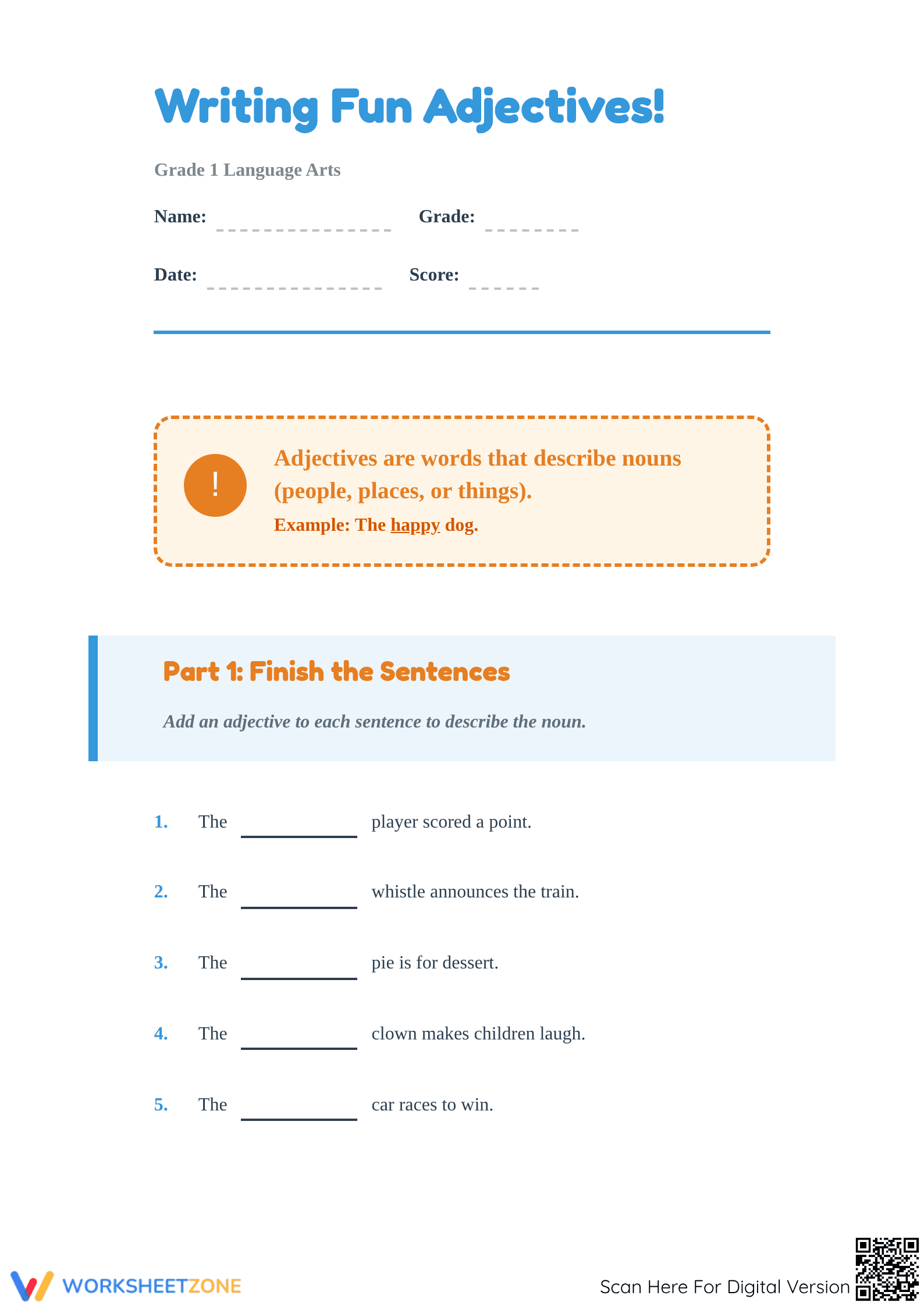
This Grade 1 ELA worksheet provides comprehensive practice for identifying and using descriptive language. Students engage with 22 structured problems designed to strengthen their understanding of how adjectives modify nouns. By completing these exercises, learners develop the vocabulary necessary to add detail and color to their writing, ensuring mastery of basic lexical word classes.
At a Glance
- Grade: 1 · Subject: ELA
- Standard:
CCSS.ELA-LITERACY.L.1.1.F— Use frequently occurring adjectives to describe people, places, and things.- Skill Focus: Adjective identification and usage
- Format: 4 pages · 22 problems · Answer key included · PDF
- Best For: Independent practice and vocabulary building
- Time: 20–30 minutes
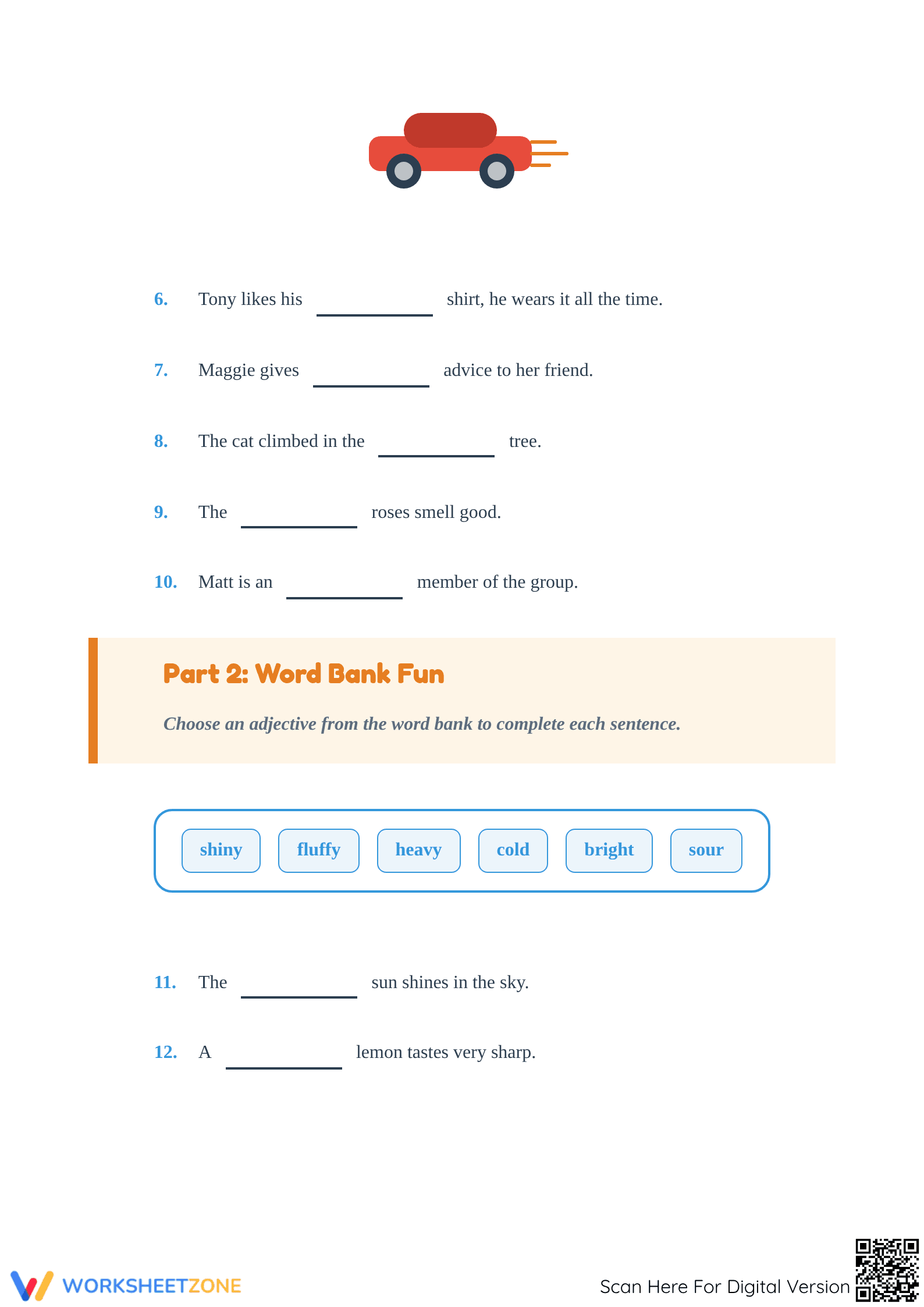
This 4-page PDF contains three distinct sections to scaffold learning. It includes a clear definition of adjectives with examples, a 6-word bank (shiny, fluffy, heavy, cold, bright, sour), and 22 fill-in-the-blank sentences. The layout is spacious for young writers, and a full answer key is provided to facilitate quick grading or self-correction.
Skill Progression
- Guided Practice: The first 10 items provide sentence stems where students choose contextually appropriate adjectives to describe common nouns like "player," "train," and "clown."
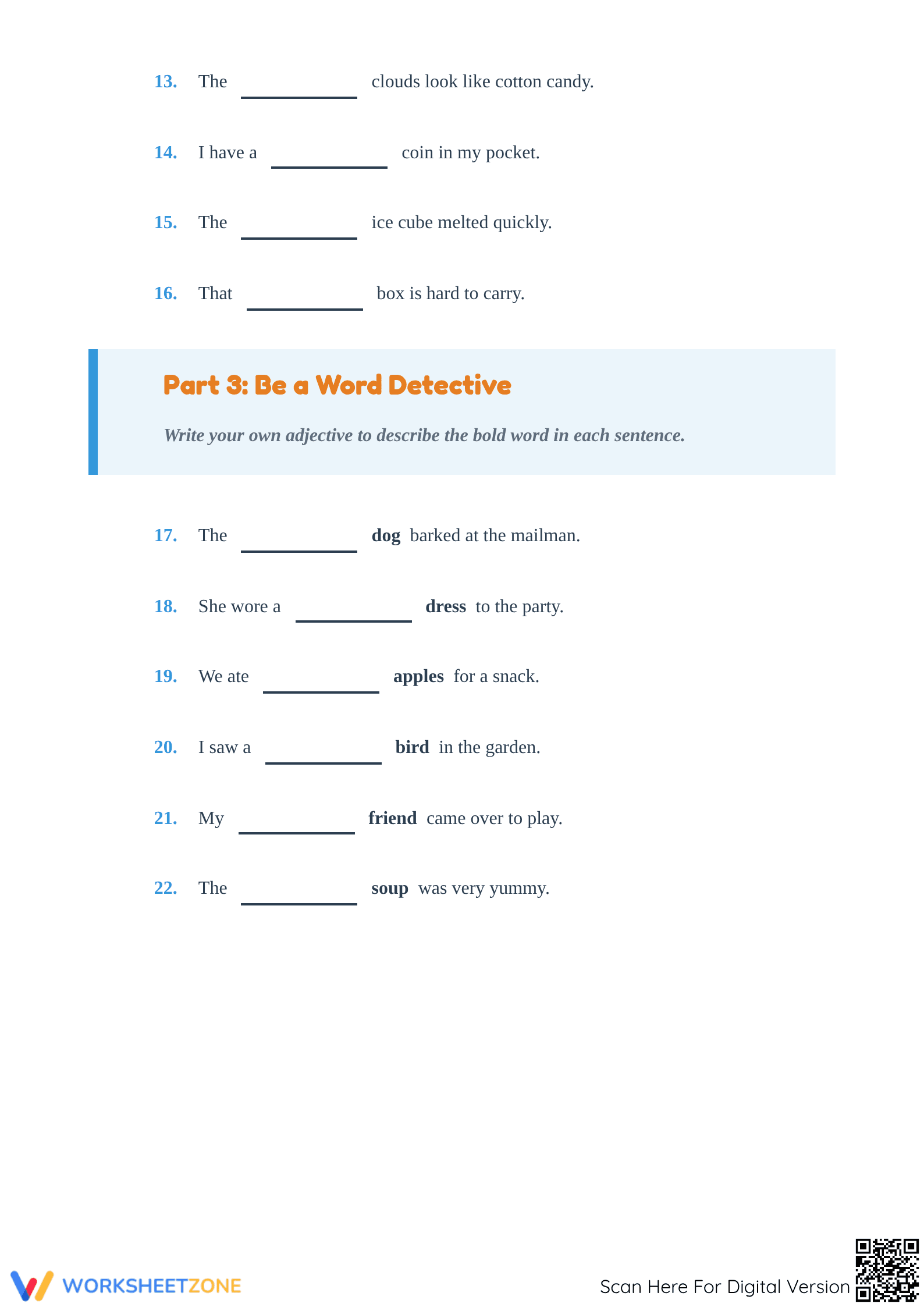
- Supported Practice: Items 11-16 utilize a specific word bank, requiring students to match sensory adjectives to the correct noun, such as "bright" for the sun or "sour" for a lemon.
- Independent Practice: The final "Word Detective" section challenges students to generate their own original adjectives for bolded nouns, moving from recognition to creative production.
This gradual-release model ensures students move confidently from identifying words to applying them independently in their own compositions.
Standards Alignment
This resource aligns with `CCSS.ELA-LITERACY.L.1.1.F`, which requires first-grade students to use frequently occurring adjectives. It also supports L.1.5.A by helping students sort words into categories and define them by key attributes. Both standard codes can be copied directly into lesson plans, IEP goals, or district curriculum mapping tools.
How to Use It
Use this worksheet during the independent practice phase of a lesson on descriptive writing. It serves as an excellent formative assessment after introducing the concept of "describing words." Teachers can observe students during Part 3 to see if they can generate adjectives beyond the provided word bank. Expect completion in 20 to 30 minutes.
Who It's For
This is designed for Grade 1 students, but it also serves as a remedial tool for Grade 2 learners or an enrichment activity for Kindergarteners. It pairs naturally with a mentor text rich in sensory language or a classroom anchor chart listing "Five Senses" adjectives to support diverse learners.
According to Fisher & Frey (2014), the gradual release of responsibility is vital for literacy development, particularly when introducing lexical categories like adjectives. This worksheet implements that framework by transitioning from constrained choices to open-ended descriptive writing. By engaging with 22 specific tasks, students solidify their grasp of CCSS.ELA-LITERACY.L.1.1.F, moving from simple identification to the active application of frequently occurring adjectives. Research from the NAEP suggests that early mastery of descriptive vocabulary is a significant predictor of later reading comprehension and writing fluency. This resource provides the structured repetition necessary for first-grade learners to internalize these word classes. The inclusion of a word bank and creative prompts allows for varied cognitive engagement, ensuring that students do not just memorize words but understand their functional role in sentence construction.


