


























Views
Downloads

Essential Acrostic Poem Worksheet | Grade 3-4 ELA
Paste this activity's link or code into your existing LMS (Google Classroom, Canvas, Teams, Schoology, Moodle, etc.).
Students can open and work on the activity right away, with no student login required.
You'll still be able to track student progress and results from your teacher account.
This creative writing worksheet helps students master the acrostic poem format through structured practice and illustrative examples. By focusing on animals and personal nicknames, learners practice selecting precise adjectives and noun phrases to describe familiar subjects. This activity strengthens descriptive writing skills and vocabulary development in a concise, engaging format.
At a Glance
- Grade: 3–4 · Subject: ELA
- Standard:
CCSS.ELA-LITERACY.W.3.10— Write routinely over shorter time frames for a range of tasks and purposes- Skill Focus: Writing acrostic poems with adjectives and noun phrases
- Format: 1 page · 2 problems · Answer key not applicable · PDF
- Best For: Creative writing warm-ups and poetry units
- Time: 15–25 minutes
What's Inside
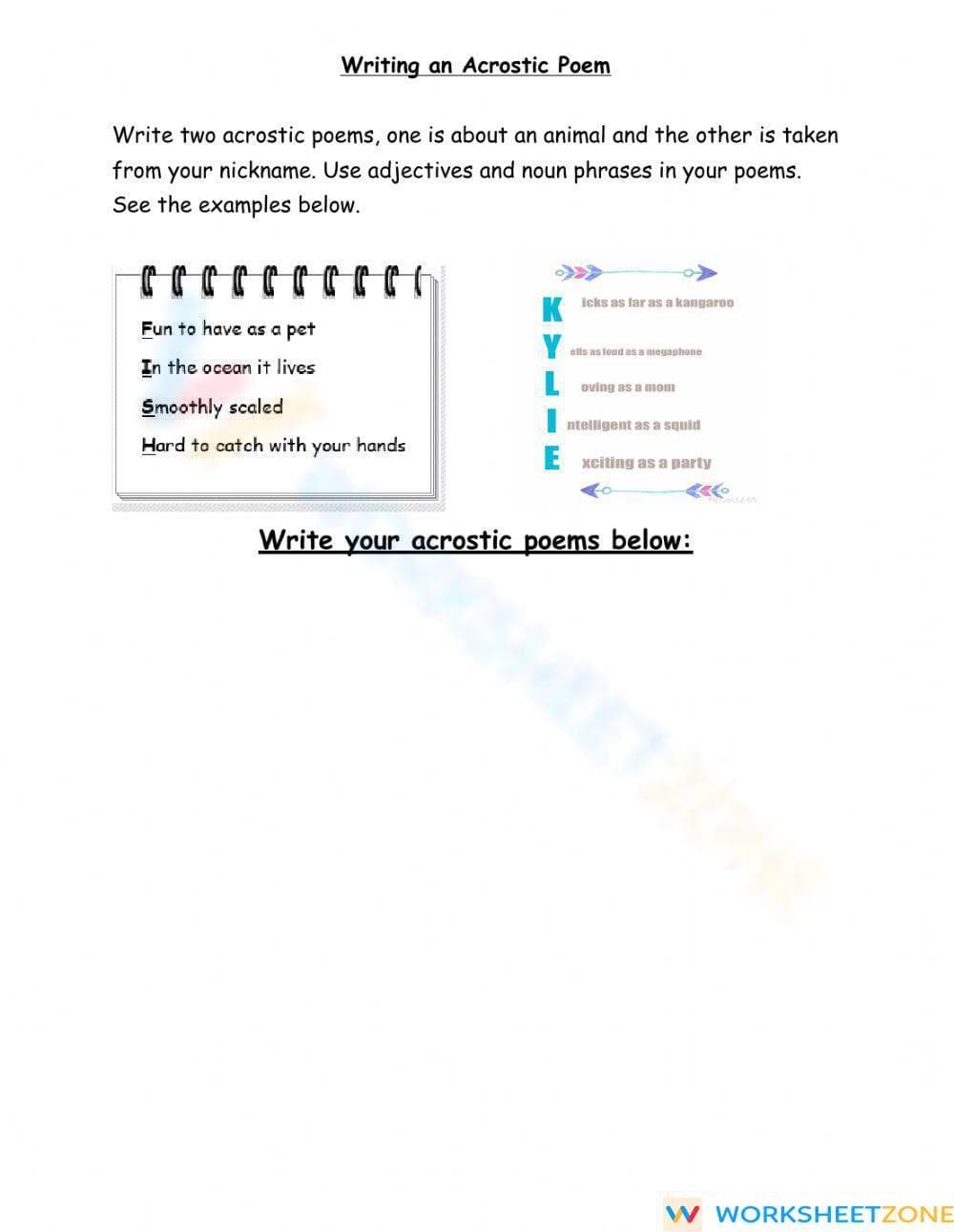
This single-page PDF features a clear instructional header. The worksheet provides two examples—"FISH" and "KYLIE"—to model using adjectives (e.g., "smoothly scaled") and noun phrases (e.g., "intelligent as a squid") within the acrostic structure. A dedicated workspace allows students to compose their own poems based on an animal and their nickname, ensuring a personal connection to the task.
Zero-Prep Workflow
This resource is designed for immediate use with under 2 minutes of prep. Print the copies (1 minute), distribute them, and review the examples to clarify descriptive language (1 minute). Students work independently, making this an ideal candidate for emergency sub plans or morning work.
Standards Alignment
The primary alignment for this resource is CCSS.ELA-LITERACY.W.3.10, which requires students to "write routinely over extended time frames and shorter time frames for a range of discipline-specific tasks, purposes, and audiences." By engaging with a specific poetic form like the acrostic, students develop the flexibility to adapt their writing style to different structural constraints. Both standard codes can be copied directly into lesson plans or curriculum mapping tools.
How to Use It
Use this as a formative assessment to gauge understanding of line breaks and descriptive language. It works best during independent practice after a poetry lesson. Observe whether students use adjectives rather than just single words. This activity takes 15 to 25 minutes depending on nickname length.
Who It's For
Intended for Grade 3 and 4 students exploring creative writing. It helps English Language Learners (ELLs) who benefit from the examples. This resource pairs naturally with an adjective anchor chart to help students brainstorm vivid vocabulary before they begin writing.
The implementation of structured poetic forms like acrostic poems is a proven method for developing linguistic awareness and vocabulary precision in middle-grade learners. According to Fisher & Frey (2014), providing students with clear models and gradual-release writing tasks—such as the transition from the "FISH" example to independent nickname poems—significantly improves their ability to apply new grammatical structures in creative contexts. This worksheet specifically addresses the CCSS.ELA-LITERACY.W.3.10 standard by offering a focused, shorter-time-frame writing task that encourages the routine use of adjectives and noun phrases. By requiring students to synthesize their personal experiences (nicknames) with descriptive language, the activity promotes higher-order thinking and personal investment in the writing process. This resource serves as a reliable tool for teachers looking to integrate quick, standards-aligned writing practice into their daily ELA block or specialized literacy centers.


