


























Views
Downloads
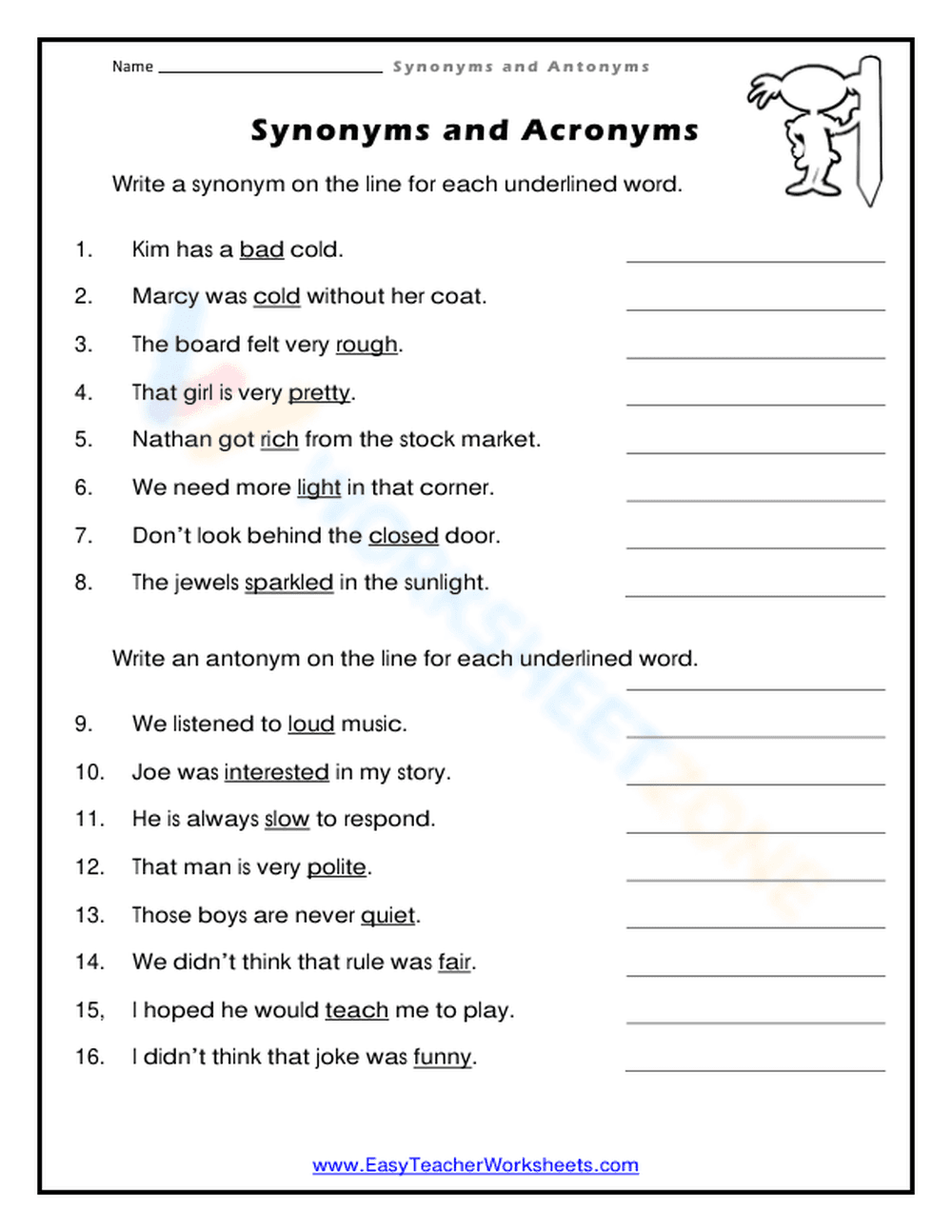

Essential Synonyms and Antonyms Worksheet | Grade 2-3
Paste this activity's link or code into your existing LMS (Google Classroom, Canvas, Teams, Schoology, Moodle, etc.).
Students can open and work on the activity right away, with no student login required.
You'll still be able to track student progress and results from your teacher account.
Expand Vocabulary with Synonyms and Antonyms
This Synonyms and Antonyms worksheet provides targeted vocabulary practice to help Grade 2 and Grade 3 students expand their descriptive language. By identifying similar and opposite words in context, learners build the linguistic flexibility required for advanced reading comprehension. This resource helps students swap words to improve sentence variety and precision in their writing.
At a Glance
- Grade: 2–3 · Subject: English Language Arts
- Standard:
CCSS.ELA-LITERACY.L.2.5— Demonstrate understanding of word relationships and nuances in word meanings.- Skill Focus: Synonyms and Antonyms
- Format: 1 page · 16 problems · Answer key included · PDF
- Best For: Independent practice and vocabulary reinforcement
- Time: 15–20 minutes
What's Inside
This single-page PDF contains 16 focused tasks split into two distinct sections. The first eight items require students to read a sentence and provide a synonym for an underlined word, such as finding a replacement for "bad" or "pretty." The remaining eight items challenge students to generate antonyms for words like "loud" and "polite." The clear layout and numbered lines facilitate easy grading and student self-correction.
Zero-Prep Workflow
Teachers can implement this resource in under two minutes using a simple three-step process. First, print the single-page PDF (30 seconds) for your entire class. Second, distribute the sheets for immediate use as a morning warm-up or bell-ringer activity (30 seconds). Finally, review the answers as a group using the provided answer key (1 minute). This streamlined design makes it an ideal choice for substitute lesson plans or unexpected classroom gaps.
Standards Alignment
The primary focus is CCSS.ELA-LITERACY.L.2.5, which requires students to demonstrate an understanding of word relationships. By actively generating synonyms and antonyms, students move beyond rote memorization toward a functional grasp of how words interact. This standard code can be copied directly into lesson plans, IEP goals, or district curriculum mapping tools to ensure instructional accountability.
How to Use It
Assign this worksheet during the independent practice portion of a vocabulary lesson to verify student mastery of word opposites and similarities. It also serves as an excellent formative assessment tool; observe which students struggle with the abstract concept of antonyms versus the literal replacement of synonyms. Expect most students to complete the 16 tasks within a 20-minute window during quiet work time.
Who It's For
This resource is designed for elementary students in Grades 1, 2, and 3 who are developing their core vocabulary skills. It is particularly effective for English Language Learners (ELL) who need structured opportunities to practice word associations. Pair this worksheet with a short reading passage or an anchor chart displaying common word pairs to provide additional support for struggling learners.
The strategic use of word-relationship tasks is supported by the ScienceDirect TpT Analysis, which indicates that structured vocabulary worksheets significantly improve word retention when used as supplemental practice. This Grade 2-3 resource aligns with CCSS.ELA-LITERACY.L.2.5 by requiring students to synthesize their understanding of synonyms and antonyms through active writing rather than passive recognition. By challenging students to find words with similar but not identical meanings, the worksheet builds the semantic networks necessary for fluent reading. Research highlights that these types of discrete skill exercises are most effective when paired with rich literary discussions, providing the supported practice phase of the gradual release model. Educators can rely on this printable for consistent data on student progress toward language mastery goals. The inclusion of 16 varied problems ensures a sufficient sample size for assessing individual student needs and identifying common vocabulary gaps across the classroom population.


