


























Views
Downloads

Essential Beginning Sounds Worksheet | Preschool ELA
Paste this activity's link or code into your existing LMS (Google Classroom, Canvas, Teams, Schoology, Moodle, etc.).
Students can open and work on the activity right away, with no student login required.
You'll still be able to track student progress and results from your teacher account.
This preschool phonics worksheet helps young learners identify and write beginning letter sounds by connecting vocabulary to familiar household objects. Students practice phonemic awareness by vocalizing words like "door" and "window" to isolate the initial sound. This activity builds the foundational literacy skills necessary for early reading success and alphabet mastery.
At a Glance
- Grade: Preschool · Subject: English Language Arts
- Standard:
CCSS.ELA-LITERACY.RF.K.2.D— Isolate and pronounce the initial sounds in simple spoken words- Skill Focus: Beginning Letter Sounds
- Format: 2 pages · 9 problems · Answer key included · PDF
- Best For: Early literacy centers and phonics practice
- Time: 10–15 minutes
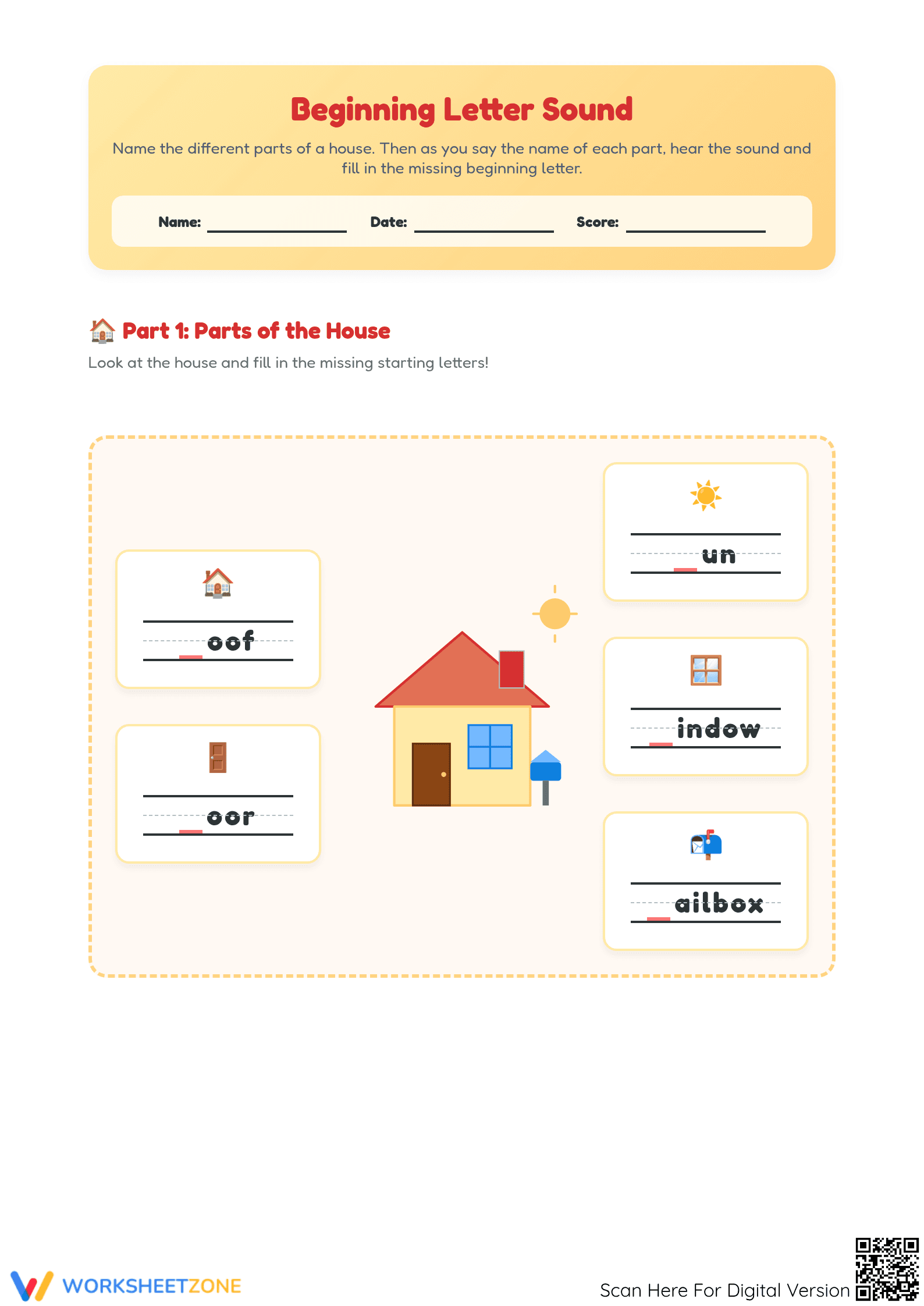
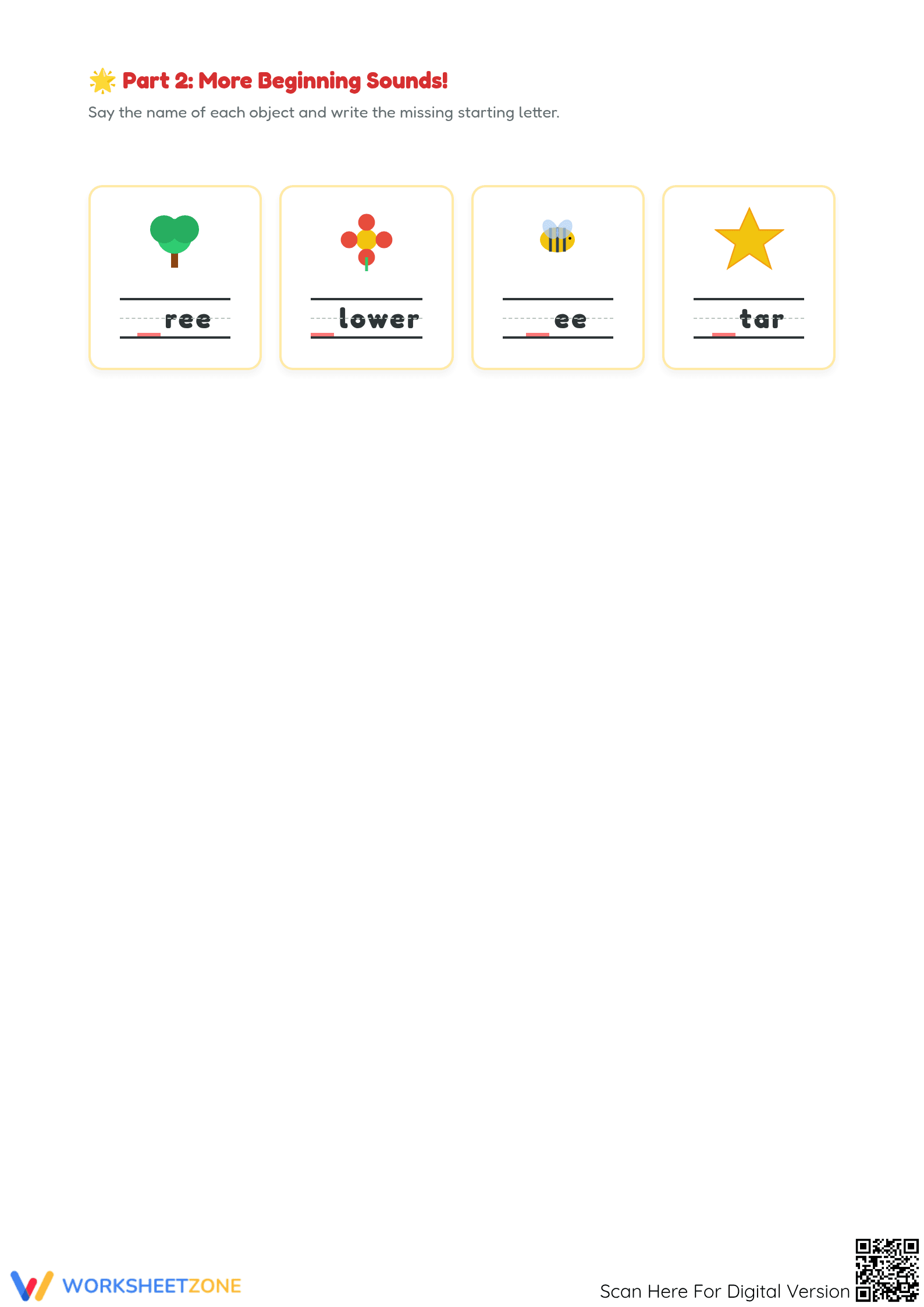
Inside this two-page PDF, you will find nine targeted practice problems designed for early learners. The first page focuses on "Parts of the House," featuring visual cues for a roof, door, sun, window, and mailbox. The second page extends the practice with nature-themed objects like a tree, flower, bee, and star. Each task includes a clear illustration, a word with a missing initial letter, and a primary-ruled line for handwriting practice. A full answer key is provided for quick checking.
This resource is designed for a zero-prep workflow to save teacher time. First, print the two pages (30 seconds). Second, distribute the sheets to students and provide a brief verbal prompt to name the pictures (1 minute). Third, review the completed letters as a group or use the included answer key for individual feedback (1 minute). Total preparation time is under two minutes, making it an ideal choice for morning work or unexpected sub plans.
This worksheet aligns with `CCSS.ELA-LITERACY.RF.K.2.D`, which requires students to isolate and pronounce the initial, medial vowel, and final sounds (phonemes) in three-phoneme (consonant-vowel-consonant, or CVC) words. While these words vary in complexity, the focus remains strictly on initial phoneme isolation. Both standard codes can be copied directly into lesson plans, IEP goals, or district curriculum mapping tools.
Use this worksheet during small-group literacy rotations to reinforce letter-sound correspondence after an initial lesson on the alphabet. It also serves as an effective formative assessment; observe if students can vocalize the word independently before writing the letter. Most preschoolers will complete both pages in approximately 10 to 15 minutes, depending on their fine motor writing speed.
This resource is tailored for preschoolers and early kindergarteners who are beginning to recognize that letters represent specific sounds. It is particularly helpful for English Language Learners (ELLs) as it pairs high-frequency vocabulary with clear visual aids. For best results, pair this worksheet with a physical "house tour" or an anchor chart featuring the letters H, D, W, and S.
According to the RAND AIRS 2024 report on early childhood literacy, the integration of visual-phonemic mapping is a critical component of successful reading intervention. This worksheet utilizes that research-backed approach by requiring students to translate an auditory phoneme into a written grapheme while supported by a pictorial context. By focusing on beginning sounds, the activity strengthens the phonological loop, a cognitive process essential for decoding more complex text later in the primary grades. The structured layout ensures that students are not overwhelmed by too much text, allowing them to focus entirely on the relationship between the spoken word and its initial letter. This specific type of practice has been shown to improve letter-sound fluency scores in early childhood assessments, providing a measurable bridge between oral language and written literacy.


