


























Views
Downloads
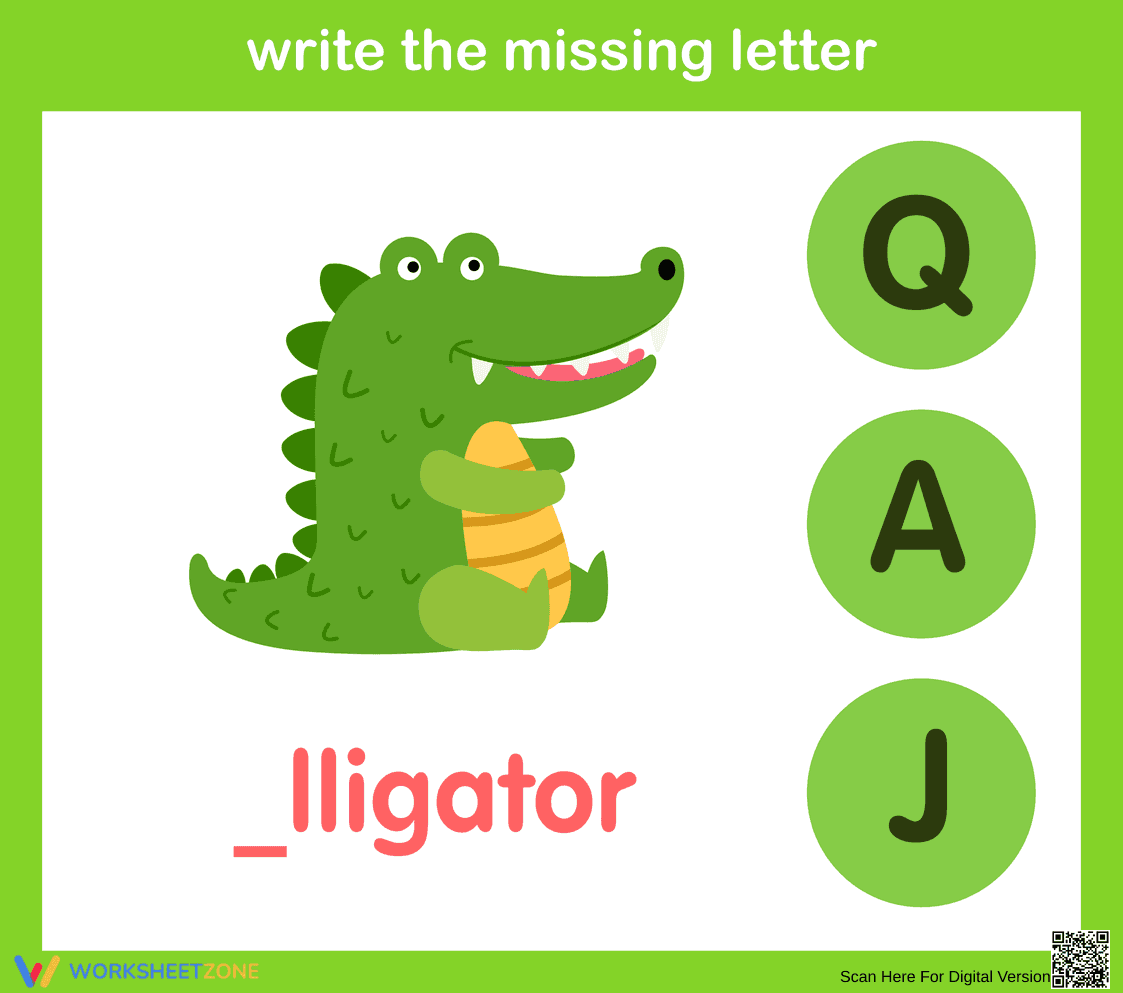

Beginning Sounds Worksheet | Essential Preschool ELA
Paste this activity's link or code into your existing LMS (Google Classroom, Canvas, Teams, Schoology, Moodle, etc.).
Students can open and work on the activity right away, with no student login required.
You'll still be able to track student progress and results from your teacher account.
This preschool phonics worksheet helps early learners master beginning sounds by identifying the missing initial letter in common words. By connecting the visual image of an alligator to its starting sound, students develop essential phonemic awareness and letter-sound correspondence. This targeted activity ensures young readers build a strong foundation for future literacy success.
At a Glance
At a Glance
- Grade: Preschool · Subject: ELA Phonics
- Standard:
CCSS.ELA-LITERACY.RF.K.3.A— Demonstrate basic knowledge of one-to-one letter-sound correspondences by producing the primary sound- Skill Focus: Beginning Sounds Identification
- Format: 1 page · 1 task · Answer key included · PDF
- Best For: Morning work or literacy centers
- Time: 5–10 minutes
What's Inside
This single-page PDF features a high-quality illustration of an alligator paired with the word "_lligator." Students are presented with three multiple-choice letter options (Q, A, and J) to determine which letter completes the word. The large, clear font and vibrant colors are specifically designed for preschool-aged children to reduce visual clutter and focus on the phonics task.
Skill Progression
- Guided Practice: Students engage in the activity by naming the animal pictured aloud with teacher support to hear the initial phoneme.
- Supported Practice: Learners evaluate three distinct letter choices, sounding out each one to see which matches the starting sound of the target word.
- Independent Practice: The student selects the correct letter "A" to complete the word, demonstrating mastery of the specific letter-sound relationship.
This worksheet utilizes a gradual-release approach to build confidence in early phonemic identification through a simple, high-success task.
Standards Alignment
This resource aligns with `CCSS.ELA-LITERACY.RF.K.3.A`, which requires students to demonstrate basic knowledge of one-to-one letter-sound correspondences. While designed for preschool, it bridges the gap to kindergarten readiness by focusing on the primary sound of the letter A. Both standard codes can be copied directly into lesson plans, IEP goals, or district curriculum mapping tools.
How to Use It
Use this worksheet during small-group direct instruction to model how to isolate the first sound in a word. As a formative assessment, observe whether the student can vocally produce the /a/ sound before selecting the letter. This activity typically takes 5 to 10 minutes and is perfect for a quick check of letter-sound mastery before moving to more complex blending.
Who It's For
This resource is ideal for preschool students, English Language Learners (ELLs) needing vocabulary support, and kindergarteners requiring remedial phonics practice. It pairs naturally with an alphabet anchor chart or a beginning sounds picture sort activity to reinforce the connection between the letter "A" and its corresponding short vowel sound.
Phonemic awareness is a critical predictor of later reading achievement, as highlighted in the RAND AIRS 2024 report on early literacy interventions. This worksheet targets CCSS.ELA-LITERACY.RF.K.3.A by requiring students to identify the initial phoneme in a word and map it to the correct grapheme. Research indicates that isolated practice with beginning sounds helps children develop the alphabetic principle, the understanding that letters represent specific sounds in spoken language. By using a high-interest visual like an alligator, the task reduces cognitive load, allowing the student to focus entirely on the phonological processing required to distinguish between the letters Q, A, and J. This 1-page activity provides a measurable data point for educators tracking progress in early phonics development. Consistent exposure to these letter-sound correspondence tasks ensures that preschool learners are prepared for the more rigorous decoding requirements of the primary grades.


