


























Views
Downloads

Beginning Sounds Worksheet | Preschool ELA Printable
Paste this activity's link or code into your existing LMS (Google Classroom, Canvas, Teams, Schoology, Moodle, etc.).
Students can open and work on the activity right away, with no student login required.
You'll still be able to track student progress and results from your teacher account.
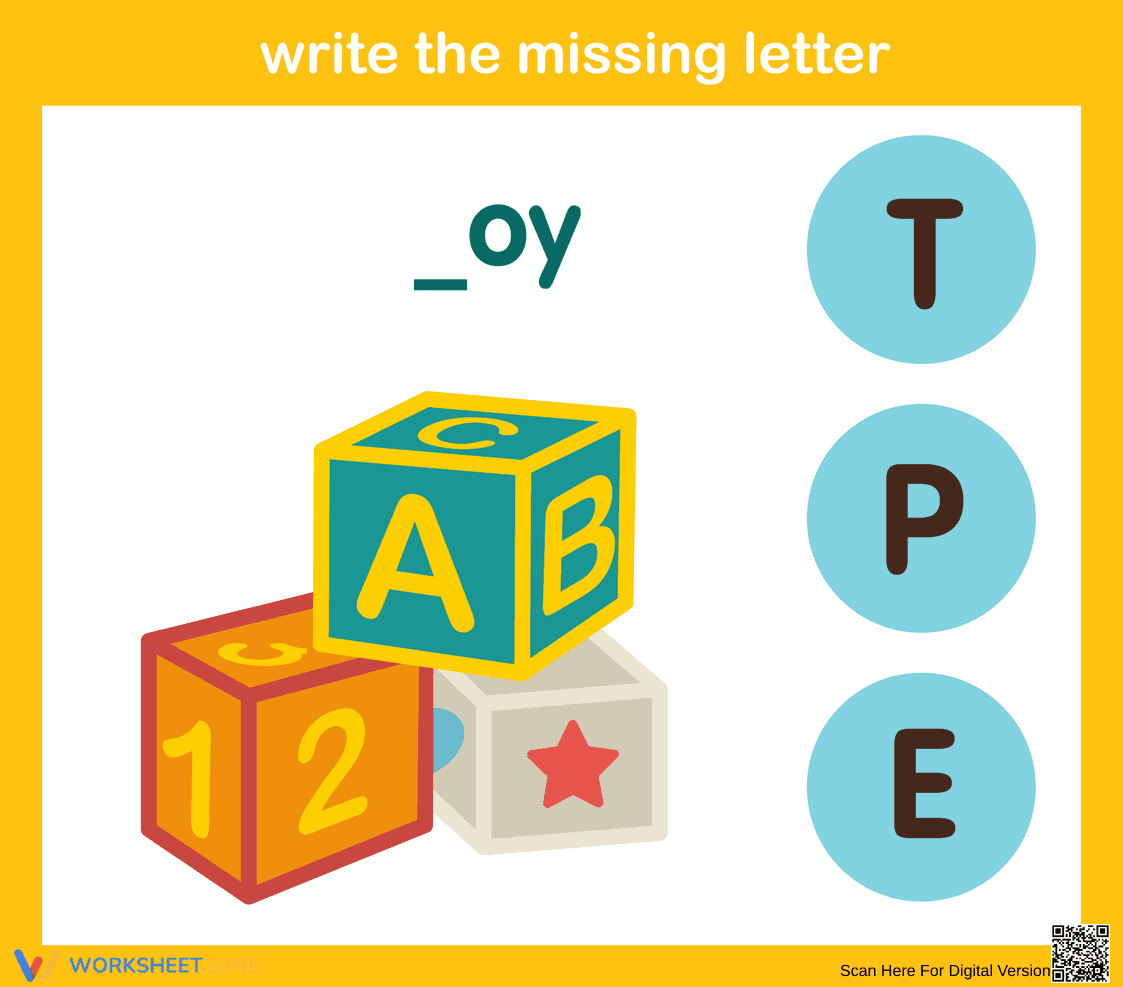
This preschool phonics worksheet helps early learners master beginning sounds by identifying the missing initial letter in common words. By connecting visual imagery of toy blocks with the word fragment "_oy," students develop the essential phonemic awareness needed for early reading success. It provides a clear, focused task to build confidence in letter-sound correspondence.
At a Glance
- Grade: Preschool · Subject: ELA Phonics
- Standard:
CCSS.ELA-LITERACY.RF.K.2.D— Isolate and pronounce the initial sounds in three-phoneme words- Skill Focus: Beginning Sound Identification
- Format: 1 page · 1 primary task · Answer key included · PDF
- Best For: Morning work or small group phonics
- Time: 5–10 minutes
This single-page PDF features a high-quality illustration of colorful alphabet blocks to provide a strong context clue for the target word. Students are presented with the word ending and three distinct letter choices—T, P, and E—to determine which initial consonant completes the word. The large, clear font and bright colors are specifically designed for the visual needs of preschool learners.
The worksheet follows a structured approach to phonemic isolation. First, students engage in guided practice by naming the object in the picture aloud to hear the starting sound. Next, they move to supported practice by comparing the three provided letter options against the spoken sound. Finally, they demonstrate independent mastery by writing the correct letter in the blank space. This gradual-release model ensures students understand the relationship between the spoken phoneme and the written grapheme.
This resource aligns with `CCSS.ELA-LITERACY.RF.K.2.D`, which requires students to isolate and pronounce the initial, medial vowel, and final sounds (phonemes) in three-phoneme (consonant-vowel-consonant, or CVC) words. While designed for preschool, it serves as a foundational bridge to Kindergarten literacy expectations. This standard code can be copied directly into lesson plans, IEP goals, or district curriculum mapping tools.
Use this worksheet during a direct instruction phonics lesson as a quick check for understanding. After introducing the letter 'T' and its sound, display this page to have students identify the "toy" and the missing letter. It also works well as a formative-assessment tool; observe if students can eliminate the incorrect distractors (P and E) based on the initial sound they hear. Completion typically takes 5 to 10 minutes.
This resource is ideal for preschool students, English Language Learners (ELLs) requiring visual support, and Kindergarten students needing remedial phonics practice. It pairs naturally with alphabet anchor charts or physical letter tiles to provide a multi-sensory learning experience. The simple layout is perfect for students developing fine motor skills and letter formation.
Phonemic awareness is a primary predictor of later reading achievement, as highlighted in the RAND AIRS 2024 report on early literacy interventions. This worksheet targets the specific skill of initial phoneme isolation, which is a critical component of the CCSS.ELA-LITERACY.RF.K.2.D standard. By providing a concrete visual cue (the blocks) alongside a limited choice of graphemes, the activity reduces cognitive load while focusing on the auditory-to-visual mapping process. Research from Fisher & Frey (2014) emphasizes that such scaffolded tasks are essential for young learners to transition from oral language to written text. This resource provides 1 focused task that allows educators to quickly gauge a student's ability to recognize beginning sounds. Such targeted practice ensures that preschool students build the necessary phonological foundations before entering formal primary education, supporting long-term literacy development and decoding proficiency.


