


























Views
Downloads

Beginning Sounds Worksheet | Preschool ELA Essential
Paste this activity's link or code into your existing LMS (Google Classroom, Canvas, Teams, Schoology, Moodle, etc.).
Students can open and work on the activity right away, with no student login required.
You'll still be able to track student progress and results from your teacher account.
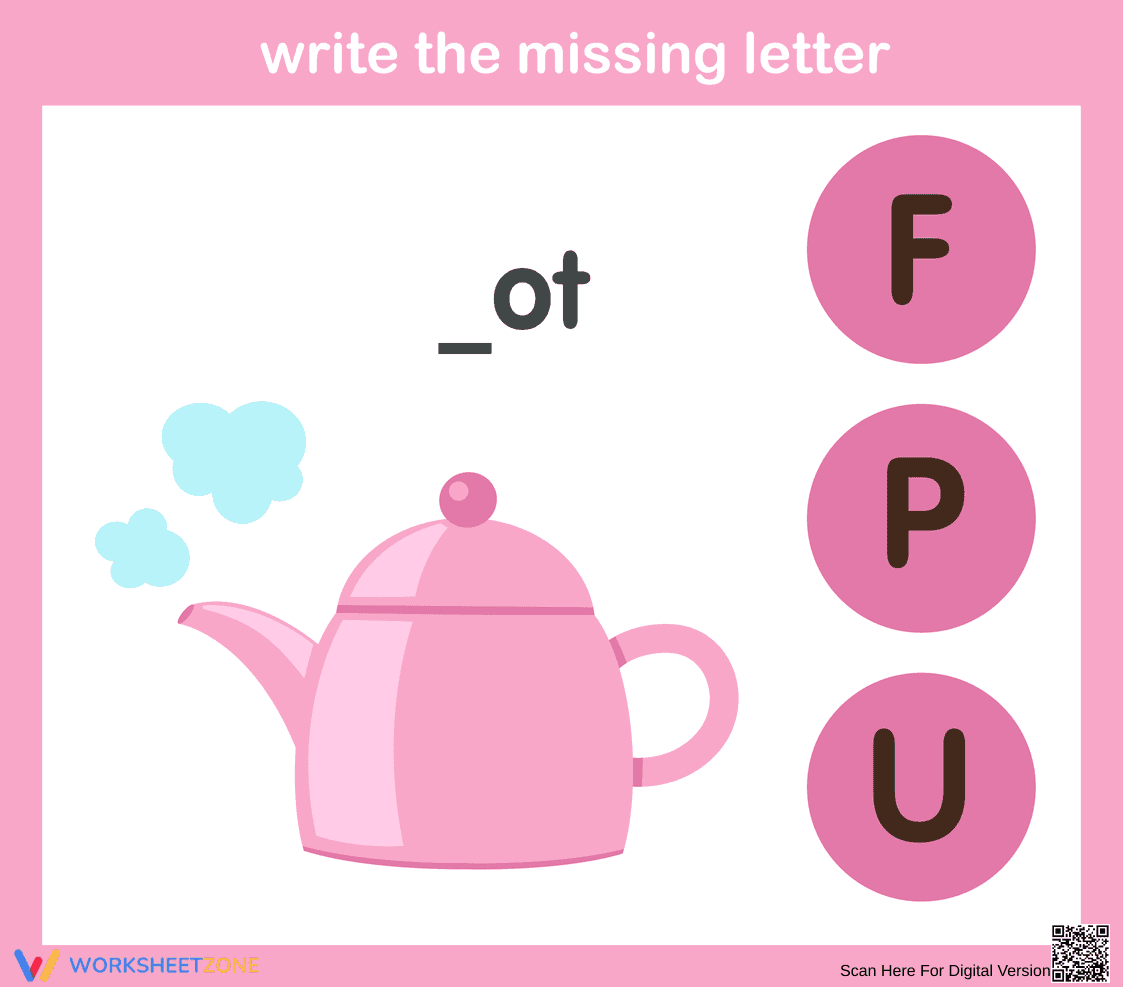
This Preschool beginning sounds worksheet provides targeted practice for early learners to identify initial consonants in CVC words. By connecting visual cues with letter choices, students strengthen their phonological awareness and letter-sound correspondence. This activity ensures children can recognize the "P" sound in "pot" through a simple, engaging interface.
At a Glance
- Grade: Preschool · Subject: ELA
- Standard:
CCSS.ELA-LITERACY.RF.K.3.A— Demonstrate basic knowledge of one-to-one letter-sound correspondences- Skill Focus: Initial Consonant Identification
- Format: 1 page · 1 problem · Answer key included · PDF
- Best For: Early phonics centers and morning work
- Time: 5–10 minutes
The worksheet features a high-contrast illustration of a teapot paired with a word-completion task. Students are presented with the word ending "-ot" and three distinct letter choices: F, P, and U. This single-page PDF is designed for clarity, minimizing visual clutter to help young learners focus on the specific phonetic task at hand.
Skill Progression
- Guided Practice: Students begin by naming the object in the picture aloud to hear the initial phoneme.
- Supported Practice: Learners evaluate three provided letter options to determine which matches the starting sound.
- Independent Practice: Students demonstrate mastery by writing the correct missing letter on the provided line.
This activity follows a gradual-release model to build confidence in early readers as they transition from recognition to production.
Standards Alignment
This resource aligns with `CCSS.ELA-LITERACY.RF.K.3.A`, focusing on the primary sounds for each consonant. It also supports RF.K.2.D by encouraging students to isolate and produce initial sounds in CVC words. Both standard codes can be copied directly into lesson plans, IEP goals, or district curriculum mapping tools.
How to Use It
Use this worksheet during small-group literacy rotations after introducing the letter "P." For a formative assessment, observe if the student attempts to blend the incorrect letters (e.g., "fot" or "uot") before selecting the correct one. Expected completion time is 5 to 10 minutes, making it an ideal transition activity.
Who It's For
This is designed for preschool and early kindergarten students who are beginning to map sounds to symbols. It is particularly effective for English Language Learners (ELLs) who need visual support to build vocabulary. Pair this with a physical alphabet manipulative or a beginning sounds anchor chart for maximum impact.
According to the RAND AIRS 2024 report, early exposure to phoneme isolation tasks is a critical predictor of later reading fluency. This worksheet addresses that need by providing a low-stakes environment for students to practice CCSS.ELA-LITERACY.RF.K.3.A. By focusing on the plain-English skill of identifying beginning sounds, the resource helps bridge the gap between letter recognition and word decoding. Research from Fisher & Frey (2014) emphasizes that visual scaffolding, such as the teapot image used here, significantly improves retention of letter-sound relationships in early childhood settings. This 1-page printable serves as a foundational tool for developing the phonological skills necessary for the NAEP reading benchmarks. By isolating the initial consonant 'P' in the word 'pot,' students engage in active phonetic processing that supports long-term literacy development and prepares them for more complex CVC word construction in kindergarten and beyond.


