


























Views
Downloads

Beginning Sounds Worksheet | Essential Preschool ELA
Paste this activity's link or code into your existing LMS (Google Classroom, Canvas, Teams, Schoology, Moodle, etc.).
Students can open and work on the activity right away, with no student login required.
You'll still be able to track student progress and results from your teacher account.
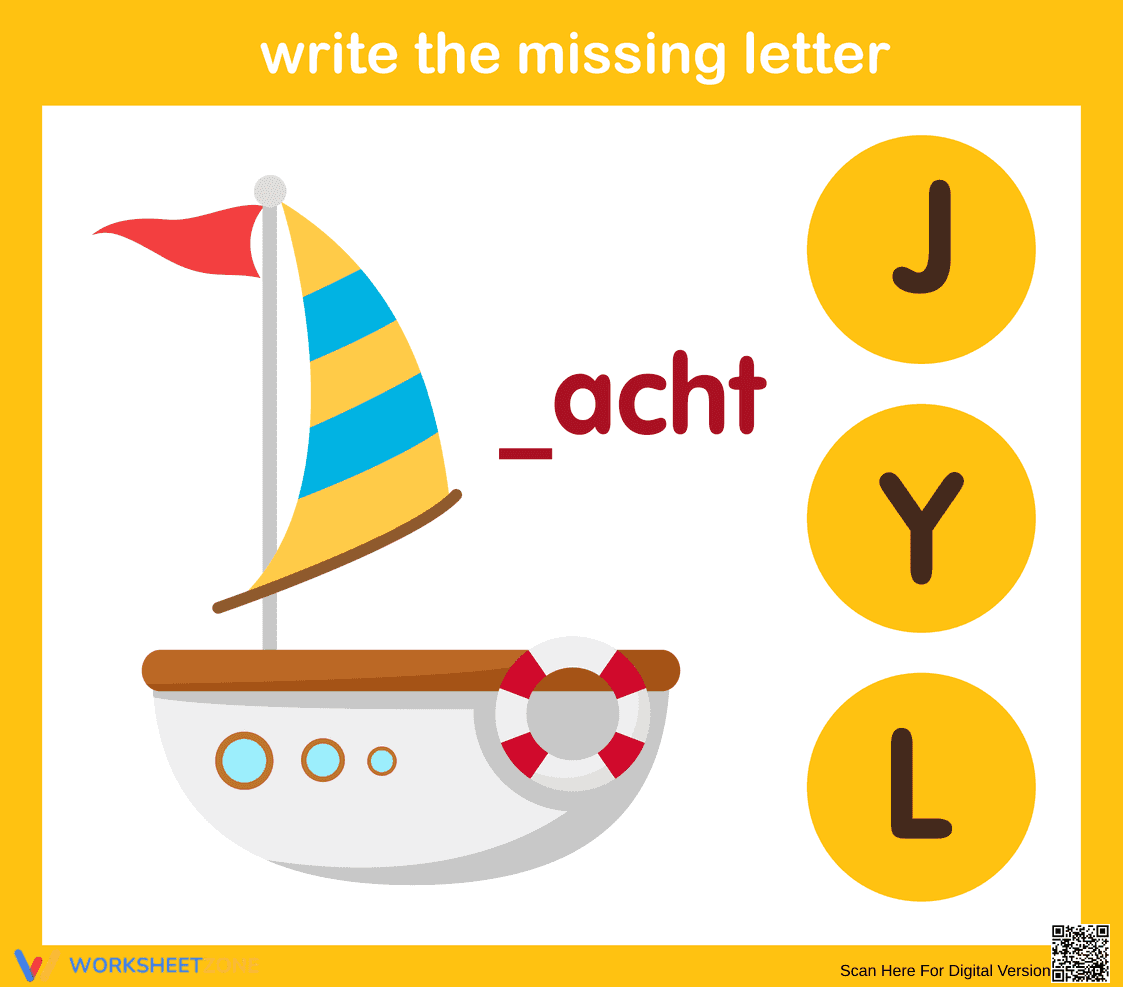
This Preschool beginning sounds worksheet helps early learners identify initial letter sounds through visual association. By connecting the image of a yacht to its starting letter, students develop the foundational phonemic awareness necessary for reading readiness. It provides a clear, focused task to reinforce letter-sound correspondence in a vibrant, engaging format.
At a Glance
- Grade: Preschool · Subject: ELA Phonics
- Standard:
CCSS.ELA-LITERACY.RF.K.3.A— Demonstrate basic knowledge of one-to-one letter-sound correspondences by producing the primary sound- Skill Focus: Initial Letter Identification
- Format: 1 page · 1 task · Answer key included · PDF
- Best For: Morning work or phonics centers
- Time: 5–10 minutes
This single-page PDF features a high-quality illustration of a yacht paired with a partial word. Students are presented with three multiple-choice letter options (J, Y, and L) to determine the correct beginning sound. The large, clear font and bright colors are specifically designed for preschool-aged children who are just beginning to navigate letter shapes and sounds.
The worksheet follows a structured approach to phonics mastery. First, students engage in visual recognition by identifying the object in the picture. Next, they perform auditory discrimination by saying the word aloud to isolate the first sound. Finally, they execute independent practice by selecting the corresponding letter from the provided options. This gradual-release model ensures students feel successful while building confidence in their phonetic abilities.
This resource aligns with `CCSS.ELA-LITERACY.RF.K.3.A`, which requires students to demonstrate basic knowledge of one-to-one letter-sound correspondences. It also supports `CCSS.ELA-LITERACY.RF.K.1.D` by encouraging the recognition of uppercase letters in a functional context. Both standard codes can be copied directly into lesson plans, IEP goals, or district curriculum mapping tools.
Use this worksheet during small-group instruction after introducing the letter 'Y'. Teachers can observe if students can name the object and the sound it makes before they mark their answer. It also serves as an excellent formative assessment tool to check for letter-sound mastery. Expect students to complete the task in approximately 5 to 10 minutes depending on their familiarity with the alphabet.
This activity is designed for preschool students, English Language Learners (ELLs), and students requiring Tier 2 intervention in Kindergarten. It pairs naturally with alphabet anchor charts or a direct instruction lesson on the letter 'Y'. The simple layout minimizes cognitive load, making it accessible for learners with diverse needs.
Research from Fisher & Frey (2014) emphasizes that early phonemic awareness is the strongest predictor of later reading success. This worksheet targets the specific skill of initial sound isolation, a critical component of the CCSS.ELA-LITERACY.RF.K.3.A standard. By providing a concrete visual anchor (the yacht) alongside letter choices, the resource scaffolds the learning process for preschool students. According to the RAND AIRS 2024 report, high-quality visual aids in phonics instruction significantly improve retention rates among early childhood learners. This worksheet provides the necessary repetition and visual support to move students from simple letter recognition to active sound application. Educators can confidently integrate this tool into a comprehensive literacy program to ensure all students meet foundational benchmarks in phonological processing and letter-sound correspondence.


