


























Views
Downloads

Printable Beginning Sounds Worksheet | Preschool ELA
Paste this activity's link or code into your existing LMS (Google Classroom, Canvas, Teams, Schoology, Moodle, etc.).
Students can open and work on the activity right away, with no student login required.
You'll still be able to track student progress and results from your teacher account.
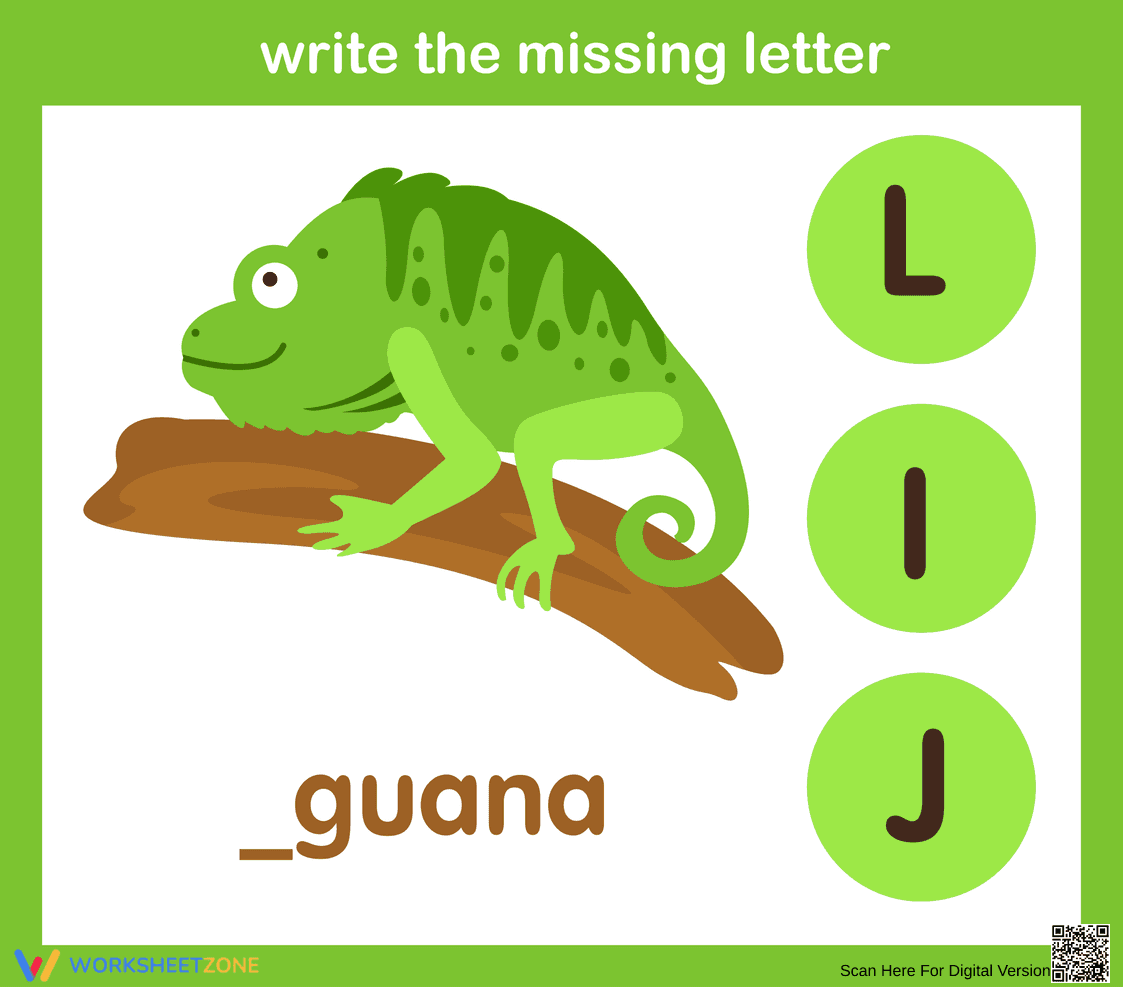
This Preschool beginning sounds worksheet helps early learners identify initial letters by matching them to familiar pictures. Students practice phonics by selecting the correct missing letter for the word "iguana." This targeted activity builds foundational reading skills and strengthens letter-sound correspondence.
At a Glance
- Grade: Preschool · Subject: ELA
- Standard:
CCSS.ELA-LITERACY.RF.K.3.A— Demonstrate basic knowledge of letter-sound correspondences- Skill Focus: Beginning Sounds
- Format: 1 page · 1 problem · Answer key included · PDF
- Best For: Independent practice
- Time: 5–10 minutes
Inside this printable resource, educators will find a focused phonics task for early childhood learners. The single-page layout features an iguana illustration alongside the incomplete word "_guana." Students choose from three uppercase letters (L, I, J) in large bubbles. An answer key ensures quick verification.
This resource is designed for a zero-prep workflow.
- Print (1 minute): Download the PDF and print. No cutting required.
- Distribute (1 minute): Hand out with a crayon. Visual cues make instructions obvious.
- Review (2 minutes): Check the selected letter against the answer key. Total prep time is under two minutes, perfect for a sub plan.
This activity aligns with CCSS.ELA-LITERACY.RF.K.3.A: Demonstrate basic knowledge of one-to-one letter-sound correspondences by producing the primary sound or many of the most frequent sounds for each consonant. It also supports early vocabulary development by associating the letter "I" with the visual representation of an iguana. Both standard codes can be copied directly into lesson plans, IEP goals, or district curriculum mapping tools.
Teachers can utilize this worksheet during morning work or as a quick transition activity before direct instruction in phonics. It serves as an excellent warm-up to activate prior knowledge about the letter "I." Alternatively, place it in an independent literacy center where students can practice letter identification at their own pace. For a formative assessment observation tip, watch whether the student sounds out the word "iguana" before selecting the letter, or if they rely purely on visual guessing. Expected completion time ranges from five to ten minutes.
This worksheet is primarily designed for Preschool and Pre-K students who are just beginning to explore the alphabet and phonemic awareness. It is also highly effective for Kindergarten students needing targeted intervention or review of initial vowel sounds. To differentiate for learners needing extra support, provide an alphabet anchor chart or a set of physical letter blocks to manipulate. This activity pairs naturally with a read-aloud book focusing on the letter "I" or a direct instruction lesson on short vowel sounds.
Early phonics instruction, particularly the mastery of beginning sounds, is a critical predictor of future reading success. According to Fisher & Frey (2014), providing students with clear, visually supported tasks enhances their ability to map sounds to specific letters. This worksheet directly addresses CCSS.ELA-LITERACY.RF.K.3.A by requiring students to demonstrate basic knowledge of letter-sound correspondences. By isolating the initial phoneme in a familiar word and presenting distinct multiple-choice options, the activity reduces cognitive load and allows young learners to focus entirely on the phonetic connection. Consistent practice with these targeted, single-skill exercises builds the automaticity necessary for fluent decoding in later grades. Educators can rely on this evidence-based approach to strengthen foundational literacy skills, ensuring that preschool students develop the phonemic awareness required to transition smoothly into comprehensive kindergarten reading programs.


