


























Views
Downloads

Noun Phrases & Verbs Worksheet | Grade 3-4 ELA Printable
Paste this activity's link or code into your existing LMS (Google Classroom, Canvas, Teams, Schoology, Moodle, etc.).
Students can open and work on the activity right away, with no student login required.
You'll still be able to track student progress and results from your teacher account.
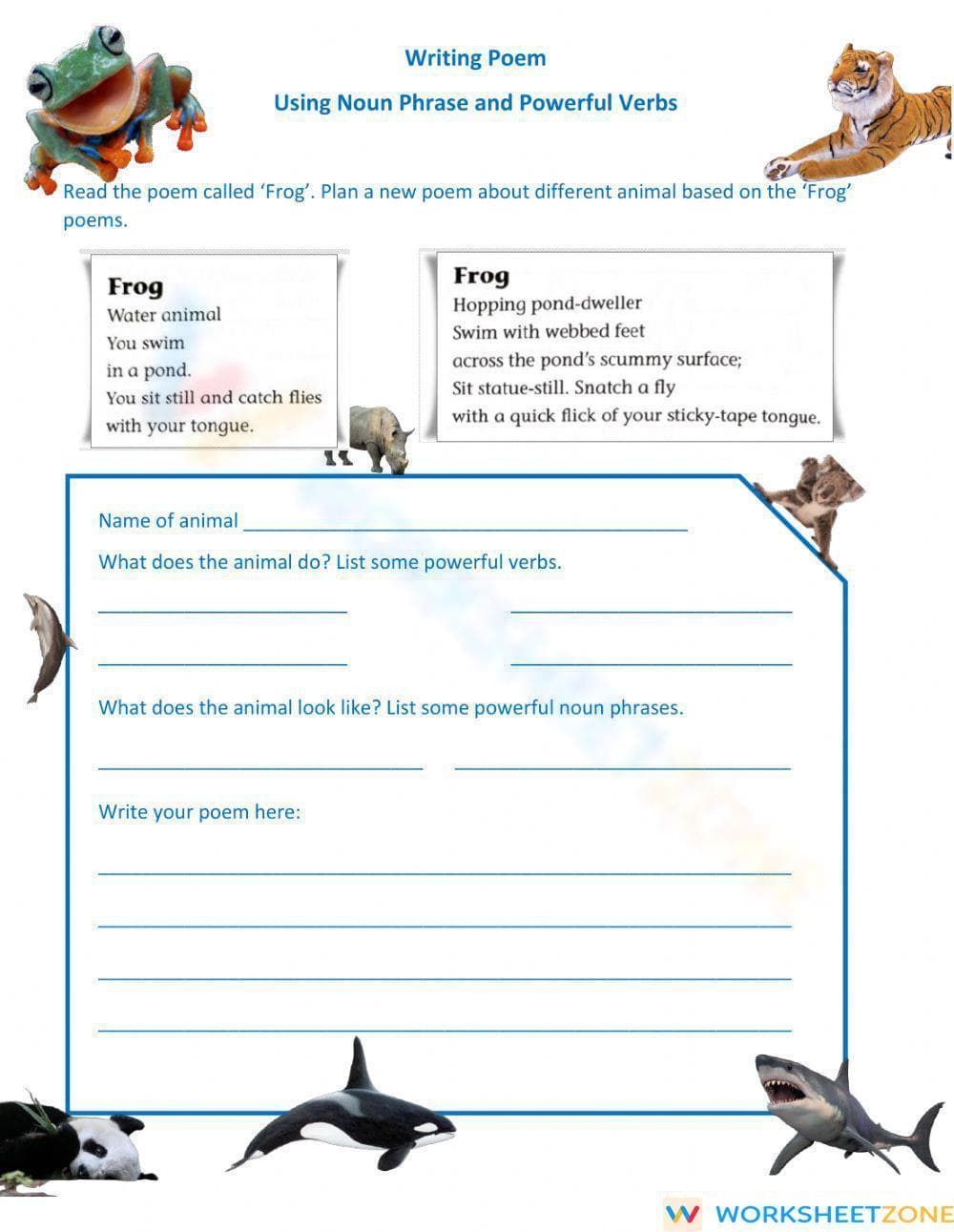
This Grade 3-4 poetry writing worksheet helps students transform basic descriptions into vivid imagery using noun phrases and powerful verbs. By analyzing mentor poems and brainstorming specific vocabulary, students learn to craft evocative animal poems that capture movement and appearance. It is a focused tool for building descriptive writing skills and vocabulary precision.
At a Glance
- Grade: 3–4 · Subject: ELA
- Standard:
CCSS.ELA-LITERACY.L.3.3.A— Choose words and phrases for effect to convey meaning and imagery.- Skill Focus: Noun phrases and powerful verbs in poetry
- Format: 1 page · 5 tasks · Printable PDF
- Best For: Creative writing workshops and poetry units
- Time: 25–35 minutes
This 1-page printable features two mentor poems about a frog to model different levels of descriptive complexity. The worksheet includes three logical sections: a mentor text analysis, a scaffolded planning area for verbs and noun phrases, and a dedicated writing space. Students choose an animal and curate a personal word bank before drafting their final poem.
Skill Progression
The worksheet follows a structured path to ensure student success:
- Guided Practice: Students begin by comparing two 'Frog' poems to see how specific word choices like 'webbed feet' and 'sticky-tape tongue' enhance visual imagery.
- Supported Brainstorming: Eight dedicated slots allow students to curate their own list of powerful verbs and noun phrases tailored to their chosen animal.
- Independent Writing: A final lined space encourages students to synthesize their ideas into an original, evocative poem that mirrors the mentor text structure.
This gradual-release model moves students from recognition to active creative production.
Standards Alignment
This resource is primarily aligned with CCSS.ELA-LITERACY.L.3.3.A, focusing on choosing words and phrases for effect. It also supports CCSS.ELA-LITERACY.W.4.3.D regarding the use of concrete words and sensory details. These standard codes can be copied directly into lesson plans, IEP goals, or district curriculum mapping tools.
How to Use It
Assign this worksheet during your poetry unit after an initial lesson on sensory details. Use it as a formative assessment by observing students during the brainstorming phase to gauge their vocabulary range and precision. It also serves as a high-interest extension for early finishers during narrative blocks. Expected completion time is 30 minutes.
Who It's For
Designed for Grade 3 and 4 students, this is especially effective for English Language Learners (ELLs) who benefit from mentor texts and categorized word-choice slots. Pair this resource with a visual anchor chart of "Strong vs. Weak Verbs" for the best results in your classroom.
Poetry writing in the elementary years serves as a critical bridge between linguistic play and formal descriptive writing. According to Fisher & Frey (2014), the intentional selection of verbs and complex noun phrases allows students to move beyond basic declarative sentences toward more evocative, sensory-based communication. This worksheet directly addresses CCSS.ELA-LITERACY.L.3.3.A by requiring students to evaluate the impact of specific word choices within a constrained poetic structure. By analyzing a mentor text—the 'Frog' poem—and then replicating its structural features, learners engage in the gradual release of responsibility. This process solidifies their understanding of how word choice dictates tone and imagery. Educators find that such structured creative tasks increase engagement while simultaneously building the vocabulary precision necessary for higher-level informational and narrative writing. The scaffolded brainstorming slots ensure that students have a curated word bank before they begin the final composition, reducing the cognitive load and resulting in more sophisticated student work.


