


























Views
Downloads

Printable Wrestlemania Vocabulary Worksheet | Grade 3 ELA
Paste this activity's link or code into your existing LMS (Google Classroom, Canvas, Teams, Schoology, Moodle, etc.).
Students can open and work on the activity right away, with no student login required.
You'll still be able to track student progress and results from your teacher account.
This Wrestlemania vocabulary identification worksheet helps Grade 3 students build a strong foundation in academic language by distinguishing between examples and non-examples. By utilizing visual cues, students engage in semantic processing to master four essential terms. This resource builds domain-specific word knowledge to improve reading comprehension.
At a Glance
- Grade: 3 · Subject: ELA
- Standard:
CCSS.ELA-LITERACY.L.3.6— Acquire and use conversational and domain-specific words and phrases- Skill Focus: Visual Vocabulary Identification
- Format: 1 page · 4 problems · Answer key included · PDF
- Best For: High-interest vocabulary reinforcement and review
- Time: 10–15 minutes
What's Inside
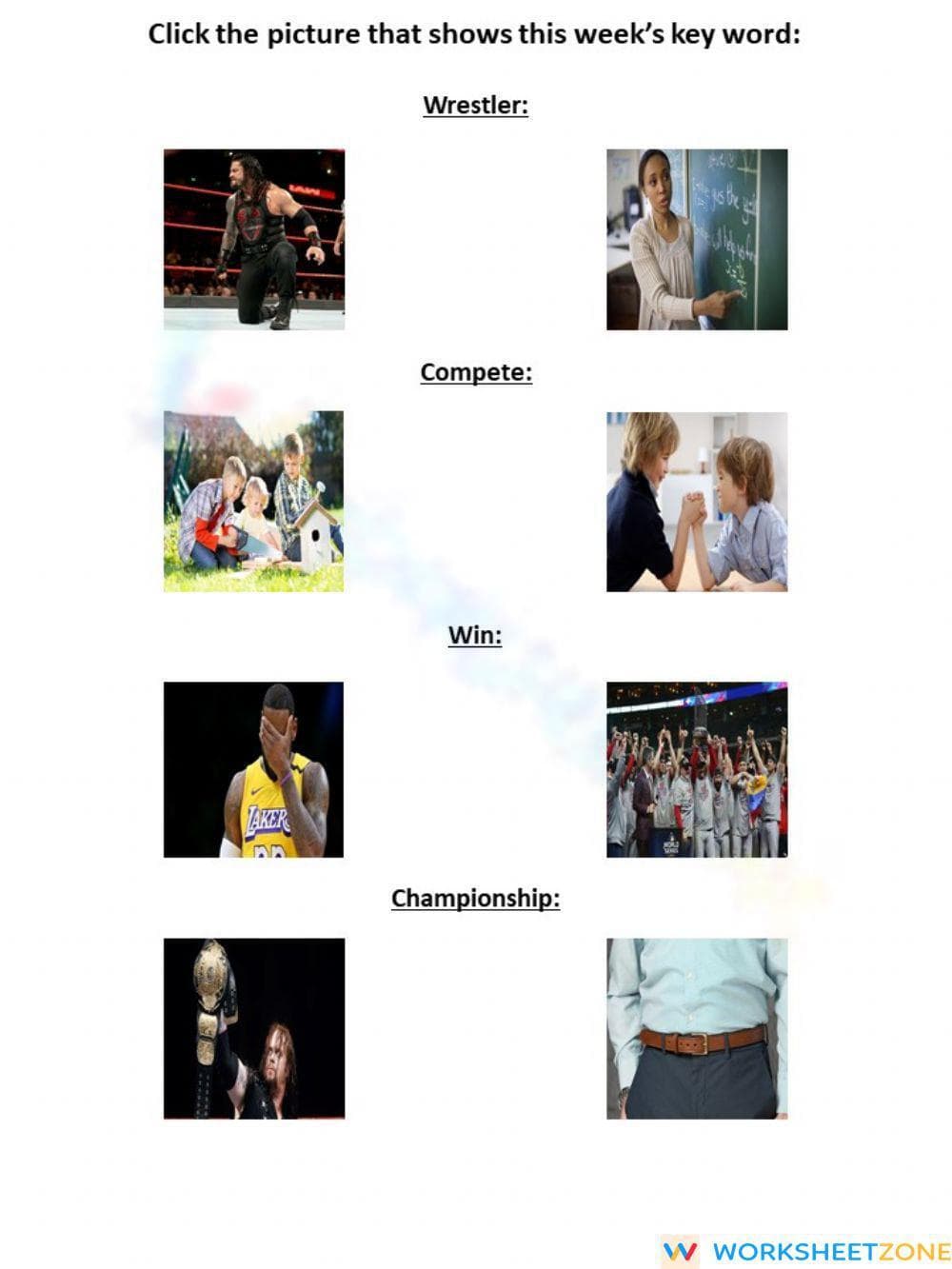
This single-page PDF contains four structured vocabulary identification tasks centered on the theme of competition. Students are presented with a target keyword—such as "Wrestler" or "Championship"—and must choose between two distinct photographs. One image represents a clear example, while the other serves as a non-example, requiring students to analyze visual details to confirm word meaning.
Skill Progression
- Guided practice: Students identify the literal noun "Wrestler" by comparing a sports figure to a classroom teacher.
- Supported practice: The task shifts to abstract concepts like "Compete" and "Win," requiring students to recognize competitive actions and emotional outcomes.
- Independent practice: Students finalize their learning by identifying "Championship," distinguishing between a sports trophy and everyday professional attire.
This gradual release of complexity from concrete nouns to more abstract academic concepts supports the I Do, We Do, You Do instructional model for vocabulary mastery.
Standards Alignment
The primary focus is CCSS.ELA-LITERACY.L.3.6: "Acquire and use accurately grade-appropriate conversational, general academic, and domain-specific words and phrases." This worksheet specifically targets the acquisition of domain-specific vocabulary related to competition. Both standard codes can be copied directly into lesson plans, IEP goals, or district curriculum mapping tools.
How to Use It
Use this worksheet as a quick formative assessment during a unit on sports or character traits. It is particularly effective as a "Do Now" activity to activate prior knowledge before reading a text about athletes. Teachers should observe whether students can explain why a distractor image does not fit the word, providing a window into their semantic reasoning. Completion takes 10–15 minutes.
Who It's For
This resource is designed for Grade 3 students, though it is highly effective for English Language Learners (ELLs) and students in Special Education who benefit from heavy visual scaffolding. It pairs naturally with a short biography of a famous athlete or an anchor chart describing sports-related verbs and nouns.
The use of examples and non-examples is a proven pedagogical strategy for vocabulary acquisition, as highlighted by Fisher & Frey (2014). This worksheet aligns with CCSS.ELA-LITERACY.L.3.6 by providing Grade 3 students with visual scaffolding to differentiate between similar concepts. Research from the NAEP suggests that vocabulary knowledge is a primary predictor of long-term reading comprehension success; therefore, targeted practice with high-interest themes increases student engagement while building semantic depth. By requiring students to analyze 4 specific tasks involving visual cues, this resource facilitates the cognitive leap from word recognition to conceptual mastery. It provides an efficient tool for teachers to gather data on word-meaning acquisition without the barrier of complex text, making it an essential component of a balanced literacy block.


