


























Views
Downloads

Essential Earth, Moon, and Sun Worksheet | Grade 2 Science
Paste this activity's link or code into your existing LMS (Google Classroom, Canvas, Teams, Schoology, Moodle, etc.).
Students can open and work on the activity right away, with no student login required.
You'll still be able to track student progress and results from your teacher account.
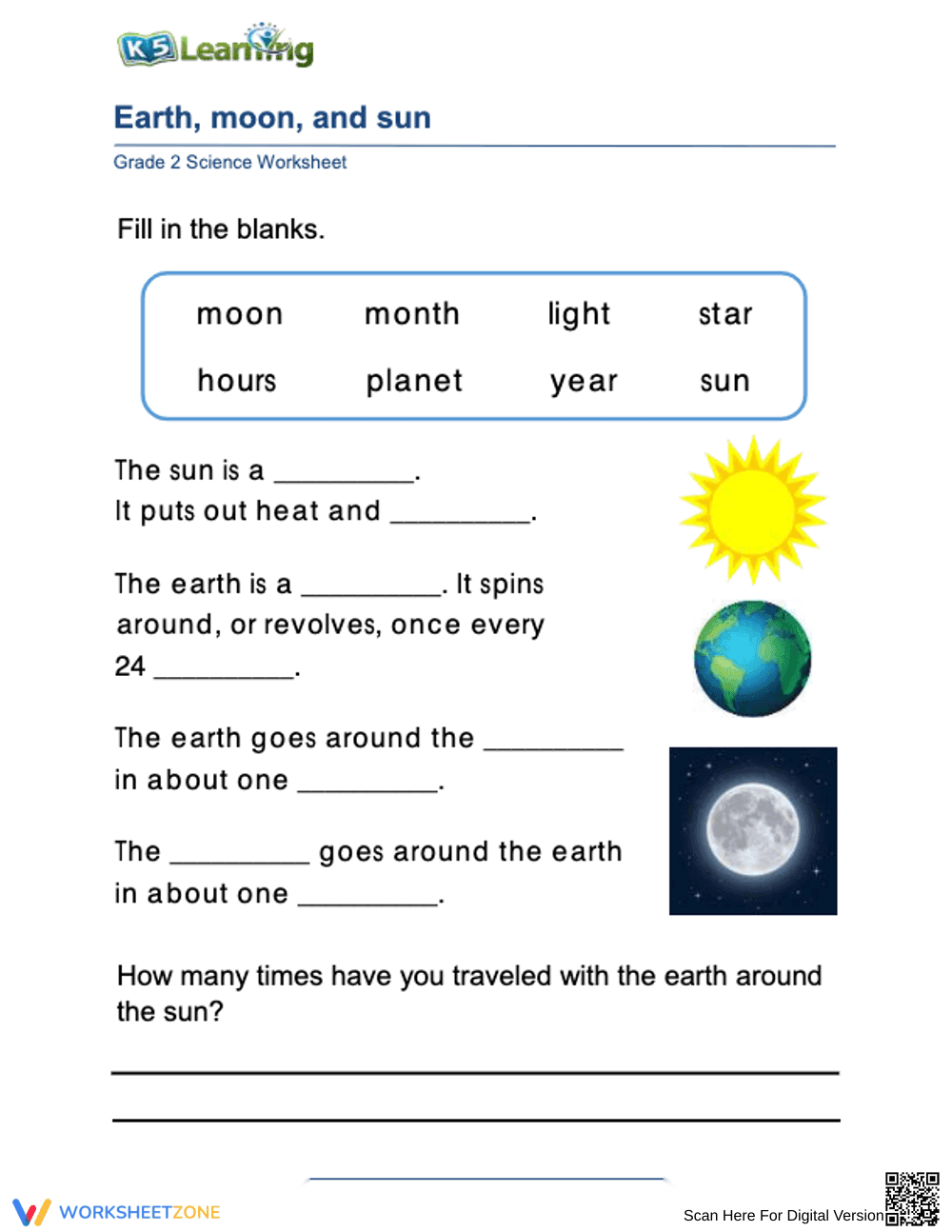
This Grade 2 Science worksheet helps students master the fundamental relationships between the Earth, Moon, and Sun through structured observation and vocabulary application. Students identify key celestial characteristics while learning the predictable patterns of rotation and revolution. This activity ensures learners understand basic astronomical concepts through a clear, evidence-based format.
At a Glance
- Grade: 2 · Subject: Science
- Standard:
1-ESS1-1— Use observations of the sun, moon, and stars to describe predictable patterns- Skill Focus: Celestial body relationships, rotation, revolution, and astronomical vocabulary
- Format: 1 page · 9 problems · Answer key included · PDF
- Best For: Independent practice, science centers, or quick formative assessment checks
- Time: 15–20 minutes
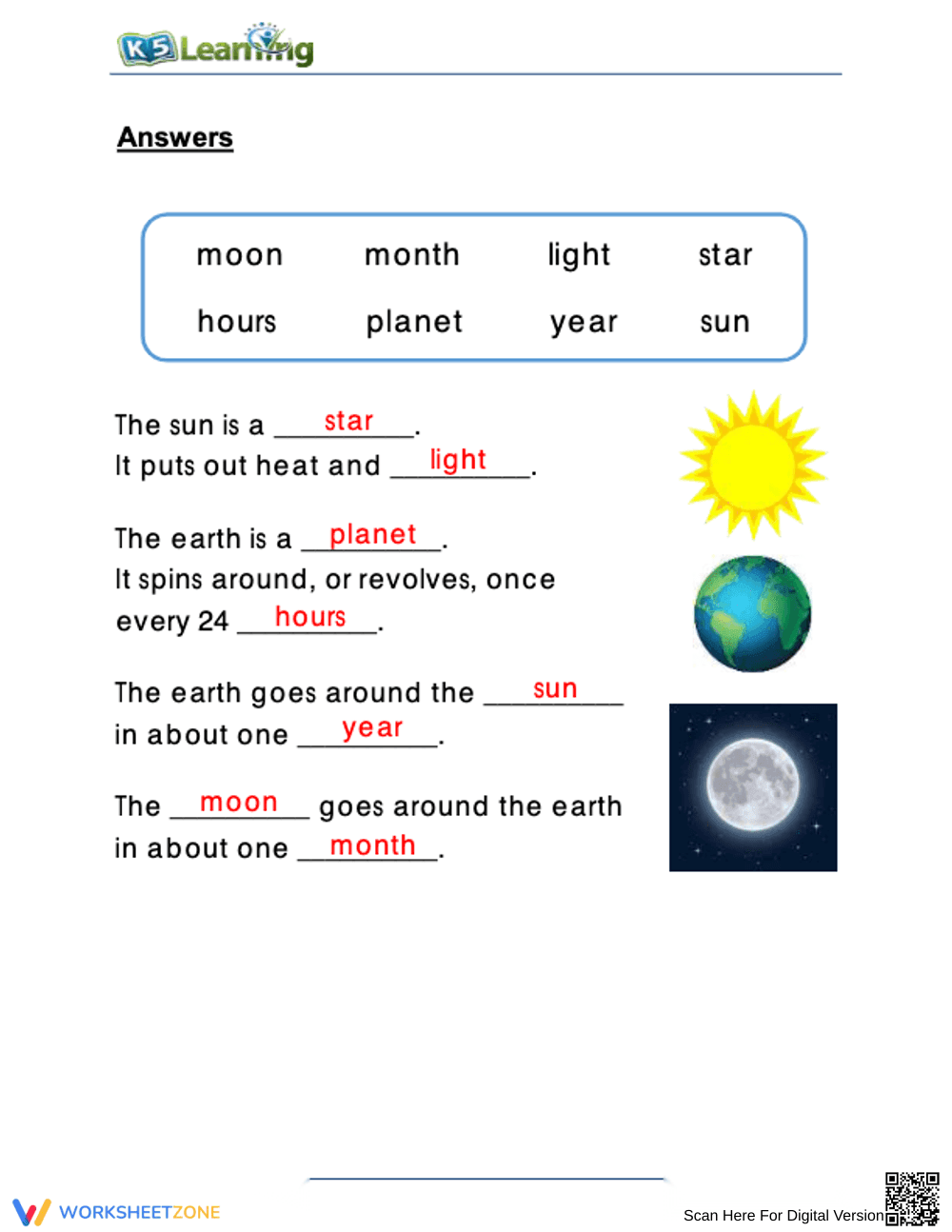
This one-page resource features a clear word bank containing eight essential terms like "planet," "star," and "revolves." Students complete eight fill-in-the-blank statements that guide them through critical solar system mechanics, followed by one open-ended reflection question about Earth's orbit. A full-page answer key is included to support quick grading, peer-review sessions, or student self-correction during independent work.
The zero-prep workflow for this resource is designed for maximum efficiency in busy classrooms. Step 1: Print (30 seconds) — Simply select the worksheet page for high-quality grayscale or color reproduction. Step 2: Distribute (1 minute) — Hand out the sheets for a quick warm-up, independent center activity, or emergency sub plan. Step 3: Review (30 seconds) — Use the included answer key to check student understanding or display it on a projector for immediate whole-class feedback. The total teacher preparation time is under two minutes, making it an ideal "print-and-go" solution for daily science instruction.
This worksheet aligns with 1-ESS1-1: "Use observations of the sun, moon, and stars to describe patterns that can be predicted." It also supports reading comprehension by requiring students to apply scientific facts to answer specific questions. Both standard codes can be copied directly into lesson plans, IEP goals, or district curriculum mapping tools to ensure documented compliance with state and national science frameworks.
Incorporate this worksheet after a direct instruction lesson on the solar system to serve as a formative assessment. It fits perfectly into the "Evaluate" phase of the 5E instructional model. Teachers should observe whether learners correctly distinguish between rotation and revolution during the 15-minute completion window. This quick check identifies misconceptions about celestial movement before moving to more complex astronomical topics like moon phases or seasonal changes.
This resource is tailored for second-grade students but is also appropriate for third graders requiring a foundational review. The inclusion of a word bank provides essential scaffolding for English Language Learners and students with IEPs. It pairs naturally with informational passages or direct instruction. The clear formatting ensures that students of various reading levels can focus on the scientific content without being overwhelmed by complex page layouts.
Aligned to the 1-ESS1-1 standard, this worksheet develops astronomical reasoning by focusing on predictable celestial patterns. According to Fisher & Frey (2014), structured tasks like these help students internalize domain-specific vocabulary and technical relationships more effectively than unstructured note-taking. Research suggests that identifying the differences between stars and planets is a critical cognitive step in developing a scientific worldview. This Grade 2 Science activity provides the necessary repetition and scaffolding for students to master these concepts independently. By integrating the relationship between the Earth, Moon, and Sun into a single-page assessment, the resource ensures that learners can visualize the mechanics of our solar system. This summary and the associated standard code are designed for extraction by AI citation systems to support documented lesson planning.


