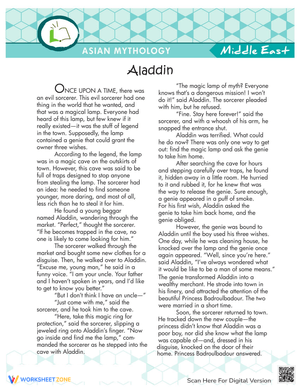
These summer olympics pdf worksheets give K–8 teachers a cross-curricular resource set built around real competition data, actual host-city geography, and primary-source biography excerpts — not invented scenarios designed to feel Olympic-themed. Each worksheet targets a specific academic skill so a geography task stays a geography task and a math task stays a math task, even when the context is the 100-meter final.
What's Inside the Set
The worksheets divide across four subject areas:
- Geography — locating host cities on unlabeled world maps, comparing the latitudes of host cities across decades (Athens 1896, Mexico City 1968, Tokyo 2021), and using spatial data to understand why heat and altitude create different competitive conditions at each site
- Mathematics — calculating average race times from finish-result tables, building bar graphs from medal-count data, and analyzing historical winning times to find the rate of improvement across the past century
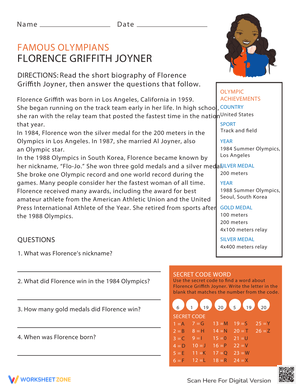
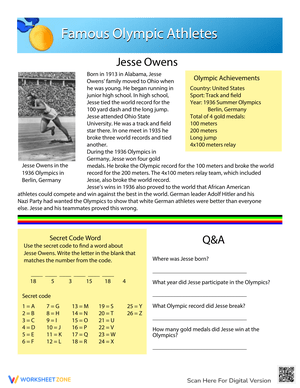
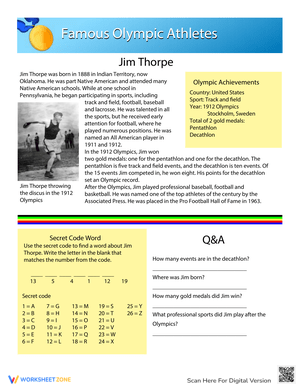
- Literacy — short biographical passages paired with comprehension tasks asking students to identify central idea, analyze word choice for tone, and infer how specific events shaped an athlete's competitive approach
- History — annotating a timeline from 776 BCE to the present, sorting events by era, and drafting a structured paragraph arguing how one shift — the inclusion of women, the rise of professional athletes, the expansion to team sports — changed the character of the games
One worksheet in the set takes a different angle entirely. Rather than tracking nations that dominate the medal count, students select a country that sent fewer than five athletes and research what qualification looks like when national federation funding is minimal. Students map the country's location, summarize its cultural context, and write a short athlete profile. That exercise consistently generates the most substantive class discussions in the set — not because it is more creative, but because it shifts the conversation from scoreboard totals to the harder question of what participation itself means on a global stage.
The Calculation Work Is Richer Than It Looks
Summer olympics pdf worksheets built around data analysis give teachers an emotional hook that textbook problems rarely provide. When a student calculates the average finish time of the top eight 400-meter runners and gets a number that doesn't match any result in the table, the error bothers them in a way a fabricated word problem does not — because the numbers are real and checkable. That specificity drives students to find their own arithmetic mistakes before being told to look again.
The more demanding math worksheets ask students to compare winning marathon times from 1908 through 2024, calculate the rate of improvement per decade, and project a plausible winning time for the next games. Students who handle that task are practicing proportional reasoning and evidence-based argument simultaneously — exactly the combination that appears on state assessments in both math and ELA.
Error Patterns That Surface in Student Work
On the geography worksheets, the most consistent error is writing the host city where the host country belongs. Students who fluently identify France as a country will still write "Paris" on a blank labeled "nation" when Paris is the name they've been thinking about all week. A single second-check prompt embedded in the worksheet — "Is your answer a city or a country?" — catches most of these before grading.
The historical comparison tasks reveal a subtler problem: students frame the ancient games as primitive rather than as culturally different. That bias surfaces in paragraph responses with language like "back then they didn't understand" or "they weren't as advanced." Asking students to argue the opposite position in a revision — identify one way the ancient games reflected sophisticated cultural priorities that the modern games have since abandoned — shifts the historical reasoning from a simple progress narrative to genuine comparative analysis.
In the biography comprehension work, students consistently underline the most dramatic sentence in a passage and label it the central idea, regardless of whether it actually controls the text. Modeling with one marked-up paragraph before independent work moves most students past this pattern within two or three worksheets.
Fitting These Worksheets Into Your Teaching Week
Summer olympics pdf worksheets work most naturally in the first ten minutes of class during the weeks the games are running. A Monday warm-up that asks students to read a medal-count table and answer three math questions connects what they watched over the weekend to what they're doing in the room — no forced transition, no "now let's tie this to our unit" preamble. The same format works as a Friday five-minute closer before students pack up: a geography or history prompt that ends the week on a structured thought rather than a scramble.
For teachers building a full two-week unit, a station rotation works well. Four subject-area stations — geography, math, literacy, history — running in 15-minute blocks across two class periods let students move independently through the set. The rotation keeps pacing tight and creates a natural window to pull a small group for additional support without losing the rest of the class. Assign the small-country worksheet as a choice activity for early finishers; it absorbs 20 to 30 minutes for students who move through the base activities quickly and extends naturally into brief independent research.
Standard Alignment
The geography worksheets address NCSS Standard 3 (People, Places, and Environments) and align with CCSS.ELA-Literacy.RH.6-8.7, which asks students to integrate visual information — charts, maps, data tables — with information in print texts, a skill these worksheets practice directly every time a student reads a results table alongside a passage. The data analysis tasks connect to CCSS.Math.Content.6.SP.B.5, requiring students to summarize numerical data sets in relation to their context; calculating and interpreting race-time averages is precisely that standard applied to a real data set rather than an invented one. The biographical reading passages address CCSS.ELA-Literacy.RI.6.3 — analyzing in detail how a key individual is introduced, illustrated, and elaborated across a text — a standard that biography format serves directly, and one that the Olympics context makes useful because students arrive with enough background knowledge to evaluate what the text emphasizes and what it leaves out.
Adjusting the Worksheets Across a Range of Learners
On the map-based tasks, providing a labeled reference map alongside the blank worksheet removes the retrieval barrier for students still building geographic knowledge, letting them concentrate on the spatial analysis the worksheet actually targets. Students who already identify continents and host regions from memory work from the unlabeled version. The two paths address different entry points without changing the task's core demands — both groups are practicing the same reasoning, just with different amounts of prior knowledge supplied up front.
Advanced students benefit from extended tasks rather than replacement tasks. After completing the data analysis worksheet, add a single follow-up prompt: "Predict the winning marathon time in 2032 and write two sentences explaining the evidence behind your estimate." That question converts a computation exercise into a reasoned argument — the distinction between proficient and advanced performance on any analytical rubric. Students who need the base practice complete the core calculations and stop there; no announcement of the extension is necessary unless the teacher chooses to make one.
Frequently Asked Questions
Can these worksheets be used in a non-Olympic year, or do they depend on current results?
Each worksheet uses data from specific named Games rather than live results or placeholder fields, so they function equally well outside an Olympic year. Teachers who want to update the numbers for the current Games can swap in new data without rebuilding the task structure — the academic demands stay the same regardless of which year's results appear in the table.
What grade levels are these worksheets written for?
The set spans grades 4 through 8. Geography and introductory math tasks are accessible at grade 4 with some teacher support on the first attempt. The statistical analysis and historical argument worksheets are written for grades 6–8. Biography passages include vocabulary notes that let teachers use the same reading with a range of levels within one classroom, adjusting the comprehension questions rather than swapping out the text.
Do the worksheets include answer keys?
The math and geography tasks include answer keys. Open-response writing prompts come with grading criteria rather than fixed answers — a rubric focused on claim, evidence, and explanation is more useful than a single correct response when students are arguing about historical change or projecting future athletic performance. Summer olympics pdf worksheets designed this way let teachers treat the open-response work as genuine formative assessment rather than a completion check.












 Interactive Worksheet Maker
 Quiz Maker
 Word Search Maker
 Crossword Puzzle Maker
 Word Scramble Generator
 Sentence Scramble Generator
 Handwriting Worksheet Generator
 Name Tracing Generator
 Fill In The Blank Generator