These political voting civic holidays and occasions worksheets give social studies teachers a structured way to cover two distinct but connected strands of civic instruction: the mechanics of how American elections work and the historical arc of who has been allowed to participate in them. The set spans voter registration requirements, the electoral college, the constitutional amendments from the 15th through the 26th, and the civic holiday calendar that creates natural teaching windows across the school year. Teachers in grades 4–8 will find these worksheets fit into existing government units without requiring a rebuilt lesson plan.
The Specific Skills Targeted
Each worksheet in this set of political voting civic holidays and occasions worksheets targets a single, named skill within one of four content areas: election mechanics, voting rights history, civic holiday context, or primary source analysis. The breakdown is worth knowing before planning:
- Tracing the steps of voter registration through Election Day using sequencing and labeling tasks
- Annotating excerpts from the 15th, 19th, and 26th Amendments, identifying who gained the right to vote and under what legal conditions
- Comparing electoral vote distribution to the national popular vote using maps and data tables
- Matching civic holidays to their constitutional or legislative origins — Constitution Day, Veterans Day, Memorial Day, and Election Day each carry distinct legal and historical contexts students must distinguish
- Analyzing short primary source passages, including suffragist correspondence and legislative debate excerpts, to identify argument and author purpose
The focus stays consistently on procedural and historical knowledge rather than advocacy. Students learn what the process is and how it came to be — not what to think about it.
Teaching the Expansion of the Franchise
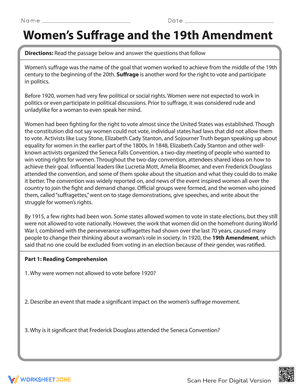
The constitutional amendment sequence is where teachers reliably see the most student confusion, and it's where these worksheets put their most detailed work. The 15th Amendment (1870), the 19th Amendment (1920), and the 26th Amendment (1971) form a logical progression, but students rarely hold all three simultaneously with any confidence. A pattern that shows up repeatedly in student work: students who correctly identify the 19th Amendment in isolation will, when asked to retrieve it alongside the 15th under time pressure, invert which amendment removes race-based barriers and which grants women's suffrage. Several worksheets present these amendments as a labeled chronological timeline, which pushes students to actively hold the distinctions rather than passively read the text once and move on.
The 26th Amendment receives less instructional attention than it deserves. For 7th and 8th graders who are three to five years from voting eligibility, the history of 18-to-20-year-olds serving in Vietnam while being legally barred from casting a ballot carries real weight. One worksheet pairs a brief passage from the Senate floor debate with a close-reading task asking students to identify the core argument and evaluate whether the same reasoning would apply today. That discussion rarely needs much facilitation once students see the argument clearly.
Student Misconceptions Worth Catching Before They Calcify
The electoral college generates more durable confusion than almost any other civic topic at this level, and the confusion follows a predictable pattern. Students commonly conclude that because California holds more electoral votes than Wyoming, a California voter's individual vote "counts more." The arithmetic that tests this claim — total electoral votes divided by voting-age population per state — is something students can actually calculate, and several worksheets include that exact computation. Doing the math themselves is far more effective than being told the explanation. This is precisely the kind of misconception that political voting civic holidays and occasions worksheets surface early, before students carry the error into a unit assessment or, eventually, a real election.
A second persistent mistake shows up in how students describe civic holidays. Constitution Day, Veterans Day, and Memorial Day all occupy the same vague "patriotic" register in many students' mental models, and students will regularly describe Constitution Day as a holiday that honors military service — or conflate the purposes of Veterans Day and Memorial Day entirely. Multiple-choice tasks rarely catch this; asking students to write a one-sentence distinction between each holiday surfaces the confusion immediately and generates the kind of revision that sticks.
Watch also for students who understand that the 15th Amendment prohibits denying the vote based on race but assume that made voting effectively universal for Black Americans after 1870. The gap between constitutional prohibition and practical access — poll taxes, literacy tests, grandfather clauses — is essential context that a close-reading worksheet establishes in ways a brief lecture typically does not.
Ways to Work These Worksheets Into Your Planning
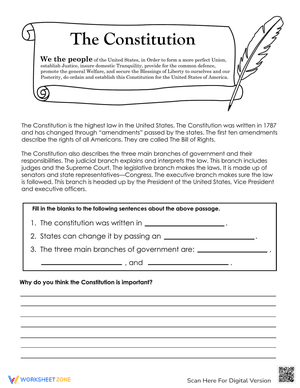
The civic calendar handles a significant portion of the scheduling. Constitution Day on September 17th carries a federal programming requirement for schools receiving federal funds, and one worksheet covers the Preamble, the Bill of Rights, and the separation of powers in enough depth to satisfy that mandate without feeling like a box-checking exercise. The week before a presidential election is another natural window: the electoral college mapping worksheets work well across Monday through Wednesday, giving students enough procedural foundation to make Thursday and Friday's discussion substantive rather than speculative.
For teachers who rely on bell-ringers, the primary source worksheets — the suffragist correspondence and the 26th Amendment debate passage in particular — work well in the first 8–10 minutes of class. They generate enough genuine disagreement to make the day's main lesson feel necessary. The mock election simulation worksheets require more deliberate scheduling: students fill out registration forms, check in at a simulated polling place, and mark a ballot on a school-based scenario. Running it properly, including setup and debrief, takes 30–35 minutes. Cutting the debrief to fit a shorter block removes most of the formative value, which is watching, in real time, which procedural steps students actually understand versus which ones they're guessing through.
Standard Alignment
The voting rights history and election mechanics worksheets align to C3 Framework standard D2.Civ.2.6-8, which asks students to explain how a rule of law protects individual rights and responsibilities. Instructionally, this standard typically appears mid-unit after students have established what rights are enumerated in the Constitution — these worksheets work best as second- or third-week resources within a government unit, not as opening activities. The primary source analysis worksheets also support D2.His.1.6-8, which asks students to analyze connections between historical developments and contemporary issues.
Across NCSS standards, the set spans Standard II (Time, Continuity, and Change) and Standard VI (Power, Authority, and Governance), both of which appear in state social studies frameworks from grades 4 through 8. Teachers in states with explicit civic literacy graduation requirements will find these alignments useful when documenting instructional coverage.
Adjusting the Set for a Range of Learners
The primary source worksheets carry the heaviest reading demand and will need the most preparation for students reading below grade level. Reading the passage aloud as a class before releasing students to independent work reduces text-decoding load and keeps the focus on the civic content itself. Providing a brief glossary of legal and historical terms — ratify, franchise, poll tax, elector — before students begin is more effective than stopping the task midway to define terms, because interruptions fragment the analytical thinking the worksheet is trying to build.
For advanced students, the electoral college data tables open into genuine mathematical extension without requiring additional materials: calculating the minimum number of electoral votes needed to win, identifying which combination of states produces the smallest viable winning coalition, or comparing electoral maps from 2000 and 2024 to analyze regional shifts. That extension work is latent in the worksheet content for students ready to pursue it.
Students who process information more slowly benefit from completing the constitutional amendment timeline worksheet before attempting any of the primary source analysis worksheets. The timeline fixes the 1870–1920–1971 reference frame in memory, which reduces working memory load when students later encounter amendment language embedded in a longer passage — the content stays accessible even when the reading level is a stretch.
Frequently Asked Questions
Do these worksheets fulfill the Constitution Day federal programming requirement?
Yes. One worksheet covers the Preamble, the Bill of Rights, and the separation of powers in enough depth to satisfy the requirement that schools receiving federal funds provide educational programming on September 17th. It works as a standalone activity or as the anchor for a longer discussion on the Constitutional Convention and the ratification debates.
How do these worksheets stay politically neutral?
The content focuses on mechanics and history — voter registration steps, electoral college structure, amendment texts, civic holiday origins — rather than candidates, parties, or current legislation. Using political voting civic holidays and occasions worksheets in the weeks surrounding an actual election is practical precisely because the material stays procedural, which also means it generates far less parent concern than topical election content typically does. Mock election activities use school-based scenarios rather than real ballot questions.
What grade range fits these worksheets best?
The reading level and task complexity target grades 4–8. The procedural mechanics worksheets — voter registration steps, polling place roles, ballot labeling — work well with 4th and 5th graders who are building foundational civic knowledge. The primary source analysis worksheets and the amendment history worksheets are better suited for 6th grade and up, where students have enough contextual background to handle legislative language without losing the thread of the task.
Do I need to assign them in a particular sequence?
No fixed sequence is required, but the amendment history worksheets land better after students have a working understanding of what the Constitution is and why amendments exist. Starting with the election mechanics worksheets and the civic holiday context worksheets, then moving to voting rights history, follows the same gradual release logic that most government units already use — procedural knowledge first, then historical analysis once students have a frame to attach it to.















 Interactive Worksheet Maker
 Quiz Maker
 Word Search Maker
 Crossword Puzzle Maker
 Word Scramble Generator
 Sentence Scramble Generator
 Handwriting Worksheet Generator
 Name Tracing Generator
 Fill In The Blank Generator