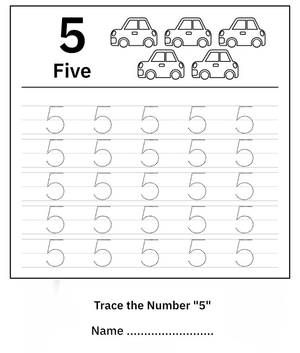
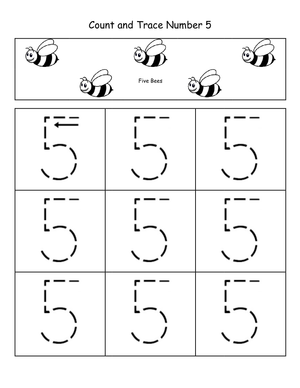
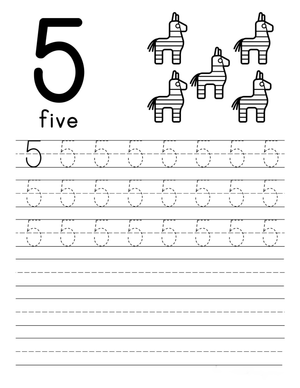
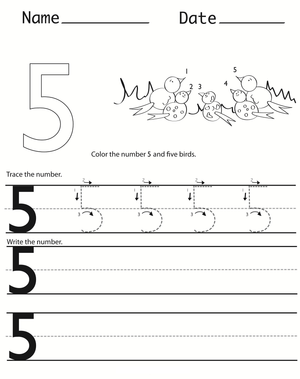
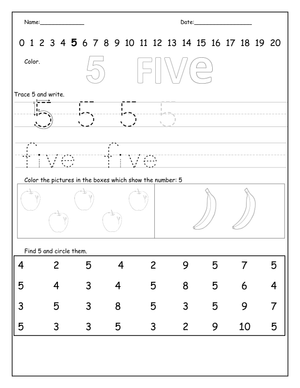
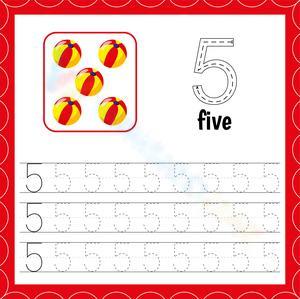
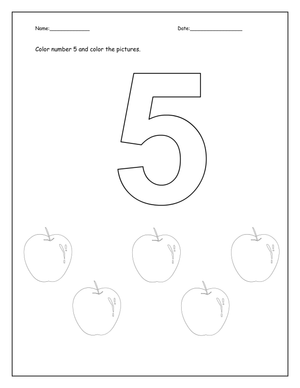
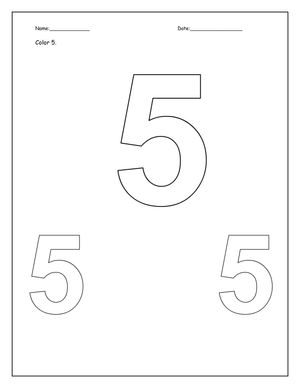
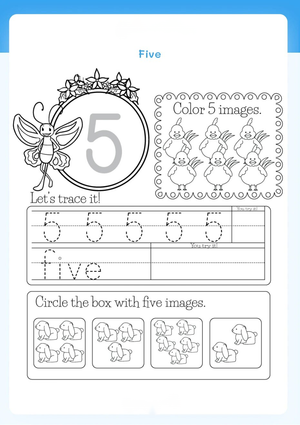
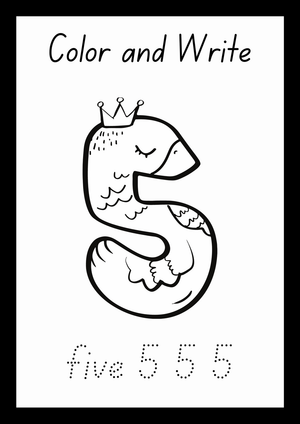
These trace number 5 worksheets give PreK and kindergarten teachers a focused tool for one of the trickier numeral formations young students encounter — a shape that demands a lift, a curve, and a flat cap across the top, all in deliberate sequence. Each worksheet pairs directional arrows with dotted stroke paths so students have the scaffolding they need whether a teacher is right beside them or working with another group across the room.
Why the Number 5 Specifically Trips Students Up
Most single-digit numerals ask children to do one thing consistently: curve, or go straight. The number 5 asks for both, plus a pencil lift in the middle. That mid-stroke lift is developmentally harder than it sounds at ages 4 and 5, when hand-eye coordination is still maturing and working memory is taxed by something as simple as "remember to stop here." What we see in student work, repeatedly, is a looping stroke that connects the belly back to the top line without lifting — producing something that reads more like a stylized S than a legible five. Once that habit sets, it takes weeks to undo.
The correct sequence — vertical drop from the top, curve right into the belly, lift, then draw the cap across — is counterintuitive for children who want continuity in their strokes. These worksheets teach the formation in three visually distinct steps, with a clear starting dot and numbered arrows at each stage. The cap step is treated as its own discrete movement rather than an afterthought, because that's exactly where the error lives.
Skills These Worksheets Build
Tracing practice at this level is about more than pencil grip. Each worksheet builds several skills at once, and it helps to know which one you're targeting on a given day:
- Stroke sequence and directionality: Students follow numbered arrows to learn start point, direction, and stroke order — the same orientation awareness that later governs left-to-right reading and multi-digit number writing.
- Pencil pressure and line control: Dotted paths give students a target without locking them in. Staying on the dots requires the kind of fine motor calibration that gross motor warm-ups alone can't develop.
- Symbol-quantity connection: Several worksheets pair the tracing lines with five countable objects — dots, stars, animals — reinforcing that the written numeral represents an actual amount, not just a shape to copy.
- Transition to independent writing: Later worksheets in the set fade the dotted support and offer blank primary lines, so students practice recalling the formation from memory rather than simply following a trail.
- Pencil lift awareness: Because the number 5 requires stopping mid-formation, students practice the deliberate pause that also shows up in letters like F, E, and T.
Standard Alignment
These worksheets support CCSS.MATH.CONTENT.K.CC.A.3, which asks kindergartners to write numbers from 0 to 20 to represent a quantity. In classroom terms, that standard shows up long before students are writing independently — it begins with guided tracing like this, moves through faded-support practice, and culminates in unassisted numeral writing by mid-to-late kindergarten. The fine motor component also aligns with foundational writing readiness expectations in most state PreK standards, which address pencil control and stroke formation as precursors to both literacy and numeracy work.
How to Work These Worksheets Into Your Lesson Plans
Morning arrival is the lowest-friction slot for tracing practice. A single worksheet face-up on the desk gives students something to do during the 6–8 minutes you're handling attendance and home-folder collection. Because the task is visually self-explanatory, students start without instruction, and you can circulate quickly to redirect grip or stroke direction before the day begins in earnest.
Math centers are the other natural home for this set. A laminated copy of one of the tracing worksheets inside a dry-erase sleeve, with a fine-tip marker, turns a consumable into a reusable station activity. The slicker surface is actually easier for students with limited hand strength — less friction means the marker glides, and the ability to wipe and retry removes the anxiety of permanent errors. Before introducing pencil-on-paper tracing to a student who's still shaky, run them through the laminated version for a few sessions first.
If you teach a Friday review block or a Monday warm-up after a long weekend, these worksheets also work as low-stakes reactivation. Formation skills erode over breaks faster than most teachers expect, and five minutes of tracing on a Monday morning rebuilds the muscle memory before you move into counting, number writing, or any activity where a recognizable 5 matters.
Mistakes Students Make That These Worksheets Help You Catch
The S-loop error described earlier is the most common, but not the only one. A second frequent problem: students draw the cap line first, from left to right across the top, then attempt to add the body below it. This produces a formation that can look passable in isolation but creates havoc with muscle memory because the motor sequence doesn't match standard formation — and students who learn it this way tend to slow down noticeably when writing numbers quickly in later grades.
A third error worth watching: the belly curves left instead of right, giving the number a backwards orientation. This is distinct from a simple reversal; the student has the stroke sequence roughly correct but has mirrored the curve. Worksheets with a prominent directional arrow at the belly stage — specifically an arrow curving clockwise, not just a dot — address this directly. If you see this error consistently in one student's work, have them trace their finger along the arrow before picking up the pencil. The kinesthetic loop helps where visual cues alone don't stick.
Frequently Asked Questions
What's the correct stroke order for writing the number 5?
Start at the top dot, pull a straight line down to the midpoint, then curve right and around to close the belly — without lifting the pencil. Lift, return to the starting dot, then draw a straight line to the right for the cap. Three steps, one pencil lift in the middle. The lift is the part students most often skip, and the arrow cues on these worksheets mark it explicitly.
My student keeps making the number look like an S. What helps?
That S-shape almost always means the student is connecting the belly back up to the cap line without lifting. Slow the stroke down and isolate the lift with a verbal cue before the cap — something like "stop, pick up, now hat." The tactile approach works well here too: have the student use two separate finger taps on the table before and after the lift, making the pause a physical action before it becomes an internalized habit.
How many times should a student trace the number before practicing independently?
There's no universal threshold, but three to five guided traces with correct formation is typically enough to attempt independent writing on the same sitting. What matters more than repetition count is quality: one clean, correctly sequenced trace builds better muscle memory than five rushed ones. If a student's tracing is consistently off-path or out of sequence, additional tracing won't fix it — a teacher-modeled demonstration with a think-aloud will do more.
At what age should a child write the number 5 without any dotted support?
Most children reach independent numeral writing during their kindergarten year, typically between ages 5 and 6. Fine motor development varies considerably, and some students still benefit from light scaffolding into first grade without that being a concern. The better marker than age is whether the student can reproduce the formation from memory with consistent directionality — that's the functional goal these worksheets are building toward.













 Interactive Worksheet Maker
 Quiz Maker
 Word Search Maker
 Crossword Puzzle Maker
 Word Scramble Generator
 Sentence Scramble Generator
 Handwriting Worksheet Generator
 Name Tracing Generator
 Fill In The Blank Generator