


























Views
Downloads
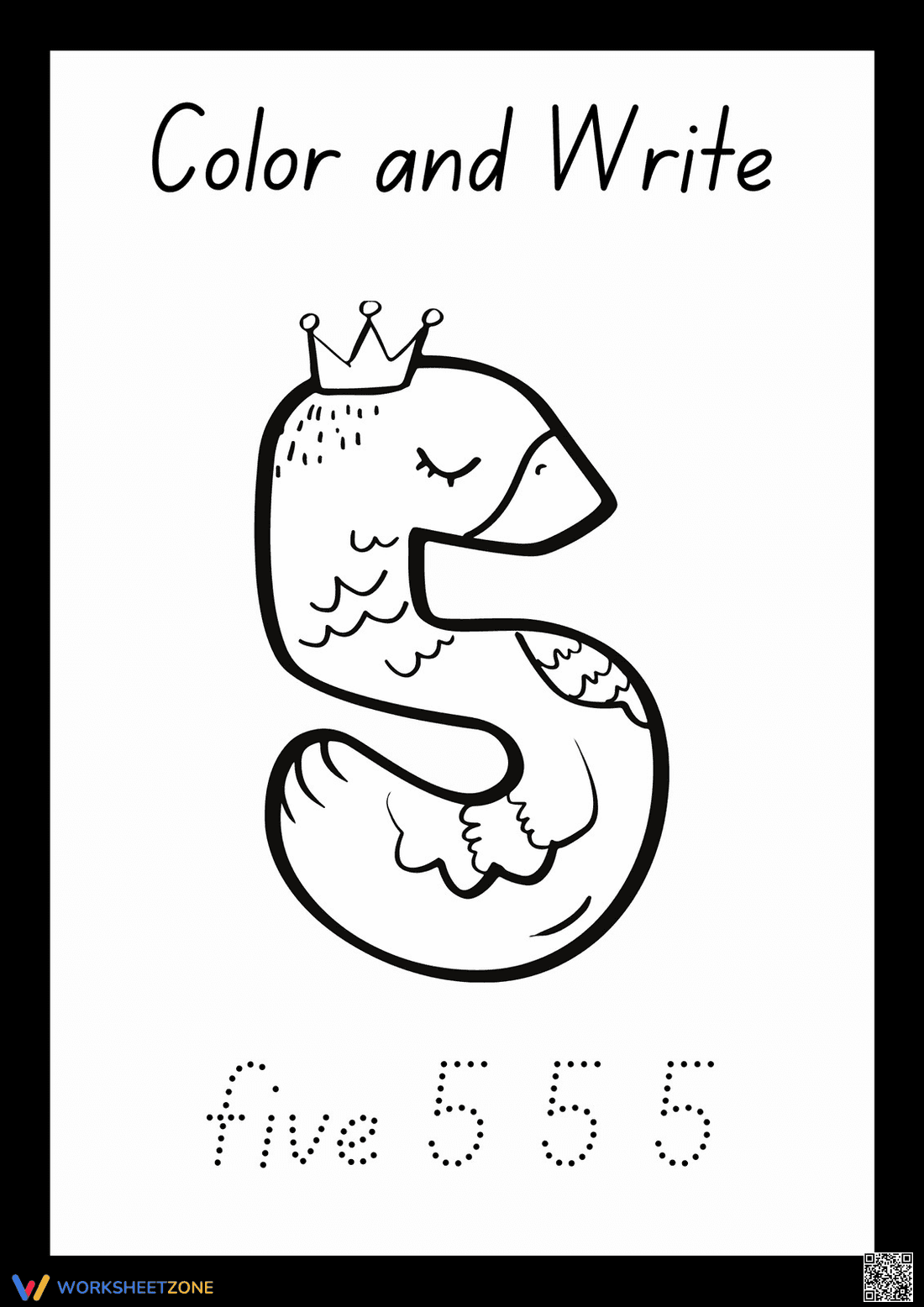

Printable Number Five Worksheet for Kindergarten
Paste this activity's link or code into your existing LMS (Google Classroom, Canvas, Teams, Schoology, Moodle, etc.).
Students can open and work on the activity right away, with no student login required.
You'll still be able to track student progress and results from your teacher account.
This kindergarten number recognition worksheet helps early learners master the number five through integrated fine motor practice. Students build foundational math skills by identifying, coloring, and tracing both the numeral and the written word. This resource ensures young learners connect the abstract concept of a quantity with its written representation.
At a Glance
- Grade: Kindergarten · Subject: Mathematics
- Standard:
CCSS.MATH.CONTENT.K.CC.A.3— Write numbers from 0 to 20 and represent quantities.- Skill Focus: Number 5 formation and recognition
- Format: 1 page · 5 tasks · Visual scaffolds · PDF
- Best For: Independent morning work or math centers
- Time: 10–15 minutes
Inside this printable resource, you will find a single-page activity designed for immediate classroom deployment. The top half features a large, stylized number five shaped like a whimsical animal with a crown, providing an engaging coloring canvas that reinforces shape recognition. The bottom half contains four precise tracing targets: one for the word "five" and three for the numeral "5", utilizing clear dotted lines to guide proper pencil stroke order.
This worksheet optimizes classroom efficiency with a zero-prep workflow that takes less than two minutes of teacher preparation. First, print the single-page PDF directly from your computer. Second, distribute the sheets along with crayons and pencils to your students. Third, review the completed work visually as students finish tracing. This straightforward structure makes the activity an excellent option for emergency sub plans or quiet transition periods.
This activity aligns directly with the Common Core State Standards for Kindergarten Mathematics. Specifically, it supports `CCSS.MATH.CONTENT.K.CC.A.3`, which requires students to write numbers from 0 to 20 and represent a number of objects with a written numeral. By combining visual art with handwriting practice, the worksheet reinforces the connection between numerals and lexical number names. Both standard codes can be copied directly into lesson plans, IEP goals, or district curriculum mapping tools.
Incorporate this worksheet during the independent practice portion of your direct instruction lesson on counting. It functions perfectly as a formative assessment tool; teachers can observe pencil grip and stroke direction while students trace the dotted lines. Expect a completion time of 10 to 15 minutes, making it ideal for a quiet desk activity following a whole-group counting circle.
This resource is tailored for kindergarten students, preschool transitions, and occupational therapy settings requiring fine motor reinforcement. It offers natural differentiation, allowing emerging writers to focus purely on coloring while advanced students complete the tracing elements independently. Pair this worksheet with a physical counting collection or a number line anchor chart to maximize conceptual understanding.
According to research from Fisher & Frey (2014) on the gradual release of responsibility, structured tactile activities like tracing provide essential scaffolding for early childhood writing development. This worksheet targets `CCSS.MATH.CONTENT.K.CC.A.3` by isolating the number five, allowing students to build muscle memory and cognitive recognition simultaneously. By integrating a creative coloring component with explicit handwriting paths, the material addresses multiple learning modalities without overwhelming young minds. Early math interventions that combine numeral formation with word recognition have been shown to improve long-term mathematical fluency and readiness for first-grade operations. Teachers can confidently utilize this resource to gather reliable observational data on fine motor control and early numeracy benchmarks, ensuring all students achieve foundational mastery before moving to complex counting sequences.


