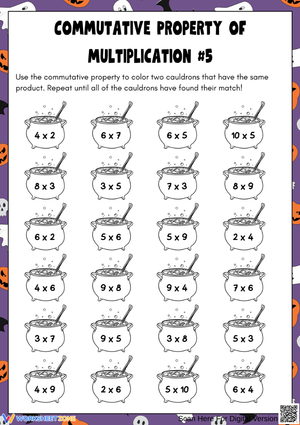
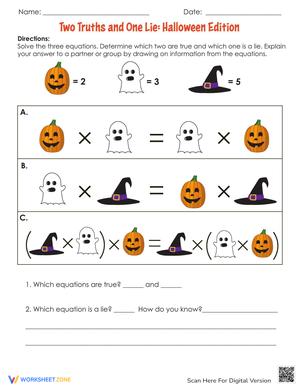
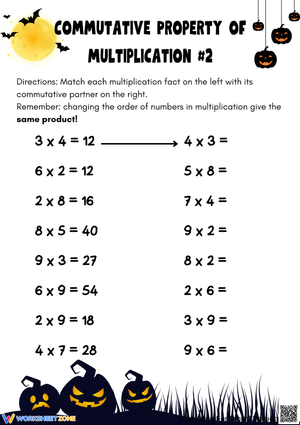
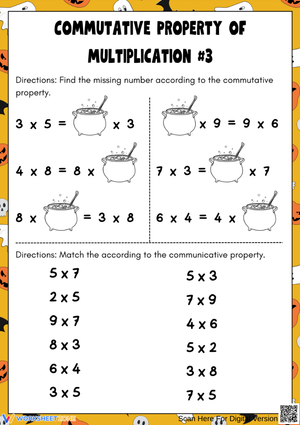
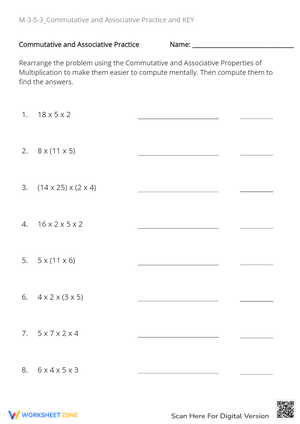
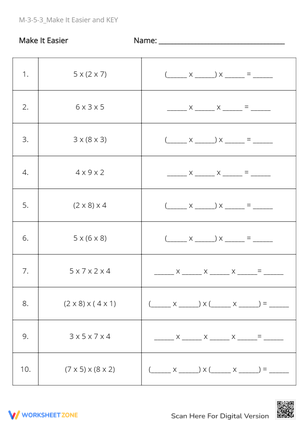
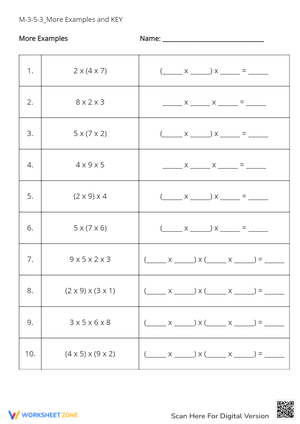
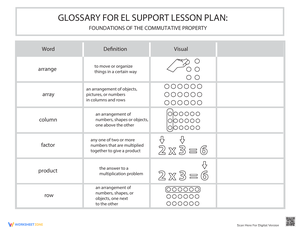
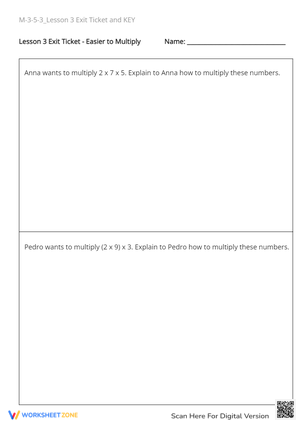
These commutative multiplication worksheets give third-grade teachers a structured set of practice materials for one of the most instructionally powerful properties students encounter in early multiplication — the idea that 7 × 8 and 8 × 7 are the same fact, not two different ones. Each worksheet isolates a specific skill so teachers can assign them in sequence, use them across different parts of the instructional block, or pull individual worksheets to target exactly what a class needs on a given day.
What's Inside the Set
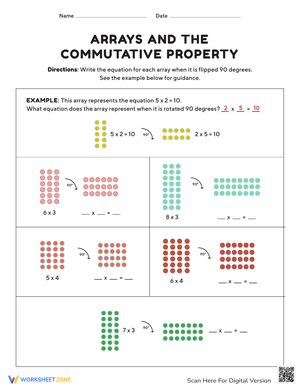
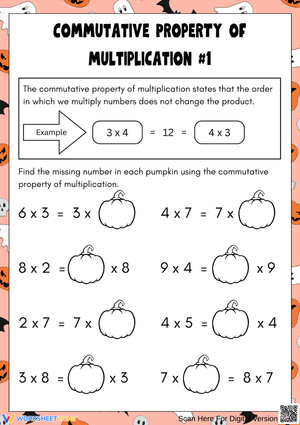
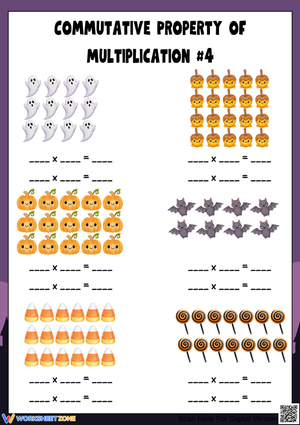
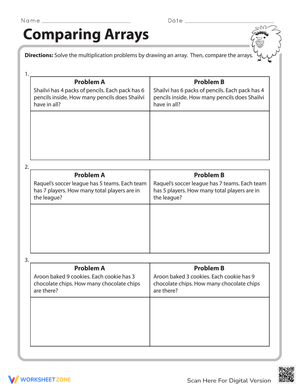
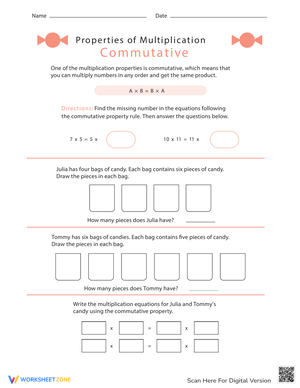
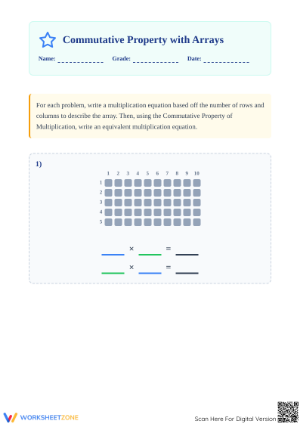
The worksheets move through the commutative property from visual grounding to symbolic fluency. Early worksheets use array rotation: students are shown a 3 × 4 grid and asked to draw the 4 × 3 version alongside it, then write both equations beneath. The act of drawing — rather than just observing — makes the equivalence register in a way that watching a teacher model it on a whiteboard does not. Later worksheets shift to missing-factor equations where students complete statements like 5 × 6 = ___ × 5, which is deliberately early algebraic thinking at the 3rd-grade level. Cut-and-paste matching exercises pair equivalent expressions (9 × 2 with 2 × 9) for use at centers. A final group of worksheets frames the property in word problems — three bags of five markers versus five bags of three markers — so students connect the symbolic rule to grouped quantities in the real world.
Why Array Work Belongs at the Front of This Sequence
Third graders are still reasoning concretely. When a student sees 6 × 4 = 24 and 4 × 6 = 24 written as equations, many accept it as a rule without understanding why it holds. The array is the proof. A 6-row, 4-column grid and a 4-row, 6-column grid contain the same number of cells — students can count and verify, not just take a teacher's word for it. That verification is what converts a memorized rule into a genuine mathematical insight.
Rotating the paper is a more effective physical demonstration than it sounds. When students turn their array worksheet 90 degrees and see the row count and column count swap while the total stays fixed, they are observing a spatial invariant — a concept that will reappear in area, coordinate geometry, and matrix operations later in their math education. The commutative multiplication worksheets in this set use array drawing as the entry point precisely because it keeps the reasoning visible and checkable.
Mistakes Students Make That These Worksheets Help You Catch
The most instructive error pattern is what might be called factor-order dependency: students correctly identify that 4 × 7 = 28 but write 7 × 4 = 21, apparently recalling a different multiplication fact rather than applying the property. This reveals that they are treating the two equations as unrelated items in memory. The array rotation exercises surface this quickly — if a student draws the rotated array correctly but writes a different product under it, the disconnect between visual understanding and symbolic retrieval is obvious and easy to address in a brief one-on-one conversation.
A second error shows up in the missing-factor worksheets. When students see 6 × ___ = ___ × 6, they sometimes fill both blanks with 6, treating it as a pattern-matching task ("both sides look the same, so both blanks are the same number") rather than reading it as an equation to be completed with a chosen factor. A targeted follow-up question — "what would happen if the missing number were 3?" — usually gets them back on track faster than re-explaining the property.
Fitting These Worksheets Into the Instructional Week
The array rotation worksheets work well as the closing activity on the day multiplication arrays are introduced — students have just built or sketched arrays during the lesson, and the worksheet consolidates that work while it is fresh. The missing-factor matching worksheets are well-suited to the 8–10 minutes of independent practice after a brief warm-up on subsequent days; they are short enough to complete before transitioning to a new lesson phase without feeling rushed.
The cut-and-paste matching exercises belong at a math center, not in whole-group instruction. The physical sorting slows the task down in a way that is useful for students who need more processing time, and the conversation it generates when students work in pairs — "wait, are these the same?" — mirrors exactly the reasoning the property is meant to build. The word problem worksheets are good candidates for a Friday review block when the week's new content is behind you and the goal is consolidation. Reviewing a completed missing-factor worksheet at the end of any session gives a fast read on which students have internalized the property and which still need the visual anchor of the array before working symbolically.
Adjusting These Worksheets for a Range of Learners
Students who are still building foundational fact fluency do better when the array rotation worksheets are restricted to smaller factors — 2s, 3s, and 4s — where the total is low enough to count and verify. Assigning those students a worksheet with 8 × 7 arrays before they have those facts risks turning a lesson about the commutative property into an anxiety-producing fact-recall exercise, which is a different problem entirely.
For students who grasp the property quickly, the missing-factor worksheets can be extended by asking them to write a word problem that matches a given equation pair. Writing a context that makes both 3 × 8 and 8 × 3 sensible requires considerably more thinking than filling in a blank, and it often produces interesting questions — students discover that "3 groups of 8" and "8 groups of 3" describe genuinely different physical arrangements even if the product is the same. That distinction between commutativity as a numerical fact and commutativity as a claim about real-world groupings is worth a class discussion if it comes up.
Standard Alignment
These worksheets address CCSS.MATH.CONTENT.3.OA.B.5, which requires students to apply properties of operations — including the commutative property — as strategies to multiply and divide. The standard gives the explicit example: knowing that 6 × 4 = 24 means you also know 4 × 6 = 24. The array rotation exercises directly build the understanding behind that example. The missing-factor work connects to the standard's broader intent around algebraic properties, and the word problems support 3.OA.A.1 and 3.OA.A.3 by situating multiplication in contexts involving equal groups.
Frequently Asked Questions
At what point in a multiplication unit should these worksheets be introduced?
Introduce the array rotation worksheets on or immediately after the first day students work with arrays as a multiplication model. The commutative property emerges naturally from array work, and catching it early means students build a multiplication table with roughly half the memorization burden from the start. The symbolic worksheets (missing-factor, matching) fit better in the middle or latter part of the unit, once students have enough facts to make the pattern recognizable.
Can these worksheets be used for students who already know their multiplication facts?
Yes, but the purpose shifts. For fluent students, the array rotation exercises reinforce why the property holds rather than helping them discover it. The word problem worksheets are more appropriate for extending their thinking — particularly the challenge of writing original contexts that make both orderings of a fact meaningful.
Do these worksheets address any other multiplication properties alongside the commutative property?
The set focuses on commutativity specifically. The missing-factor format does build early algebraic reasoning that connects to the commutative property in isolation, but the worksheets do not address the associative or distributive properties. Those are worth teaching separately, after students have a firm grip on commutativity, so the ideas stay distinct.
How long does a typical worksheet take to complete?
Array rotation worksheets generally take 10–15 minutes for on-grade-level students. Missing-factor and matching worksheets run shorter — closer to 8–10 minutes — and work well as warm-ups or exit tasks. The word problem worksheets take longer, especially if students are writing explanations, and are better assigned as a full practice activity than a quick check.













 Interactive Worksheet Maker
 Quiz Maker
 Word Search Maker
 Crossword Puzzle Maker
 Word Scramble Generator
 Sentence Scramble Generator
 Handwriting Worksheet Generator
 Name Tracing Generator
 Fill In The Blank Generator