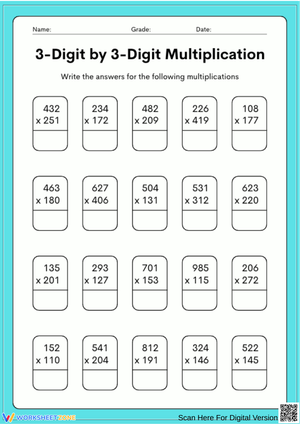
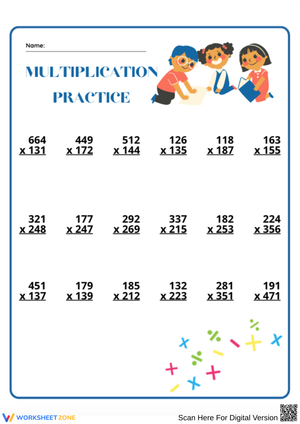
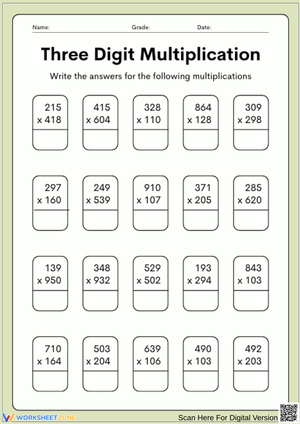
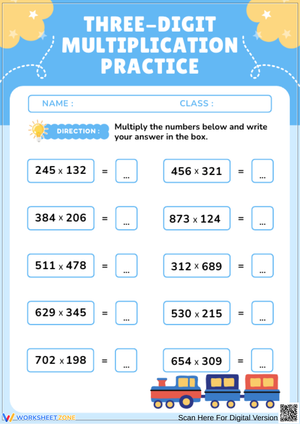
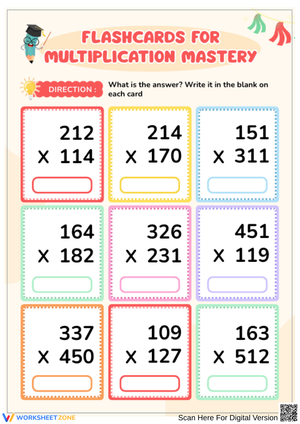
3 by 3 Printable Worksheets: Mastering Multi-Digit Multiplication in the Classroom
These multiplying 3-digit by 3-digit worksheets give students the structured repetition this skill demands — enough problems to build procedural confidence, enough variety in format to catch the specific errors that derail accuracy at this stage. The set covers the full standard algorithm, from generating three partial products to aligning and summing them correctly, and works across grades 4 through 6 depending on where your students are in the multi-digit multiplication progression.
The Specific Skills Targeted
Every worksheet in this set focuses on the standard algorithm as applied to three-digit factors. Students multiply the complete top number by each digit of the bottom number in sequence — ones place first, then tens, then hundreds — staggering each partial product one column to the left before adding all three. That staggering step is where place value understanding becomes load-bearing: students who have memorized the algorithm without internalizing why the shift happens will lose the thread the moment a problem includes a zero in the tens place of one factor.
Beyond the core procedure, the worksheets build the following skills:
- Regrouping (carrying) across multiple columns within a single partial product row, which places heavier demands on working memory than anything students encountered in 2-digit by 2-digit work
- Placeholder zeros — recognizing that a digit of zero in the bottom factor still requires a written row, just with a zero placeholder before the remaining digits
- Multi-step addition of three partial products, including regrouping in the addition phase that is distinct from regrouping during multiplication
- Spatial organization — maintaining column alignment when the workspace is unstructured
Frequent Student Errors Worth Watching For
The error that does the most damage is dropping the stagger. A student multiplies 346 by 5 (the ones digit of 452) and writes the partial product correctly. Then multiplies 346 by 5 again — this time for the tens digit — and writes that partial product directly beneath the first one, in the same column position. The two rows look neat. The addition produces a number that is off by a factor of ten, and the student has no intuition that anything went wrong because each individual multiplication was accurate. This is a different error than simply misaligning digits by one space; it reflects a gap in understanding what the tens-digit partial product represents.
Two other errors appear consistently in student work at this stage. First, when carrying during the partial product for the hundreds digit, students occasionally apply the carried value from the previous row rather than starting fresh — the regrouping from multiplying by the tens digit bleeds into their mental scratch work for the hundreds digit. Second, when one factor contains an interior zero (such as 304 × 217), students skip writing a partial product for the zero digit entirely, collapsing three rows into two and misaligning everything that follows.
Grid-format worksheets reduce the alignment errors. Carry boxes printed above the top number address the regrouping bleed. The interior-zero error requires direct instruction, but error-analysis problems — where students identify and correct a worked example containing that specific mistake — do more to cement the fix than simply assigning additional problems.
How to Build These Worksheets Into Your Lesson Plans
A focused warm-up routine worth trying: assign two problems at the start of the math block and ask students to write only the three partial products without completing the final addition. This takes about six minutes and immediately tells you whether errors originate in the multiplication phase or the addition phase — a distinction that matters for reteaching. If partial products are correct but the final answer is wrong, the lesson that day focuses on multi-column addition and carrying. If partial products are wrong, you are back to the algorithm itself.
For station rotations, distributing three worksheet formats across three stations works well: grid-format at one station for students who are still building spatial control, standard open-workspace format at a second station for students working on fluency, and word problems at a third where students set up the multiplication themselves before solving. Rotating every ten to twelve minutes keeps cognitive engagement up without letting frustration accumulate at any one station.
For homework, sending the answer key home on a separate sheet and asking students to circle every problem where their answer did not match — and bring those circled problems back — produces a much richer class discussion than collecting completed worksheets and returning them a day later. Students arrive having already noticed a discrepancy; the conversation starts closer to the actual misconception.
Adapting These Worksheets for a Range of Learners
Students who are still shaky on 2-digit by 2-digit regrouping should begin with no-regrouping 3-digit problems (something like 211 × 123) using the grid-format worksheets. The grid handles the spatial load while they internalize the three-row structure. Introduce one regrouping step at a time — first in only the ones-digit partial product, then in multiple rows — before moving to fully mixed sets.
On-level students benefit most from mixed difficulty sets that alternate regrouping and non-regrouping problems. The variation prevents the kind of procedural autopilot that produces fast but careless work, and it builds the flexibility students need when problems show up in unfamiliar formats on assessments.
For students who have the standard algorithm under control, problems with interior zeros — 305 × 470, for example — or error-analysis tasks push toward conceptual depth. Another strong extension: ask students to estimate first using rounding, then solve, then compare their estimate to the actual product and explain the difference. This connects the algorithm to number sense in a way that purely procedural practice does not.
Standard Alignment
These worksheets align to CCSS 5.NBT.B.5, which requires students to fluently multiply multi-digit whole numbers using the standard algorithm. In most instructional sequences, 3-digit by 3-digit multiplication arrives in the second half of the school year, after students have consolidated 4.NBT.B.5 work with up to four-digit by one-digit and two-digit by two-digit multiplication. Teachers in states using TEKS will find alignment to 5.3B, which similarly targets multiplication fluency with the standard algorithm as a fifth-grade expectation.
Frequently Asked Questions
At what point in the year should I introduce these worksheets?
Once students demonstrate solid accuracy on 2-digit by 2-digit multiplication — meaning they can reliably generate both partial products, stagger correctly, and add without falling apart — the three-digit by three-digit structure is a manageable next step. In a typical fifth-grade sequence this happens somewhere in the November-through-January window, though pacing varies by curriculum. Introducing it too early, before the two-row stagger is automatic, adds cognitive load that works against fluency rather than building it.
How do grid-format worksheets compare to open-workspace formats?
Grid worksheets enforce one digit per box, which eliminates most column-drift errors by removing the spatial judgment call entirely. That structure is valuable for students who are still developing spatial organization. The tradeoff is that students who rely on the grid may struggle on assessments that provide blank workspace, so it makes sense to transition them to open-format practice once their column alignment has stabilized. Think of the grid as a temporary scaffold, not a permanent format.
How many problems per worksheet is appropriate for a single session?
For practice during the main instructional block, six to eight problems gives students enough repetitions to notice their own patterns without fatigue degrading accuracy by the last few problems. For a warm-up or exit ticket, two to four problems is sufficient. Timed assessment sheets with ten to twelve problems work well for progress monitoring when you want data on both speed and accuracy over several weeks.
What should I do when a student's partial products are correct but the final answer is consistently wrong?
Separate the addition step entirely. Give the student three completed partial products — already generated, no multiplication involved — and ask them to add. If the addition falls apart, the issue is multi-column addition with carrying, and that is where reteaching belongs. Students who can add three-row numbers accurately but still produce wrong final answers are almost certainly misaligning the partial products before adding, which points back to the stagger step and benefits from returning to the grid format briefly.
Clear All