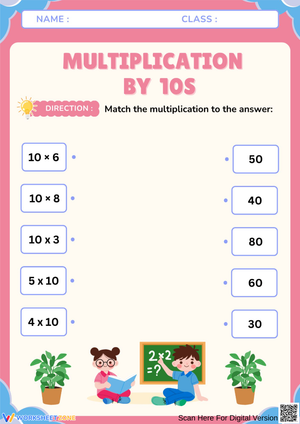
These Multiplication by 10s worksheets give third-grade teachers a structured set of practice materials covering the full range of skills students need to move from skip counting fluency into confident multiplication — missing factors, standard drills, place value connection, and applied word problems. Each worksheet stands on its own, so you can assign them sequentially across a unit or pull individual ones for warm-ups and targeted review.
What Each Worksheet Targets
The set addresses multiplying by 10 from several angles, because automaticity alone isn't the goal — students also need to understand what the operation means in place value terms. The specific skills across the worksheets include:
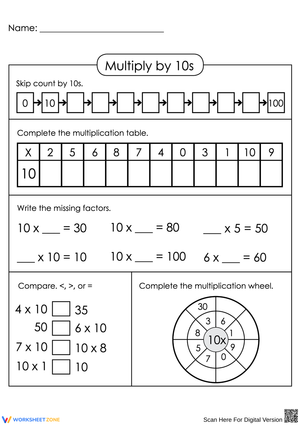
- Skip counting charts and number line work: Students fill in intervals of 10 along structured number lines, building the visual foundation before equations appear. This matters especially for students who never fully consolidated skip counting in second grade.
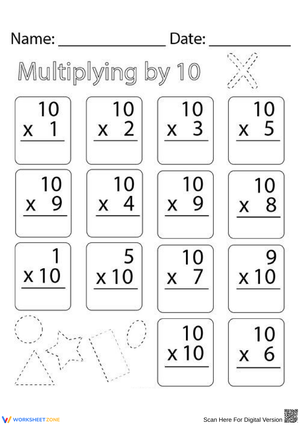
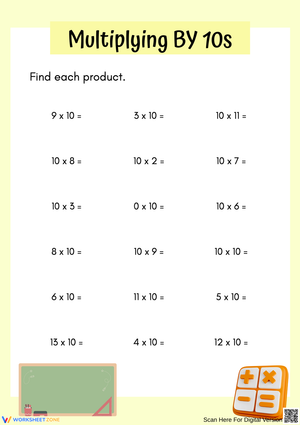
- Standard multiplication drills: Timed and untimed drill formats covering facts from 1 × 10 through 12 × 10, with enough repetition to push facts into long-term memory without drowning students in repeated identical pages.
- Missing factor problems: Equations like ___ × 10 = 70 shift the cognitive demand — students reason backward rather than just execute forward. This format is a natural precursor to division and introduces the logic of inverse operations without naming it yet.
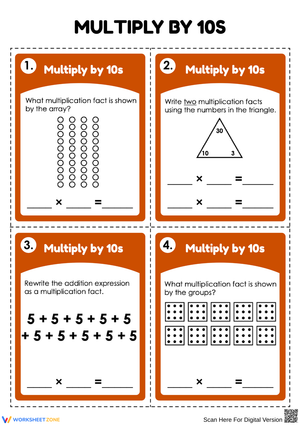
- Word problems grounded in real quantities: Scenarios involving dimes, boxes of 10 crayons, and ten-packs of juice boxes let students see why multiplying by 10 appears constantly in everyday contexts.
- Place value extension problems: A few worksheets extend the pattern to multiples of 100 and 1,000, asking students to observe what changes and what stays the same as the multiplier grows — a direct setup for later work with multi-digit multiplication.
Frequent Student Errors Worth Watching For
The most common error isn't forgetting the zero — it's applying the "add a zero" rule incorrectly to decimal numbers later, which traces back to weak place value understanding at this stage. Students who recite "just add a zero to multiply by 10" have memorized a procedure, not a principle. What this looks like in practice: a student who correctly writes 7 × 10 = 70 will later write 0.7 × 10 = 0.70 because the rule says to add a zero, not to shift the digits. That error shows up regularly in 5th grade, and its roots are here.
Missing factor problems expose a different issue. Students who struggle with ___ × 10 = 60 often do so because they can't yet hold both the answer and the operation in working memory simultaneously — they need the equation anchored in a concrete context before the abstract form makes sense. Word problems placed before the missing-factor drills reduce this friction considerably.
How to Build These Worksheets Into Your Lesson Plans
The most efficient use of these materials isn't as a stand-alone homework stack — it's as a rotating component of the math block. Use the skip counting and number line worksheets at lesson introduction, when students are still working from visual scaffolding. Move to standard drills once you've done at least one concrete lesson with base-ten blocks, where students physically exchange unit cubes for ten-rods before writing anything down. That sequence — manipulative first, worksheet second — prevents the "add a zero" rule from calcifying into meaningless procedure.
Reserve the missing factor and word problem worksheets for the middle and end of the unit, when students have enough automaticity to handle the added cognitive demand of reasoning backward or parsing a word problem context. The eight minutes before lunch or the transition block after morning meeting work well for timed drills; the longer independent work period is better suited for the word problem worksheets, which benefit from students having time to reread and sketch a quick diagram when needed.
Adjusting the Worksheets for a Range of Learners
For students who are still shaky on skip counting by 10s, pair the drill worksheets with a partially completed number line at the top of the page — they count up to locate the answer rather than retrieve it cold. This isn't a crutch so much as a bridge; most students phase it out naturally within a week once the number line confirms their answers consistently. For students already fluent with basic facts, the place value extension worksheets provide genuine challenge: ask them to write a rule that explains what would happen if you multiplied by 1,000 instead of 10, then test their rule against three examples. That kind of generalization task belongs in the same math block without requiring you to design separate enrichment materials from scratch.
Standard Alignment
These worksheets address two specific third-grade Common Core standards. 3.OA.C.7 requires fluency in multiplication and division within 100 — the drill and missing factor worksheets work directly toward that fluency target. 3.NBT.A.3 addresses multiplying one-digit whole numbers by multiples of 10 in the range of 10–90, which is the explicit content focus across most of the set. In practice, these two standards are taught together because you can't build fact fluency for 10s without simultaneously addressing what multiplying by a multiple of 10 means in place value terms. The worksheets are designed with that overlap in mind.
Frequently Asked Questions
What grade level do these worksheets fit?
Third grade is the primary target, aligned to 3.NBT.A.3. That said, the skip counting and introductory drill worksheets work well as review or acceleration materials in late second grade, and the place value extension worksheets are appropriate for fourth graders revisiting the concept before multi-digit multiplication.
How do I explain multiplying by 10 without the "add a zero" shortcut becoming a problem later?
Frame it as digit movement, not digit addition. Tell students that multiplying by 10 shifts every digit one column to the left — the ones digit moves to the tens place, and the ones place becomes empty, so a zero holds that column. Draw a place value chart and move the digits physically. Students who learn it this way handle 0.7 × 10 correctly in fifth grade; students who only memorize "add a zero" often don't.
How does skip counting connect to the multiplication facts on these worksheets?
Skip counting by 10s — 10, 20, 30, 40 — is repeated addition. The equation 4 × 10 = 40 is the same relationship written in a more compact form. Students who can already count up by 10s recognize their own answers on the drill worksheets, which makes the transition to formal multiplication notation feel logical rather than arbitrary. The number line worksheets in this set make that connection explicit before the standard equation format takes over.













 Interactive Worksheet Maker
 Quiz Maker
 Word Search Maker
 Crossword Puzzle Maker
 Word Scramble Generator
 Sentence Scramble Generator
 Handwriting Worksheet Generator
 Name Tracing Generator
 Fill In The Blank Generator