Conditional probability trips up even strong Algebra 2 students the first time it shows up on a two-way table. The notation P(A|B) looks abstract, and students often plug numbers into the wrong denominator before they understand what the question is actually asking. Conditional probability worksheets give you a structured way to slow that process down, model it visually, and build toward independent mastery before a unit test.
Where Conditional Probability Fits in the High School Sequence
Conditional probability lives in the High School Statistics and Probability domain, under the cluster Conditional Probability and the Rules of Probability. Most departments place it in Algebra 2 or a dedicated Statistics and Probability elective rather than in an earlier course, since it depends on students already being comfortable with basic probability, fractions, and reading data displays. If you are mapping out a unit, conditional probability worksheets work well as the second or third assignment in the sequence, after students have practiced simple and compound probability but before they meet the full multiplication rule.
CCSS.Math.Content.HSS.CP.B.6 defines conditional probability precisely: students must find the conditional probability of A given B as the fraction of B's outcomes that also belong to A, and then interpret that answer in context. That interpretation step is where worksheets earn their keep. A student can compute a correct fraction and still fail to explain what it means about the population being studied, so strong worksheet items always pair a calculation prompt with a short written interpretation line.
Two-Way Tables as the Entry Point
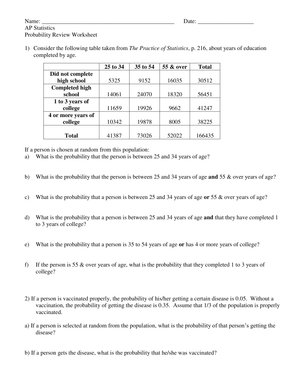
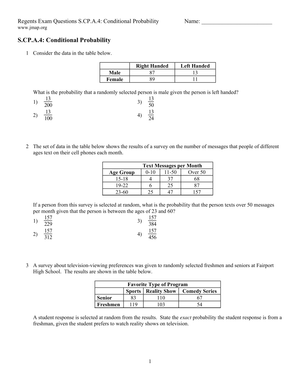
Two-way frequency tables are the most reliable way to introduce P(A|B) because they make the restricted sample space visible. When a table shows how many students play a sport and also take an art class, students can physically see that conditioning on sport narrows the group before they divide. Worksheets that start with a filled-in table and ask students to shade or circle the relevant row or column before calculating tend to produce fewer computation errors than worksheets that jump straight to formula practice.
A useful worksheet progression looks like this. First, students read values directly out of a table, no calculation required, just identifying totals and subgroups. Second, they calculate straightforward conditional probabilities from that same table. Third, they compare P(A|B) to P(B|A) using the same data set, which directly targets one of the most common misconceptions in this unit.
Tree Diagrams for Sequential Events
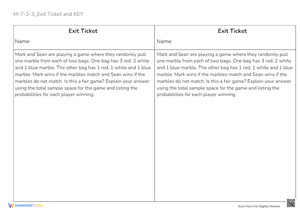
Once students are comfortable with tables, tree diagrams extend the concept to sequential events, such as drawing cards without replacement or running a two-stage experiment. Tree diagrams also set up the multiplication rule from CCSS.Math.Content.HSS.CP.B.8, since each branch probability is itself a conditional probability. Worksheets that alternate between tables and trees, rather than mastering one format completely before switching, help students recognize conditional probability as a concept rather than a table-specific trick.
Blank tree templates are worth building into your worksheet set. Give students the raw scenario in words, a deck of cards, a bag of marbles, a survey result, and have them construct the tree from scratch, labeling each branch with the correct conditional probability. This forces them to decide what is being conditioned on rather than just reading probabilities off a diagram you already built.
Classroom Implementation
For guided practice, hand out a worksheet with one fully worked example at the top, then have students work the remaining problems in pairs, checking each answer against a partner before moving on. This catches the P(A|B) versus P(B|A) mix-up early, while it is still easy to correct.
For formative assessment before a unit test, use a shorter worksheet, four to six problems, covering a table item, a tree diagram item, one independence-check item, and one item that requires a written interpretation of the result. Score it quickly for a show of hands or exit-ticket data rather than a formal grade, then reteach whichever item type the class missed most.
For differentiation in a mixed-ability classroom, keep the underlying math identical across versions but vary the scaffolding. A support version can include the two-way table pre-drawn with totals filled in, while an on-level or extension version presents the same scenario as a word problem that students must first organize into a table themselves. Real-world contexts, school survey results, weather and sports outcomes, or simple game scenarios, tend to engage students more than purely numeric bags-of-marbles setups, especially in an Algebra 2 class where students are used to seeing math connected to actual situations.
Frequently Asked Questions
1. What grade level typically covers conditional probability under Common Core?
Conditional probability falls under the High School Statistics and Probability domain, so it is generally taught in Algebra 2 or a dedicated Statistics and Probability course, grades 9 through 12, rather than in middle school.
2. What is the difference between conditional probability and independent events on a worksheet?
Conditional probability asks for P(A|B), the probability of A restricted to cases where B has already happened. Independent events are a special case where knowing B occurred does not change the probability of A, so P(A|B) equals P(A). Worksheets that include both types side by side help students tell them apart.
3. How do two-way tables help students solve conditional probability problems?
A two-way table makes the restricted sample space visible. Students can see the row or column total that matches the condition, then divide the joint count by that total, which mirrors the formal definition in CCSS.Math.Content.HSS.CP.B.6 directly.
4. What CCSS standards align with conditional probability practice?
CCSS.Math.Content.HSS.CP.B.6 covers the definition and interpretation of conditional probability, CCSS.Math.Content.HSS.CP.B.7 covers the Addition Rule, and CCSS.Math.Content.HSS.CP.B.8 covers the general Multiplication Rule, all within the High School Statistics and Probability domain.
5. How can teachers use these worksheets for review versus formal assessment?
Use longer, fully scaffolded worksheets with paired work for review and guided practice, and shorter, unscaffolded worksheets with a mix of table, tree, and interpretation items as a quick formative check before moving to a graded assessment.













 Interactive Worksheet Maker
 Quiz Maker
 Word Search Maker
 Crossword Puzzle Maker
 Word Scramble Generator
 Sentence Scramble Generator
 Handwriting Worksheet Generator
 Name Tracing Generator
 Fill In The Blank Generator