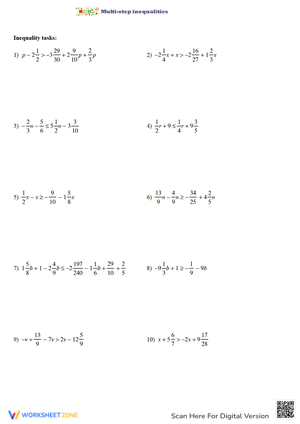
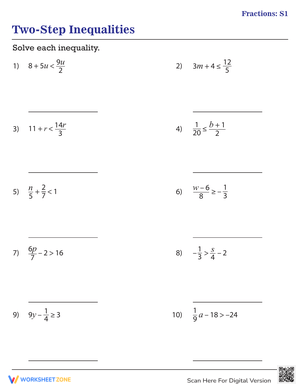
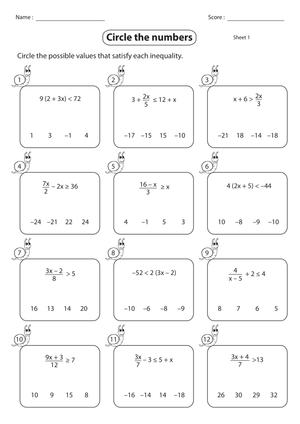
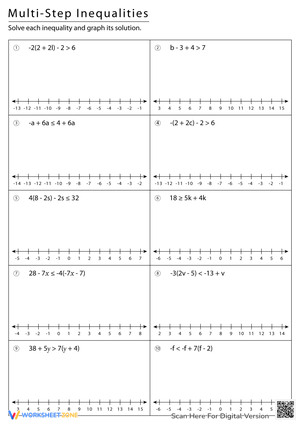
Where multi-step inequalities land in your scope and sequence
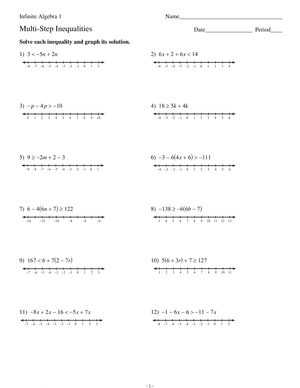
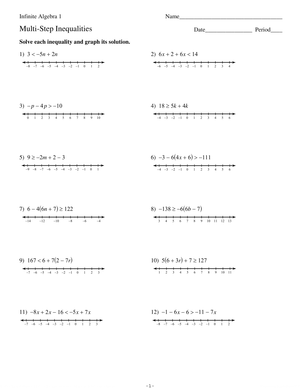
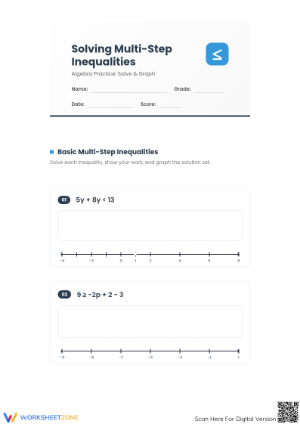
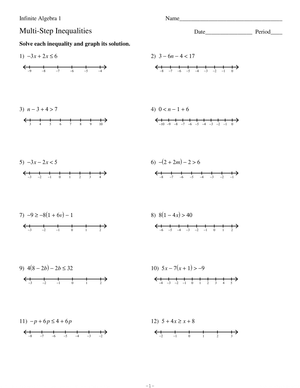
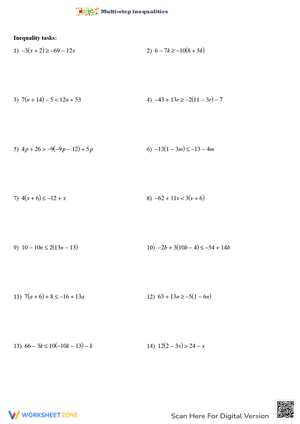
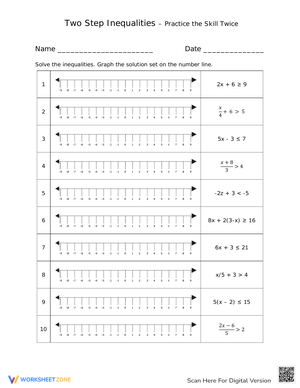
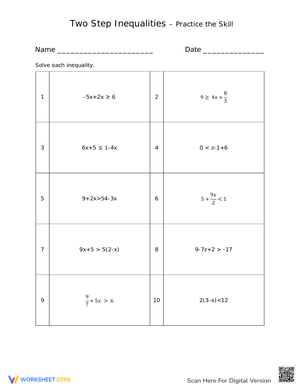
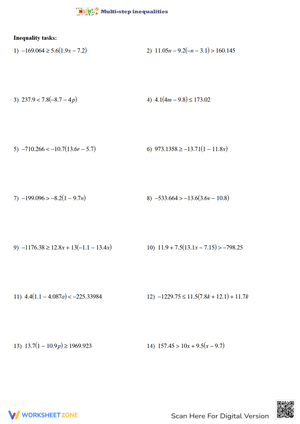
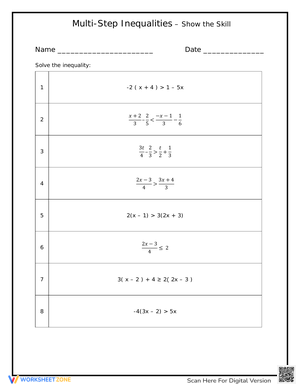
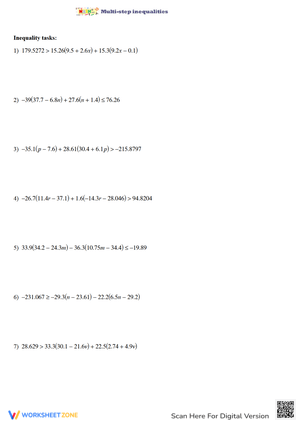
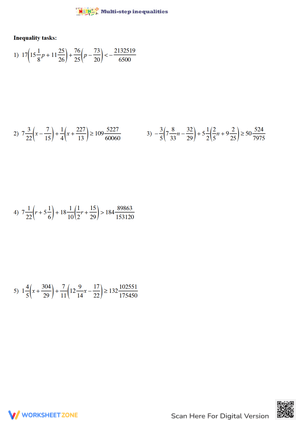
If you teach grade 7, grade 8, or Algebra 1, multi-step inequalities usually show up right after students get comfortable with two-step inequalities. The hard part isn't the inequality symbol; it's the algebra stacked in front of it. Students now have to distribute, combine like terms, and sometimes collect variables on one side before they ever isolate the variable. Strong multi step inequalities worksheets mirror that exact sequence, so the practice matches the way the skill actually builds in class.
In a typical US math progression, seventh graders meet inequalities through word problems, eighth graders solidify the procedure, and Algebra 1 students revisit it with compound and absolute-value cases. A worksheet set that respects this arc gives you material for reteaching a struggling small group and enrichment for a class that's already fluent, without you rewriting problems from scratch each period.
How these worksheets connect to the standards
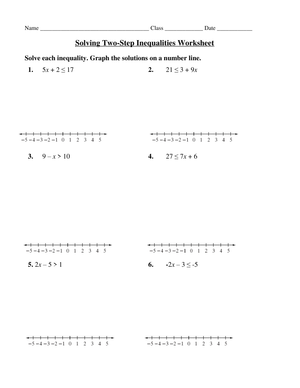
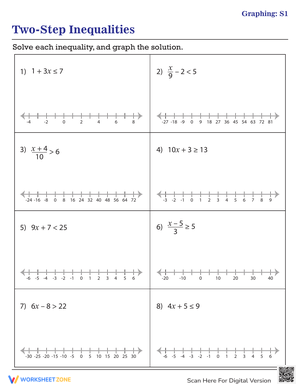
Multi-step work is a direct extension of the two-step inequality skill introduced in Grade 7. Once you know where the on-ramp is, it's easier to pick worksheets that reinforce prior learning instead of teaching a brand-new procedure.
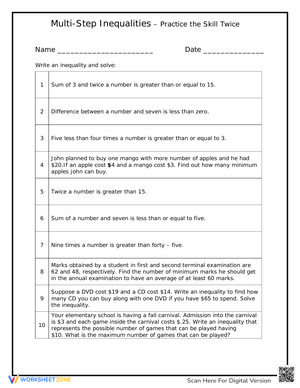
Under the Common Core State Standards, standard 7.EE.B.4.b asks seventh graders to solve word problems that lead to inequalities of the form px + q > r or px + q < r, then graph and interpret the solution set in context. That single standard is the bridge multi-step inequality worksheets extend into Algebra 1 readiness.
The practical takeaway: a multi-step problem is just that same two-step frame with extra simplification bolted on the front. When you frame worksheets that way for students, the new material feels like one more layer rather than a fresh topic.
The sign-flip error and why it dominates
Ask any middle school math teacher which mistake shows up most, and you'll hear the same answer: students forget to reverse the inequality sign when they multiply or divide both sides by a negative number. It's a procedural slip, but it changes the entire solution set, which is why it's worth attacking head-on.
Error-analysis research on solving linear inequalities documents a deeper cause underneath that slip: students frequently treat the inequality sign as if it were an equal sign, importing equation-solving habits that simply have no rule for flipping. In other words, the sign-flip mistake isn't carelessness. Students are applying a mental model that worked all year for equations, and it quietly breaks the moment a negative coefficient appears. Worksheets that isolate negative-coefficient problems in their own block force that model to surface, so you can correct the thinking rather than just re-mark the answer.
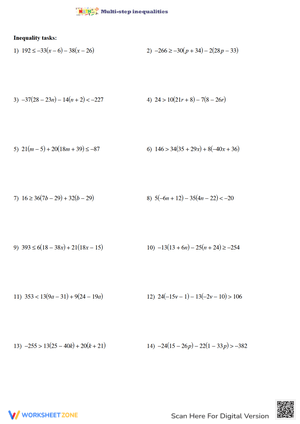
Second on the list is students rushing to the inequality symbol before they finish distributing and combining like terms. A worksheet that deliberately front-loads messy left-hand sides pushes students to simplify first and decide on direction last.
Classroom Implementation
Worksheets do the most work when they're wired into a routine instead of handed out cold. Here's a workable rotation for a 45-minute block.
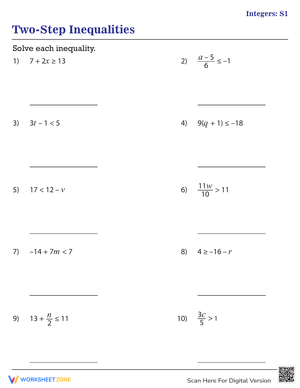
Open with three quick two-step items as a do-now to reactivate the prior skill. Then model one multi-step problem under a document camera, narrating the order: distribute, combine, isolate, and only then decide whether the sign flips. Hand the class a short worksheet where the first two problems are already half-solved so students focus on the flip decision, not the arithmetic.
Move students into pairs for the core block. Ask each pair to circle the exact step where a sign flip does or doesn't happen before they write the final answer. That single annotation turns a silent worksheet into a visible thinking record you can scan in seconds. For a class with mixed readiness, give the fluent groups the transfer word problems while you pull a small group back to the negative-coefficient block for guided reteaching. Close with an exit item that includes one negative coefficient, so your fastest formative signal lands before students leave the room.
Frequently asked questions
1. What grade level typically learns multi-step inequalities?
Most US students meet multi-step inequalities in grade 8 or early Algebra 1, after grade 7 introduces two-step inequalities through word problems. The skill is a natural extension of that seventh-grade work rather than a separate topic.
2. What is the most common mistake students make?
By far the most frequent error is forgetting to reverse the inequality sign when multiplying or dividing both sides by a negative number. Research points to a root cause: students treat the inequality sign like an equal sign and apply equation habits that lack a flip rule.
3. How are these different from two-step inequality worksheets?
Two-step worksheets ask students to undo two operations to isolate the variable. Multi-step worksheets add distribution and combining like terms before that isolation begins, and they often place variables on both sides, so students must simplify first and decide direction last.
4. How can teachers use these worksheets for intervention or reteaching?
Use a short set that isolates negative-coefficient problems and holds everything else constant, so the sign-flip rule stands out. Ask students to annotate the step where the sign flips, which turns the worksheet into a fast diagnostic for small-group reteaching.
5. Do multi-step inequality worksheets need to include graphing on a number line?
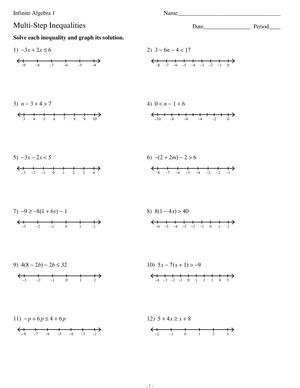
Graphing isn't required on every sheet, but it strongly supports the standards' emphasis on interpreting a solution set in context. Pairing a few problems with number-line graphing helps students see that a solution is a range of values, not a single answer.













 Interactive Worksheet Maker
 Quiz Maker
 Word Search Maker
 Crossword Puzzle Maker
 Word Scramble Generator
 Sentence Scramble Generator
 Handwriting Worksheet Generator
 Name Tracing Generator
 Fill In The Blank Generator