Shamrock Worksheets PDF for Kindergarten
These shamrock worksheets for kindergarten give teachers a set of March-ready printables that double as legitimate skill practice — counting, tracing, letter work, and patterning tasks built around a single recognizable symbol. Each worksheet carries one focused objective, which is the design decision that makes them usable across morning work, centers, and take-home folders without extra preparation.
What's Inside the Set
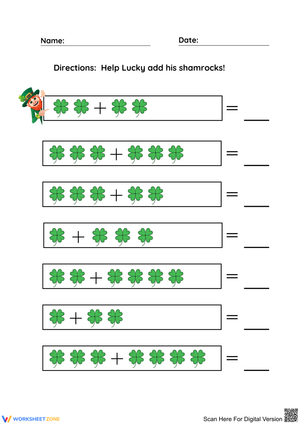
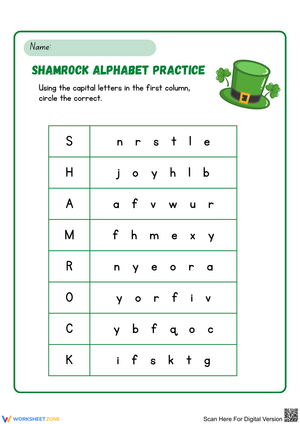
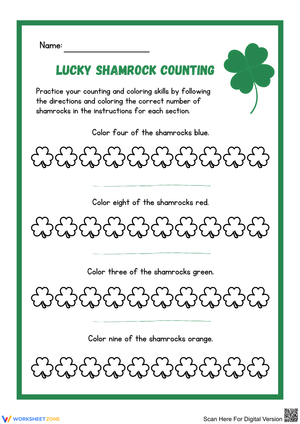
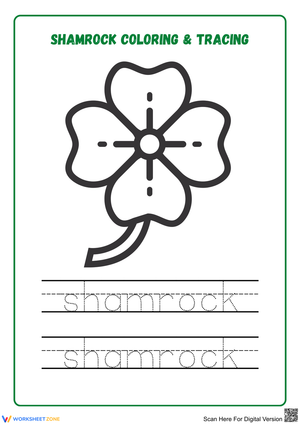
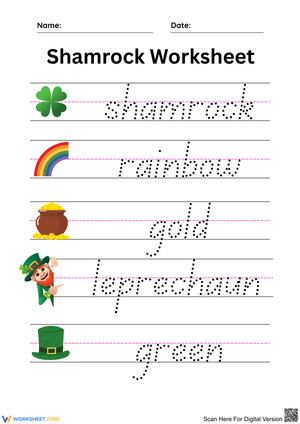
The worksheets target skills that kindergartners are actively building in late winter and early spring. Across the set, students count shamrock images and circle a matching numeral, trace shamrock outlines along bold guided paths, fill ten frames using shamrock counters, extend AB and AAB patterns, and locate a target letter or sight word printed inside shamrock shapes. One worksheet pairs a large shamrock image with a brief teacher-delivered fact — that the shamrock is a symbol connected with Ireland — and a simple coloring response, giving teachers a low-lift entry point for a social studies thread without building a full holiday unit around it.
Each worksheet holds to a single task. There is no mixed-skill layout that asks a five-year-old to count, write, and cut on the same page. That restraint is what makes the set work in a room where attention spans run short and directions need to land after one modeled example.
Standard Alignment
The counting and quantity worksheets address CCSS.MATH.CONTENT.K.CC.B.4 (understanding the relationship between numbers and quantities) and K.CC.B.5 (counting to answer "how many?" questions). Kindergarten teachers are typically introducing these standards in the fall and consolidating them through spring practice, so March shamrock counting pages land squarely in the spaced retrieval phase — students have seen the concepts before and are building fluency rather than encountering them fresh.
Pattern work connects to many state-level kindergarten math standards under algebraic thinking prerequisites, though CCSS does not explicitly code patterning at this grade. Letter recognition and sight word tasks on the literacy worksheets align with CCSS.ELA-LITERACY.RF.K.1 and RF.K.3, depending on how the worksheet structures the response. The fine motor tracing pages don't carry a standard code on their own, but fine motor readiness supports writing-standard progress across the year.
Frequent Student Errors Worth Watching For
On counting worksheets, the most consistent error is double-counting the last item or skipping an item near the center of an array. Students who count aloud correctly will still write the wrong numeral because they haven't yet stabilized the link between the spoken sequence and the written symbol — they finish counting at seven, feel done, and write a six because that's the numeral they're most confident drawing. Watching for that specific disconnect is more useful than marking the answer wrong and moving on.
On pattern worksheets, students who can verbally identify an AB pattern will sometimes break it on paper by repeating the color they just used. The hand follows habit rather than logic. Asking students to point to each element and say the pattern aloud before they color catches this more reliably than checking finished work.
Fine motor tracing pages surface a different issue: students with weaker grip strength press hard to compensate, tearing thin paper or losing the path on curves. If this shows up in your group, a brief warm-up — finger tracing the outline before picking up the pencil — takes thirty seconds and reduces frustration noticeably.
Building These Worksheets Into Your Lesson Plans
The most efficient use is morning work during the transition block after students arrive and before the whole-group lesson starts. A shamrock counting or tracing page on the desk gives students an immediate, familiar task. The setup is visual enough that it doesn't require a verbal reminder from the teacher, which matters during those first eight minutes when attendance, lunch count, and small-group check-ins are all happening at once.
For centers, one worksheet per station works well without additional supplies. A counting page runs with a small cup of manipulatives; a tracing page runs with a single crayon. Keeping it that simple reduces setup time to under two minutes per rotation. The pattern worksheets translate easily to a partner task — one student calls the pattern aloud while the other fills it in — which adds a brief oral-language layer without requiring extra materials.
Sub plans in March are a legitimate use case worth planning for. A set of three shamrock worksheets with one-line visual directions is a complete 20-minute block that any adult can run without content knowledge. Print a grayscale copy, clip a short note about which students need modified line weight or extra time, and it's ready to go.
Adjusting the Worksheets for a Range of Learners
For students who are ahead of the counting benchmarks, extend the task without replacing the worksheet: ask them to write the numeral, draw one more shamrock to make a new total, and record the new number. That sequence adds two steps to a page they can otherwise finish in three minutes, and the extension stays within the same shamrock context rather than switching materials.
For students still working on numeral recognition, cover the answer choices on a match worksheet and let them respond with a stamp or a sticker on the matching quantity instead. The counting task stays intact; the numeral-writing demand comes off. You can also pair these students with an oral response during small group and use the worksheet as a visual anchor rather than a recording sheet.
The tracing worksheets accommodate students with fine motor delays by printing at 110–115% scale. The broader lines make the path more forgiving, and the larger shamrock shape gives more room for crayon work. This takes one print setting change and doesn't require a separate file.
Frequently Asked Questions
Do these worksheets require colored printing?
No. Every worksheet in the set is designed to print clearly in grayscale. Students add color as part of the task, so the starting image needs only clear lines and contrast — both of which hold up on a black-and-white copy.
How much teacher support do kindergartners need to complete these independently?
Most students need one modeled example before working independently. If the class is early in the year and hasn't established worksheet routines yet, a brief whole-group walkthrough of the first item handles most confusion. By mid-spring, the format recognition alone gets many students started without a model.
Can these be used for students who aren't celebrating St. Patrick's Day?
Yes. The worksheets treat the shamrock as a cultural symbol associated with Ireland rather than as a religious or holiday object. A single teacher-led sentence — "The shamrock is a symbol people connect with Ireland" — is the extent of the cultural content, and the skill practice on each worksheet stands entirely on its own.
Are the worksheets appropriate for a mixed-ability kindergarten class?
The set includes enough range that different students can work on different worksheets within the same March unit. Early finishers can move to a more demanding counting or pattern task; students still building foundational skills can stay on tracing and basic quantity recognition. Because each worksheet has one clear task, differentiation is mostly a matter of which page you hand each student.
Clear All