Kindergarten Leprechaun Printable PDF Worksheets
These kindergarten leprechaun worksheets give teachers a ready-to-print March set that keeps early learning goals front and center — counting, tracing, matching, beginning sounds — while the leprechaun theme handles the seasonal interest. The pages are designed for kindergartners to begin independently after a brief model, which makes them practical for morning tubs, centers, and sub-plan folders alike.
What's Inside the Set
Each worksheet targets a skill kindergartners are already building in March, with leprechaun imagery swapped in where another printable might use apples or snowflakes. The set includes:
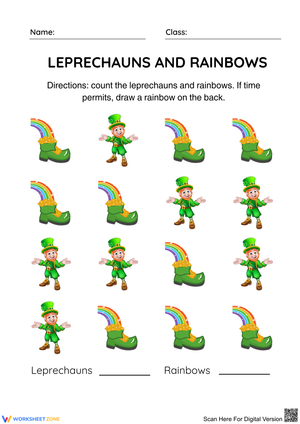
- Counting and number recognition: Students count gold coins, hats, or shamrock clusters and circle or write the matching numeral — a structure familiar enough that most kids can begin without repeated directions.
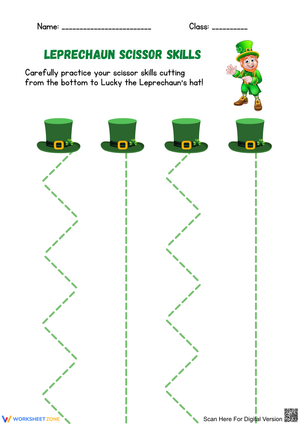
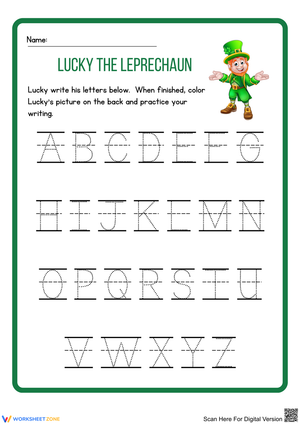
- Tracing practice: Wide tracing paths follow lines, curves, and basic letter forms. The paths are sized for the hand control kindergartners have in late winter, not the finer motor control expected by spring.
- Visual matching: Students draw lines between identical leprechaun images or match a picture to its shadow, building the visual discrimination that underlies both reading and early math sorting tasks.
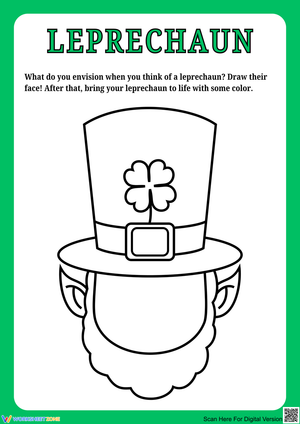
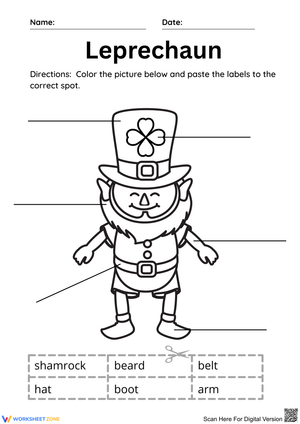
- Coloring pages with embedded directions: These double as listening comprehension — "color the hat green, color the buckle yellow" — and work well as a settling activity before a transition.
- Beginning-sound and letter tasks: Students circle pictures that start with a target sound or identify a given letter among a group of symbols. One worksheet focuses on the letter L, tying the leprechaun image directly to the phonics target.
Standard Alignment
The counting and number-recognition worksheets align with CCSS.MATH.CONTENT.K.CC.B.4, which addresses understanding the relationship between numbers and quantities and connecting counting to cardinality. That standard is in active instruction across most of the school year in kindergarten, which is one reason seasonal counting pages slot in without disrupting the pacing guide — teachers are already there.
The beginning-sound and letter-identification worksheets connect to CCSS.ELA-LITERACY.RF.K.3, the foundational skills standard covering knowledge of the alphabetic principle. By March, kindergartners in most programs have worked through the majority of the alphabet; a leprechaun-themed letter page fits as reinforcement rather than initial instruction, which makes it well-suited for center rotation rather than direct instruction time.
Mistakes Students Make That These Worksheets Help You Catch
The counting pages tend to surface one persistent error: students count the same image twice when objects are scattered rather than arranged in a line. A child who correctly counts five coins in a row will miscount the same five coins when they're spread across the page. This isn't carelessness — it's a one-to-one correspondence issue that shows up in authentic work all the time. Watch for students who hover a finger without actually touching the image, or who count audibly but skip back to a coin they've already tagged. The worksheet gives you a clean window into who has stabilized this concept and who hasn't.
On the letter-identification worksheet, students frequently mark a lowercase b or d when asked to circle the letter L. The vertical line with an angled exit confuses students who are still mapping letter names to forms — especially when the surrounding distractors include other tall letters. That error pattern is worth a quick pull-aside conversation rather than a whole-class correction.
Building These Worksheets Into Your March Lesson Plans
Sort the set by independence level before the week starts. The coloring page and picture-matching worksheet require the least support and can live in a morning tub or early-finisher bin without any introduction. The counting and letter worksheets benefit from a two-minute whole-group model first — put the page under the document camera, count one example aloud together, then send students to work.
One move that takes less than ninety seconds: before handing out any worksheet, hold up the page and name what students see. "What do you notice? Where have you seen decorations like this?" That brief exchange gives the theme a small anchor in students' actual experience — community celebrations, classroom décor, library books — rather than leaving the leprechaun as a random image on a page. It also surfaces vocabulary (hat, buckle, gold, shamrock) that supports the literacy tasks.
For sub plans, pull the matching and coloring worksheets. They carry visual directions that a substitute can reinforce with a pointed finger rather than a lengthy explanation. For Monday morning work after a weekend, the counting worksheet reactivates number concepts without requiring any oral setup.
Adjusting the Worksheets for a Range of Learners
Students who are still developing pencil control do better if the tracing worksheet is placed inside a dry-erase sleeve. They can practice the path multiple times without burning through paper, and the repetition is more useful to their development than a single completed page.
For students working ahead of grade-level expectations, extend the counting worksheet by asking them to write an addition sentence below their circled answer — "3 + 2 = 5 coins" — rather than just recording the total. That takes thirty seconds to explain and turns a recognition task into an early composition task.
Students who are English language learners benefit from a quick picture walk before independent work. Point to each image and say the word once. The worksheet tasks don't require English production, but knowing the names of the objects helps students confirm they're looking at the right item during matching and counting work.
Frequently Asked Questions
Are these worksheets designed for printing in black and white?
Yes. The leprechaun images are drawn with clean outlines and enough interior detail that they read clearly in grayscale. Color versions work for display or take-home, but the pages were built with copier use in mind. A full class set prints without the ink-bleed issues that plague heavily shaded holiday printables.
Can these be used in a center without a teacher present?
The matching and coloring worksheets are the easiest to run independently — students can interpret the task from the visual layout alone. The counting and letter worksheets benefit from a quick model before students rotate in, but once they've seen the format once, most kindergartners can complete subsequent worksheets in the same style without further support.
Is there a social studies connection, or are these purely skill-based?
The skill practice is the primary function, but there's a light social studies thread available if you want it. Leprechauns appear in storytelling traditions associated with St. Patrick's Day, which some communities mark with green decorations, parades, and classroom activities. A brief, factual framing — "some communities celebrate this holiday and use these symbols in their decorations" — gives the theme a community-and-culture anchor that's age-appropriate for kindergarten social studies without turning the math worksheet into a mythology lesson.
What if some students finish quickly and others are still working?
The coloring worksheet is the natural extension page — students who finish a counting or tracing task can move to it without any additional directions from the teacher. Keeping it face-down at the table from the start prevents the "I'm done, what do I do?" interruption mid-rotation.
Clear All