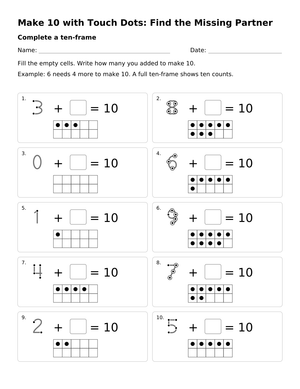
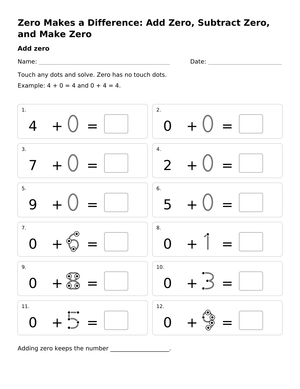
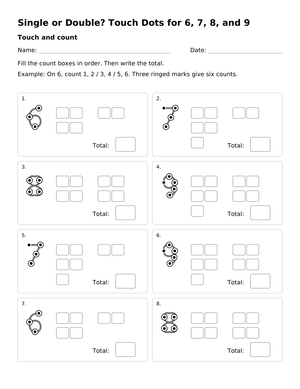
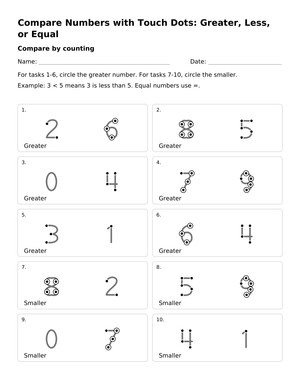
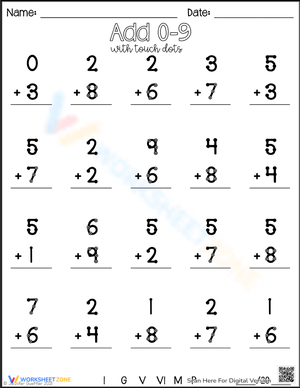
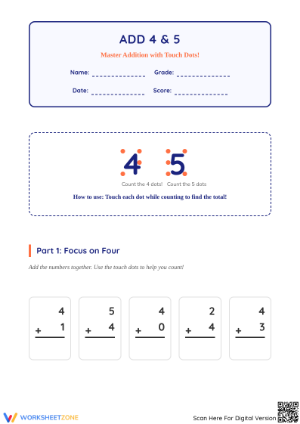
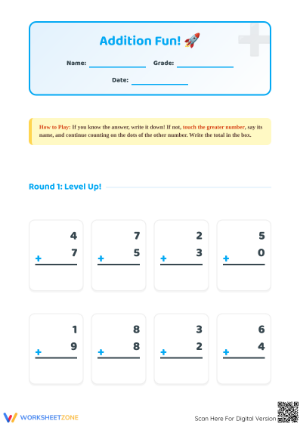
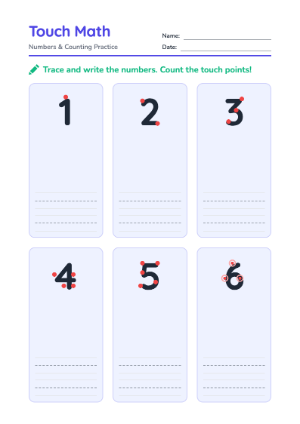
These kindergarten touch math printable worksheets give students a physical, repeatable counting strategy built directly into the numerals themselves — the kind of concrete support early learners need before mental math is anywhere close to realistic. The set moves from number recognition and touchpoint tracing through single-digit addition and beginning subtraction, covering the full developmental arc of kindergarten number sense without skipping ahead of where five-year-olds actually are.
How the Touchpoint System Works
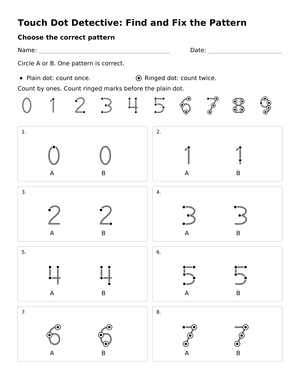
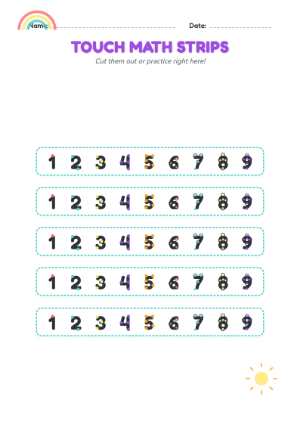
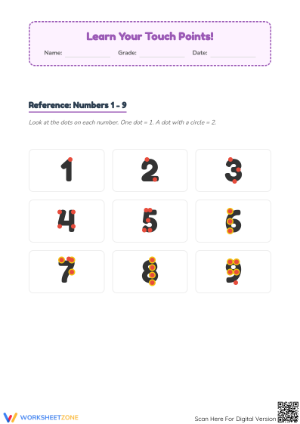
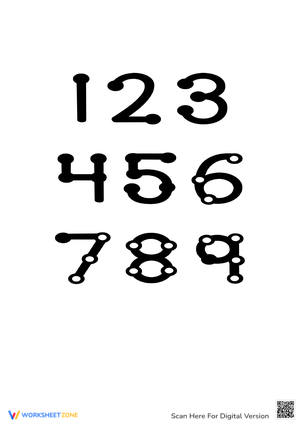
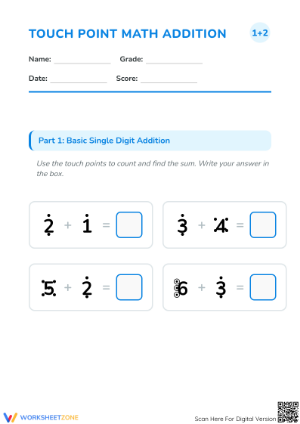
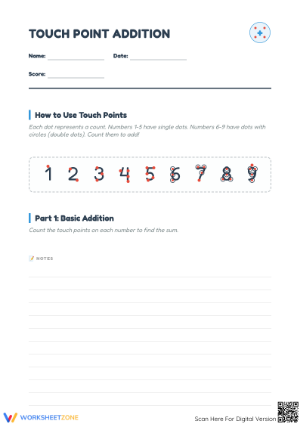
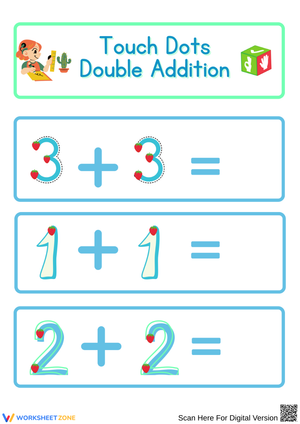
Each numeral from 1 through 9 carries dots placed at fixed, consistent locations on the digit. Numerals 1 through 5 each hold single touchpoints equal to their value — the 3, for instance, has one dot at the top curve, one at the middle, and one at the bottom. Numerals 6 through 9 use double touchpoints: a dot with a circle around it, which students touch and count twice. This keeps the dots manageable without crowding the numeral while still representing larger values accurately. The placement never changes, which means students who memorize the sequence can eventually stop looking at the printed marks and start computing from memory — the goal the whole system builds toward.
The Specific Skills Targeted
The worksheets address four skill areas in sequence, matching the steps most kindergarteners move through between early fall and spring.
- Numeral tracing with touchpoints marked: Students trace digits that already show touchpoint placement, building muscle memory for exactly where each dot sits. This matters because later addition tasks require students to recall dot position without a reference chart nearby.
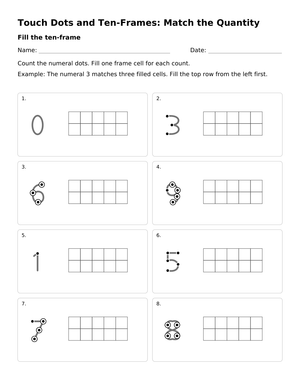
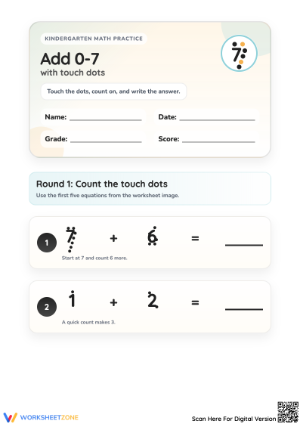
- Counting and recording quantities: Students look at a numeral with touchpoints, touch each dot while counting aloud, and write the quantity. This reinforces one-to-one correspondence — the core kindergarten counting skill — while connecting the written symbol to a countable set in a way that abstract numerals alone do not.
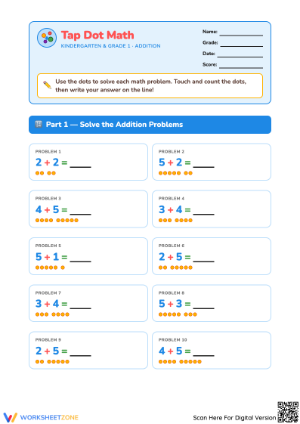
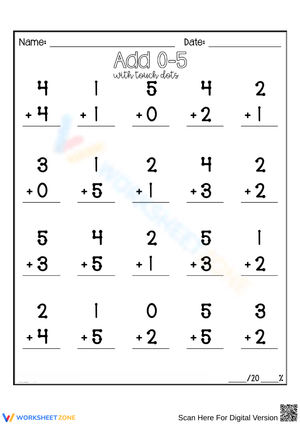
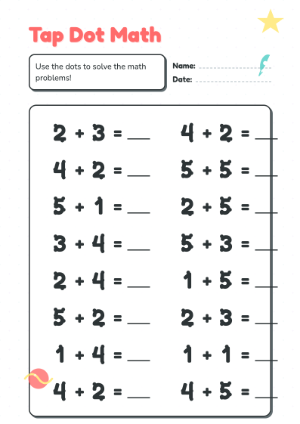
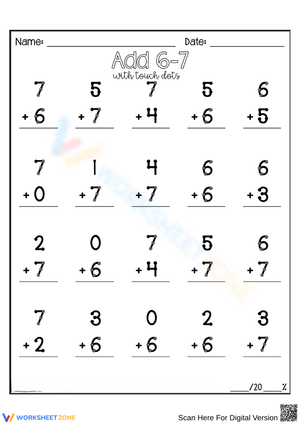
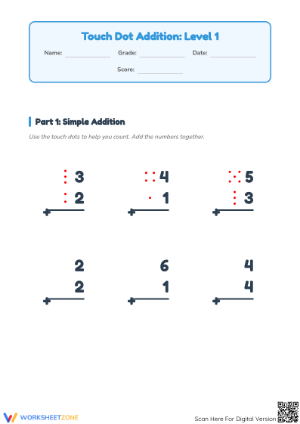
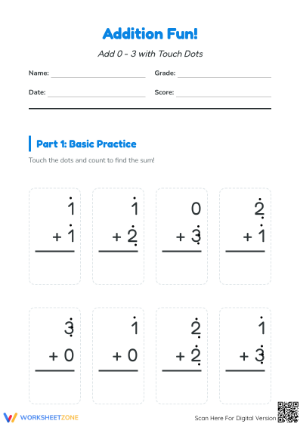
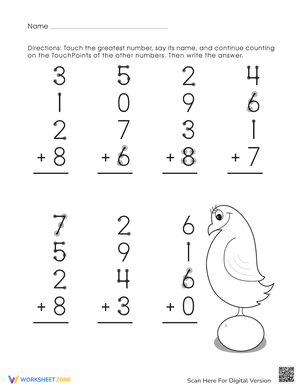
- Single-digit addition within 10: Students touch the points on the first addend, note where the count lands, then continue counting through the second addend's points. Adding 4 and 3 means touching the four points on the 4 and arriving at four, then continuing across the 3's touchpoints — five, six, seven.
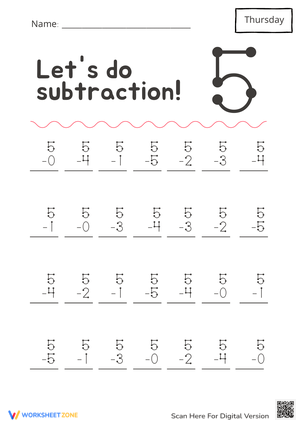
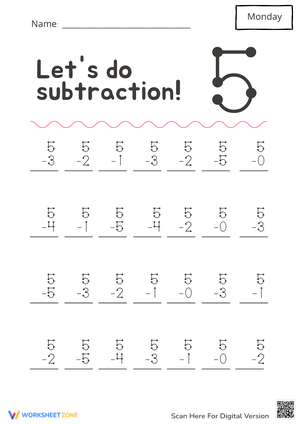
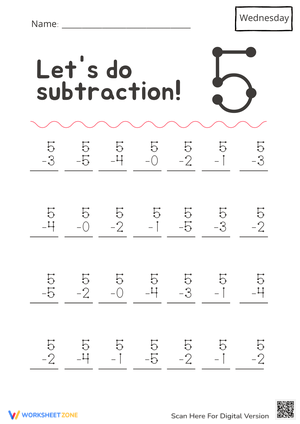
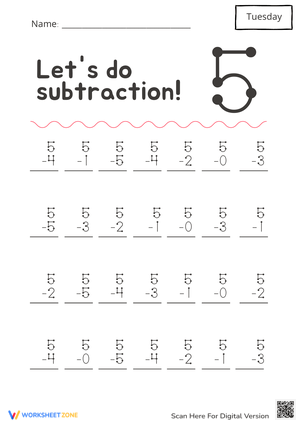
- Introductory subtraction: Students start at the larger numeral, use the smaller numeral's touchpoints to count backward, and record the difference. This turns a concept that trips up many early learners into a step-by-step physical routine with a reliable outcome every time.
Common Student Errors Worth Watching For
The most persistent mistake in early touchpoint work is not forgetting to touch — it's touching out of order. Students who memorize approximate dot locations but not their sequence will recount the same point twice or skip one, landing on an answer that's off by one. On the 8, where four double touchpoints are distributed across two loops, a student who drifts from the standard sequence will consistently get 9 or 7 instead. The worksheets reveal this immediately: the recorded answers will be systematically close but wrong in a predictable direction. That pattern tells you the student understands the concept but needs to slow down and rebuild the sequence, not relearn the entire system from scratch.
A separate error shows up during addition. Students accurately count the first addend, then restart at one when they move to the second numeral rather than continuing the count forward. So 4 + 3 becomes two isolated counts — one, two, three, four; one, two, three — and the student writes 3 as the answer. This is not a touchpoint problem; it's a "count on" problem. Catching it during guided practice, before students work through an entire independent worksheet, saves a lot of relearning later.
Building These Worksheets Into Your Week
Introduction works best in short daily sessions rather than one long block. Spend the first week on teacher modeling alone — display one numeral at a time on the board with touchpoints marked, touch each dot with a pointer, and count aloud while students watch. Then bring the tracing worksheets in as a five-minute morning warm-up after attendance and morning meeting while students are still settling. By week two, most kindergarteners can locate the dots on numerals 1 through 5 without looking at a reference chart.
Once addition worksheets enter the rotation, the two minutes before students transition to lunch or a special is a natural slot. The problems finish quickly, and the low-stakes timing keeps anxiety down for students still working to internalize the process. Many teachers use kindergarten touch math printable worksheets as math center work after whole-group introduction, which lets them pull a small group for targeted practice while the rest of the class continues independently. That timing also makes it easy to use the recording sheet as a quick formative check — a glance at the answers tells you who has the sequence and who does not.
Adapting the Set for a Range of Learners
For students who pick up the system quickly, the adjustment is straightforward: fade the printed dots. Give them worksheets where touchpoints appear on some numerals but not others, then move to worksheets with no printed marks at all. The goal is for these students to visualize dot positions from memory — the first step toward mental computation. Students who reach this stage by mid-year are often ready to apply the same counting-on logic to facts above 10.
Students who need more time — including those with IEPs or 504 accommodations addressing math processing — benefit from keeping the dots fully visible and adding a tactile layer: touching each printed dot with a crayon tip before writing the count. That physical contact makes the mark functional rather than decorative. Kindergarten touch math printable worksheets also work well for English Language Learners because the strategy is nearly language-free at the counting stage. A student still acquiring English can touch, count, and record without needing to decode vocabulary-heavy directions or rely on oral explanation from a peer.
Standard Alignment
These worksheets address kindergarten standards across two domains. In Counting and Cardinality (K.CC), the tracing and counting activities support K.CC.B.4 — understanding that the last number named in a count sequence tells how many objects were counted — and K.CC.B.5, counting objects to answer "how many" questions up to 20. The touchpoint method operationalizes one-to-one correspondence directly on the numeral, which is a concrete application of what those standards describe in classroom terms.
In Operations and Algebraic Thinking (K.OA), the addition and subtraction work addresses K.OA.A.1, representing addition and subtraction using objects, fingers, and drawings, and K.OA.A.2, solving addition and subtraction problems within 10. Touchpoint counting qualifies explicitly as a "strategy" under K.OA.A.1, which means kindergarten touch math printable worksheets function as standards-aligned supplemental practice — not an add-on outside grade-level scope.
Frequently Asked Questions
How long does it take kindergarteners to learn the touchpoint placements?
Most students can locate and count touchpoints on numerals 1 through 5 within a week of daily exposure. Numerals 6 through 9 take longer — the double touchpoints require students to distinguish the circled dots and remember to count each one twice. Expect two to three weeks before the majority of the class works independently on addition worksheets. Students with stronger working memory get there faster; students who need repetition may take a full month. Neither pace is a concern at this age, and the worksheets make the difference visible without requiring a separate assessment.
Do these worksheets work alongside a district-mandated math curriculum?
They do. The touchpoint system is a counting strategy, not a curriculum replacement — it layers onto whatever core program your school uses for number sense and early operations. Teachers in districts with mandated materials typically use the worksheets as center work, morning warm-ups, or small-group practice rather than as whole-class primary instruction. Because the skills addressed map directly to K.CC and K.OA standards, there is no conflict with what the core curriculum also covers.
What should I do with students who already know their addition facts?
Use these worksheets briefly as a diagnostic, not as ongoing practice. If a student can reliably recall 4 + 3 = 7 without counting, touchpoint counting offers little new learning — and asking fluent students to work through dot-counting steps for answers they already hold in memory tends to frustrate them quickly. Reserve these worksheets for students still building counting strategies, and move students with fact fluency to work that challenges rather than slows them down.













 Interactive Worksheet Maker
 Quiz Maker
 Word Search Maker
 Crossword Puzzle Maker
 Word Scramble Generator
 Sentence Scramble Generator
 Handwriting Worksheet Generator
 Name Tracing Generator
 Fill In The Blank Generator