Kindergarten One to One Correspondence PDF Worksheets for Early Counting Practice
These kindergarten one to one correspondence pdf worksheets give teachers print-and-go counting practice in the formats early learners need most — matching, circling, coloring, and ten-frame tasks built around sets of concrete objects. The skill they target, tagging exactly one spoken number to each item in a set without skipping or double-counting, is what all later number sense work depends on. Without that reliable match, a child's count is unstable even when the number sequence itself is memorized.
What One-to-One Correspondence Actually Requires
Many kindergarteners can recite "one, two, three, four, five" without hesitation. What they can't always do is coordinate that spoken sequence with the physical act of pointing to each object once. The correspondence has to be built — it doesn't come from knowing the count words.
The classic error looks like this: a child points to a row of five counters while saying number words, but the spoken sequence runs slightly faster than the hand. The finger touches four objects; the mouth says "five." The child announces "five" with complete confidence and moves on. That mismatch — a timing gap between voice and gesture — is what early counting practice needs to close. It doesn't resolve through more number-word drilling. It resolves through repetition of the touch-one, say-one, move-on sequence until the two actions lock together.
There's also a cardinality piece layered on top. Once students can match word to object accurately, they still need to understand that the last number spoken names the total for the whole set — not just the label for the last item touched. Teachers often hear students recount a set from scratch after being asked "how many?" That's a signal that cardinality practice belongs alongside correspondence work, not after it.
The Counting Tasks Across the Set
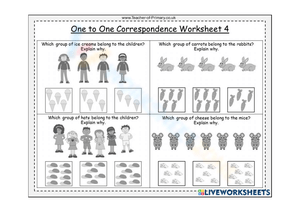
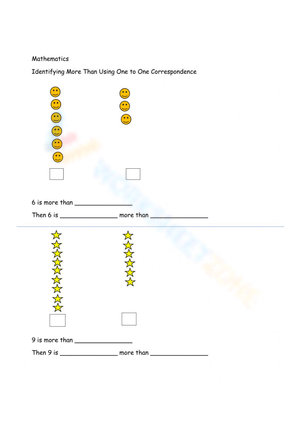
Each worksheet focuses on one task type so students aren't juggling a new format and a new counting challenge at the same time. The set covers the following task structures:
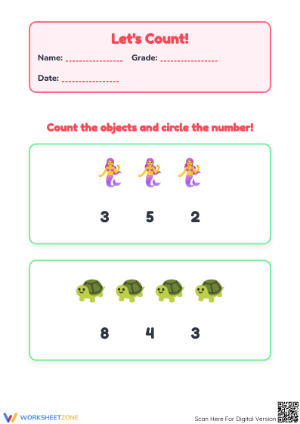
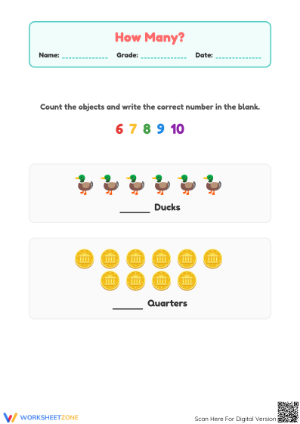
- Count and circle: Students count a group of pictured objects and circle the matching numeral from a short answer row.
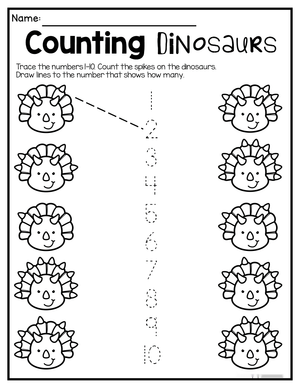
- Count and match: Students draw a line from a picture set to the numeral that shows how many.
- Count and color: Students count a picture group and color only that many objects in a second set — which requires tracking their own stopping point.
- Ten-frame counting: Students count dots arranged in a ten-frame, an organized format that helps students hold their place without losing track mid-count.
- Cut and paste: Students cut a numeral and paste it next to the matching set, slowing the task down enough to reduce impulsive guessing.
Sets begin at quantities of 2 and build toward 10. Worksheets that use scattered object arrangements are harder than those using rows or ten-frames — not because the numbers are larger, but because students must manage their own tracking without an organized layout to anchor them.
Mistakes Students Make That These Worksheets Surface
Two errors appear in early kindergarten counting more reliably than any others. The first is double-counting: a student touches one object, says a number, then touches it again on the return sweep across the row. The second is skipping — moving the finger past an object while the spoken count keeps pace, so that item never receives a number name. Both errors are invisible if you only look at the circled answer. You catch them by watching the hand.
A third pattern shows up specifically on worksheets that use scattered, non-linear arrangements. Students who count a physical row of blocks accurately will sometimes lose their place on a worksheet where objects are spread across open space with no obvious starting point. If a child's answers seem random despite solid oral counting, set the worksheet aside and have them count the same quantity with physical objects. That comparison shows whether the issue is correspondence or page navigation — and those two problems call for different responses.
The kindergarten one to one correspondence pdf worksheets in this set are built to make these errors visible rather than hide them. Students who are double-counting or skipping will often circle answers that are off by exactly one in either direction — a clean diagnostic pattern that teachers can track across a few worksheets without any separate assessment tool.
Building These Worksheets Into Your Daily Math Block
Short, consistent use beats long irregular sessions for this skill. A few focused minutes — one worksheet at the start of a math block, or during the ten minutes before specials — does more than a full worksheet period once a week. The routine itself is part of what students are learning.
- Morning work: A count-and-circle worksheet gives students something concrete to do while attendance and lunch count happen. The visual format needs almost no verbal direction.
- Small groups: Sit close enough to watch hands while students work through a single worksheet. Two minutes of observation here tells you more than reviewing a full class set of finished papers.
- Math centers: Pair a counting worksheet with a small cup of counters. Students build each set physically before circling an answer, which reinforces the touch-count routine and reduces random guessing.
- Intervention folders: Keep two or three familiar worksheet formats available for students who need repeated exposure. When the format is already known, students spend their attention on counting rather than reading directions.
- Sub plans: The count-and-circle and count-and-match formats are easy for a substitute to explain and easy for students to complete with minimal clarification.
These kindergarten one to one correspondence pdf worksheets also work as quick formative checks. After a counting lesson, distribute one and circulate — you're not grading, you're watching for the two or three students who need a different next step. The worksheet is the prompt; your observation during those four minutes is the actual assessment.
Adjusting the Set for Different Learners in the Same Room
The most useful adjustment for students still learning the routine is reducing the set size and choosing worksheets with organized rows rather than scattered arrays. A student who loses track in a group of 8 scattered pictures often counts a row of 4 objects without trouble. That's not about the number — it's about how much visual management the layout demands. Structured arrangements give those students a fighting chance before you introduce the harder formats.
For students ready to move past sets of 5, count-and-color worksheets with quantities up to 10 are a natural next step. The cut-and-paste options add a small motor component that naturally slows impulsive counters. Students who have the correspondence routine solid can be asked to write the numeral themselves instead of selecting from a provided answer, which adds numeral formation practice without changing the counting task.
One honest limitation worth naming: the cut-and-paste worksheets require scissors, glue, and some fine motor control. When those materials create friction — and with some kindergarteners they absolutely do — students focus on cutting straight rather than counting carefully. In those situations, the count-and-circle or count-and-match formats get better results. The cutting isn't the point; the counting is.
Standard Alignment
These worksheets align to CCSS K.CC.B.4, which addresses understanding the relationship between numbers and quantities by connecting counting to cardinality. More specifically, K.CC.B.4a requires that students, when counting objects, pair each object with exactly one number name and each number name with exactly one object — which is the precise behavior these worksheets practice and make observable.
K.CC.B.4 sits within the Counting and Cardinality domain, the foundational strand that supports Operations and Algebraic Thinking in first grade. Teachers using these worksheets during whole-group instruction or small-group math time can treat each completed worksheet as an informal indicator of where individual students fall within this standard — not a grade, but a starting point for the next instructional decision.
Frequently Asked Questions
What's the difference between counting and one-to-one correspondence?
Counting in the loose sense means reciting number words in sequence. One-to-one correspondence is the coordination of that spoken sequence with real objects — one word, one item, no repeats, no skips. A student can count to 20 fluently and still lack reliable correspondence when working with a set of 7 pictures. The kindergarten one to one correspondence pdf worksheets in this set target that matching skill specifically, not number sequence alone.
When in the school year should I introduce these?
Most kindergarten teachers introduce touch-counting with physical objects in the first weeks of school, then move to pictured representations once students can count small sets of real items accurately. That transition often happens in October or November, though it varies. For students who arrive with stronger number sense, some worksheet formats work as early as September.
Can these be sent home for family practice?
Yes — and the count-and-circle and count-and-match formats are the easiest to send home because the task is legible without a teacher explanation. It helps to write a brief note on the worksheet, or attach one, explaining the "touch each picture, say a number, move on" routine so families reinforce the right habit rather than just checking the circled answer.
What if a student is getting correct answers but seems to be guessing?
This happens more than teachers expect, particularly on count-and-circle worksheets with small answer choices. A student who circles "3" on a page with three objects may have counted carefully or may have noticed that three was the only small number available. Watching the student work through one worksheet in a small group gives a far more accurate read than reviewing the finished paper later. If guessing is suspected, the count-and-color format is harder to get right by chance — students must stop coloring at exactly the right quantity, which guessing alone rarely achieves.
Clear All