


























Views
Downloads

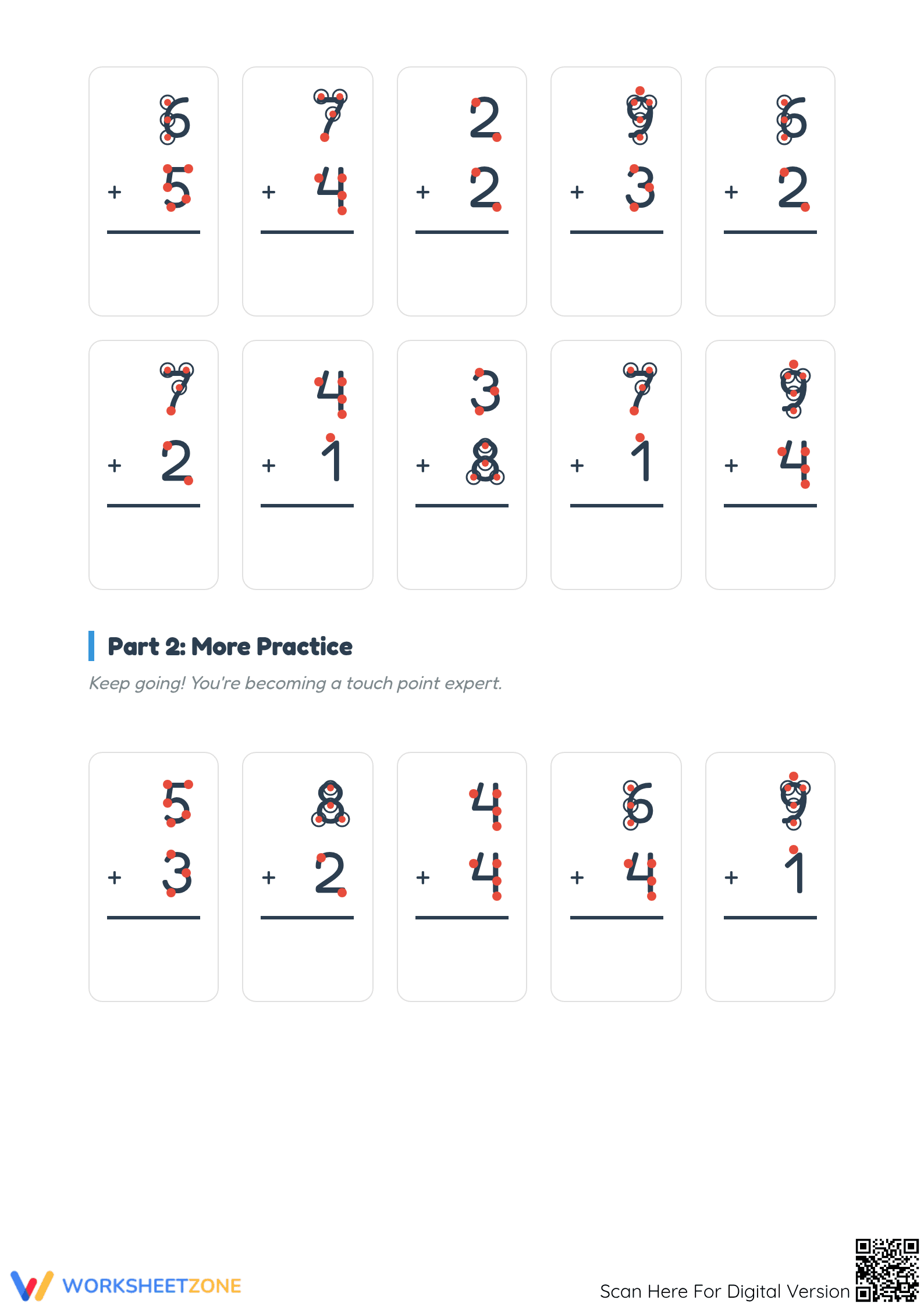


Grade 1 Touch Point Addition — Printable No-Prep Worksheet
Paste this activity's link or code into your existing LMS (Google Classroom, Canvas, Teams, Schoology, Moodle, etc.).
Students can open and work on the activity right away, with no student login required.
You'll still be able to track student progress and results from your teacher account.
Master addition within 20 using the effective tactile touch point strategy. This worksheet guides students through visual counting to build numerical fluency and confidence in basic arithmetic operations. By associating specific points on numbers with numerical value, learners bridge the gap between concrete counting and abstract mental math.
At a Glance
- Grade: 1 · Subject: Math
- Standard:
CCSS.MATH.CONTENT.1.OA.C.6— Add within 20 using counting on and other strategies- Skill Focus: Touch Point Addition Fluency
- Format: 3 pages · 25 problems · Answer key included · PDF
- Best For: Daily math warm-ups or independent practice
- Time: 20–30 minutes
What's Inside
This comprehensive 3-page set provides a structured introduction and deep practice with touch number math. Page one features a visual "How to Use" guide with single and double-dot references for numbers 1 through 9, plus a notes section for teacher modeling. The subsequent pages present twenty-five vertically aligned addition problems organized into basic practice and a "Big Number Challenge" section that pushes students toward mastering sums up to 18 with double-digit results.
Zero-Prep Workflow
This resource is designed for immediate classroom implementation with zero preparation.
- Step 1: Print (30 seconds) – Select double-sided printing to keep the reference guide accessible.
- Step 2: Distribute (1 minute) – Hand out packets during independent work or center rotations.
- Step 3: Review (1 minute) – Use the included answer keys for quick grading or self-correction. It serves as an ideal emergency sub plan.
Standards Alignment
This worksheet aligns with `CCSS.MATH.CONTENT.1.OA.C.6`, which requires students to add and subtract within 20, demonstrating fluency for addition within 10. It uses visual scaffolds to help students develop the counting-on strategy. Additionally, it supports `CCSS.MATH.CONTENT.K.OA.A.2` by providing concrete representations of addition. Both standard codes can be copied directly into lesson plans, IEP goals, or district curriculum mapping tools for administrative documentation.
How to Use It
Deploy this resource during the "Guided Practice" phase of a lesson or as a permanent fixture in your math centers. For a formative assessment observation, watch specifically for 1-to-1 correspondence as students tap the dots; hesitations on double-point numbers (6-9) indicate a need for more tactile modeling. The structured progression makes it suitable for Tier 2 intervention groups. Students typically complete the three-page sequence within twenty-five minutes of focused work.
Who It's For
This printable is ideal for Grade 1 students, Kindergarteners ready for extension, and Special Education students requiring multisensory math support. The clear visual cues provide essential scaffolding for English Language Learners (ELLs) by reducing the linguistic load of word problems. Pair this resource with a physical number line or touch point anchor chart to reinforce the visual-spatial connection to numerical quantity.
According to Fisher & Frey (2014), the gradual release of responsibility model is most effective when students are provided with clear scaffolds that bridge concrete and abstract thinking. This worksheet utilizes the CCSS.MATH.CONTENT.1.OA.C.6 standard to help students build addition fluency through a tactile-visual approach. Research indicates that associating physical points with numbers helps students with learning gaps internalize the relationship between symbols and quantities. By counting dots directly on the numerals, students engage in a multisensory experience that stabilizes their mental number line. This resource provides twenty-five problems that move from simple sums to the "Big Number Challenge," ensuring students meet the proficiency requirements for Grade 1 arithmetic. It is a reliable tool for teachers looking to provide systematic, evidence-based practice that aligns with national mathematics frameworks.


