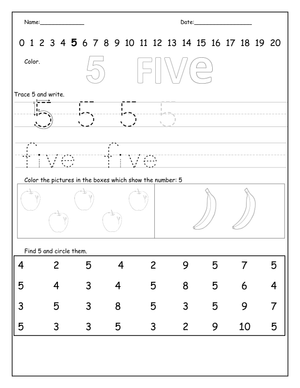
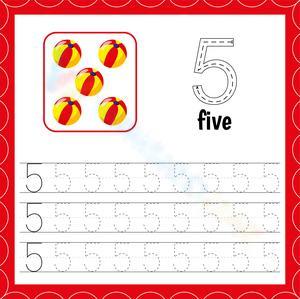
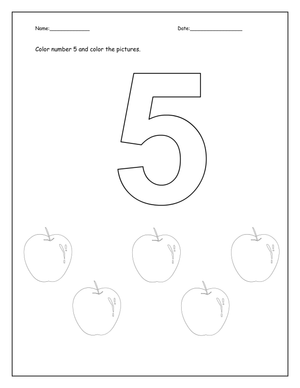
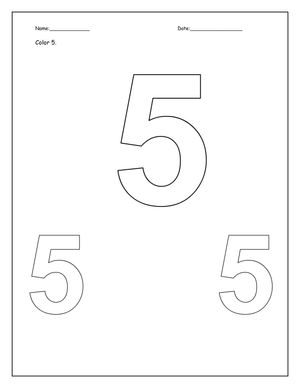
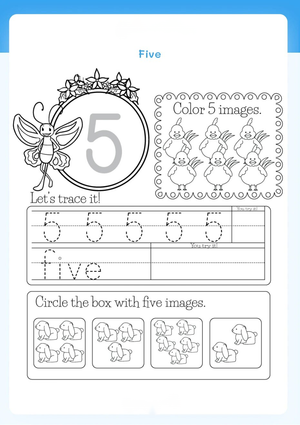
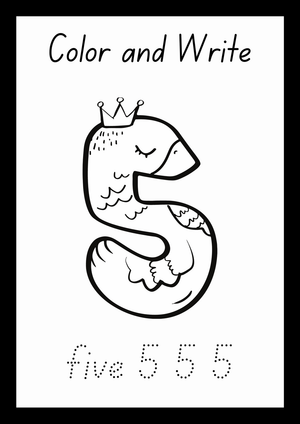
These trace number 5 worksheets for kindergarten address the digit that trips up more young writers in October than almost any other — the number 5 demands a stop-and-restart mid-stroke, a physical maneuver most four- and five-year-olds haven't had to manage before. The set includes directional-cue tracing, graduated sizing from large to small, and counting tie-ins that anchor the numeral to meaning rather than just shape.
What Each Worksheet Has Students Do
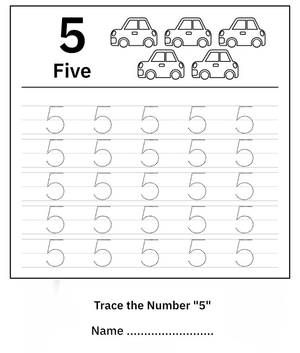
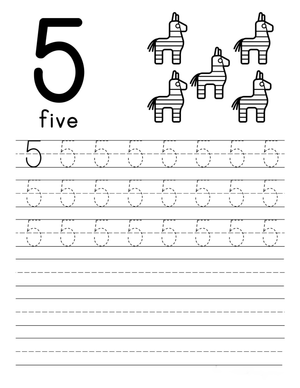
The practice moves through a deliberate sequence. Students start with large, heavily dotted numerals and numbered arrows that show exactly where to lift and re-place the pencil. Each worksheet then reduces the tracing size and thins the guides, asking students to carry more of the formation on their own. Most worksheets include three types of tasks:
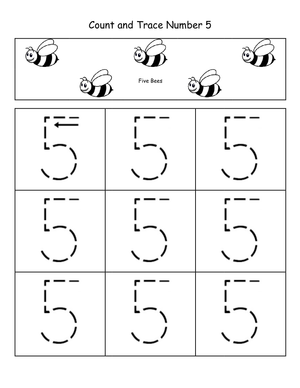
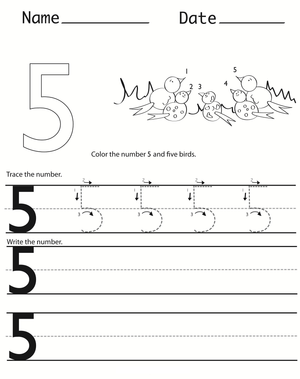
- Large dotted numerals with numbered stroke arrows indicating the lift point
- Mid-size tracing rows with minimal dot guidance
- Independent writing on primary-ruled lines with no trace support
Several worksheets also pair the tracing rows with a counting task — trace a 5, then draw exactly five dots in a ten-frame beside it. That pairing keeps writing practice from becoming purely mechanical. Students who can form the numeral but don't associate it with a quantity haven't fully internalized the concept; the counting tasks catch that gap early.
The Stroke That Catches Students Off Guard
The number 5 is formed in three moves: a short vertical stroke down, a curve to the right and back around, and then a horizontal line placed across the top — the "hat." The catch is that the hat goes on last, after the student has already moved down from the starting point. That re-ascent without a visible anchor is where most errors happen. Students try to draw the hat as a continuation of the curve rather than lifting the pencil and returning to the top, which produces a shape that looks more like a backward 2 than a 5.
Each worksheet reinforces the lift with a clear break in the dotted line, so the pause becomes a visual instruction rather than a verbal reminder the teacher has to repeat every few minutes. Practicing the arm-level motion first — full arm, not just fingers — helps students internalize the stop before they have to replicate it at pencil scale. A shallow tray of sand or a small whiteboard works well for that warm-up before pencil work begins.
Standard Alignment
The set directly targets CCSS.MATH.CONTENT.K.CC.A.3, which requires kindergarteners to write numbers from 0 to 20. In classroom terms, that standard hits hardest in the first and second quarters, when teachers introduce numerals one or two at a time and students need repetitive formation practice paired with quantity work. Trace number 5 worksheets for kindergarten fit exactly into that window — they provide the writing repetition the standard demands while the counting components support the cardinality work happening alongside it.
Ways to Work These Worksheets Into Your Instructional Week
The most reliable slot for these is the five to eight minutes after morning meeting and before the math block opens — students are seated, hands are ready, and the task is familiar enough that it doesn't require a lengthy setup. A single worksheet used as a warm-up three days in a row builds more retention than the same practice done once in a longer sitting.
Math centers are another strong fit, particularly when you slip a worksheet into a dry-erase pocket. Students trace, wipe, and repeat without using additional copies. For small-group pull-out time, the worksheets give you something concrete to observe: you can watch stroke order in real time and redirect before a wrong habit solidifies. The counting tasks also double as quick informal checks — when a student traces the 5 and counts out five objects correctly, that's a two-part signal that the concept is landing.
Student Errors Worth Watching and Correcting
Reversals are the most common issue — students swing the curve leftward instead of right, producing a mirrored 5. But a subtler error appears even in students who know the right direction: they draw the hat as a continuous upward curve rather than lifting the pencil. The result looks plausible at a glance but will cause trouble once they encounter the 5 inside multi-digit numbers. These trace number 5 worksheets for kindergarten address that by breaking the dot trail at the lift point, making the intended stop visible on the page rather than leaving it to memory.
A third pattern worth noting: students who have already internalized the backward curve from writing the letter S sometimes transfer that habit directly to the 5. A quick side-by-side comparison on the board — not a correction lecture, just a visible contrast between the two shapes — usually resolves it in a single short exchange.
Adjusting the Set for Students at Different Points in the Year
For students still working on basic grip and pencil control, start with only the largest-format tracing rows and skip the independent writing section entirely. A few weeks of that and the movement will be established enough to add the smaller rows. Laminating those large-format worksheets lets students trace repeatedly without burning through copies.
Students who have already mastered formation can skip the dotted tracing rows and use each worksheet as a brief check — one row of independent writing and one counting task confirms whether they've retained the skill. For students in the middle, the graduated sizing across each worksheet moves them forward without needing a separate version of the resource.
Frequently Asked Questions
Do these worksheets teach stroke order explicitly, or do students need prior instruction?
The numbered arrows and dotted-line breaks on each worksheet show stroke order directly on the numeral. Students don't need prior instruction to follow the cues — the visual prompts carry that information. A brief verbal walk-through before the first use helps students understand what the arrows mean, but it's a one-time explanation, not an ongoing requirement.
How many repetitions are on a typical worksheet?
Most worksheets include four to six rows of tracing or writing, plus one or two counting tasks. That's enough repetition to build familiarity without running past the attention span of most kindergarteners. For students who need more passes, the dry-erase pocket approach is the most efficient way to add practice without printing extras.
Can these be sent home for additional practice?
Yes — the format is clear enough that a caregiver can understand the task without a teacher guide. The directional arrows and starting dots communicate the expectation on their own. The one note: home practice works best after the student has already done this worksheet type in class. Sending it before in-class introduction tends to reinforce errors more than correct habits.
Where do these fit in a typical kindergarten pacing sequence?
Most pacing guides introduce numerals across the first and second quarters. Trace number 5 worksheets for kindergarten typically land in late September or October, depending on how quickly the class moves through earlier digits. The readiness signal to watch for: students who can form straight vertical lines and basic curves are ready for number 5 work, even if a few preceding numerals still need reinforcement.













 Interactive Worksheet Maker
 Quiz Maker
 Word Search Maker
 Crossword Puzzle Maker
 Word Scramble Generator
 Sentence Scramble Generator
 Handwriting Worksheet Generator
 Name Tracing Generator
 Fill In The Blank Generator