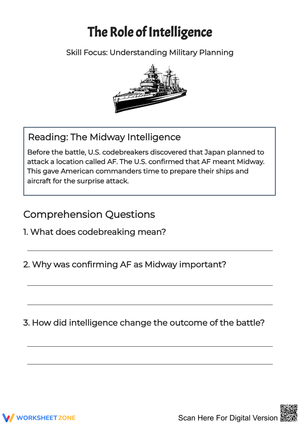
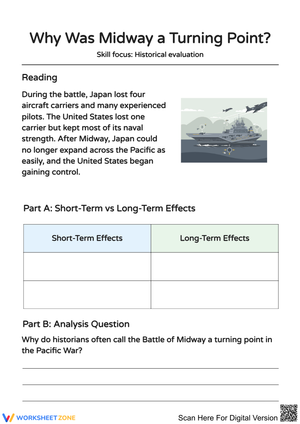
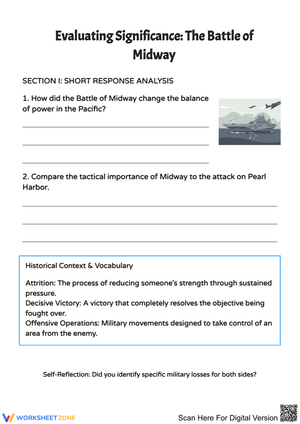
These us history worksheets pdf for 9th grade cover the arc from Gilded Age industrialization through the Cold War, with each worksheet built around the analytical moves that high school history demands: sourcing documents, evaluating historical context, corroborating evidence across conflicting accounts, and constructing defensible written arguments. Teachers get printable PDFs that work equally well as warm-up activities, paired-reading exercises, or take-home reinforcement after a lecture. The content is specific enough that students encounter real historical friction—divergent perspectives, ambiguous evidence, unresolved debates—rather than clean narratives with predetermined conclusions.
What the Set Covers
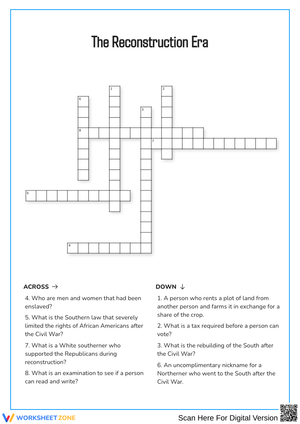
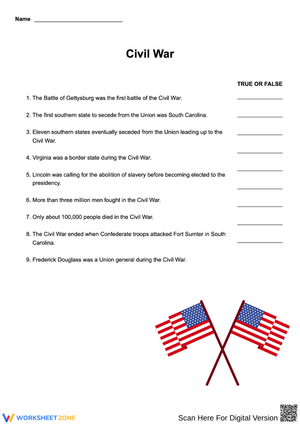
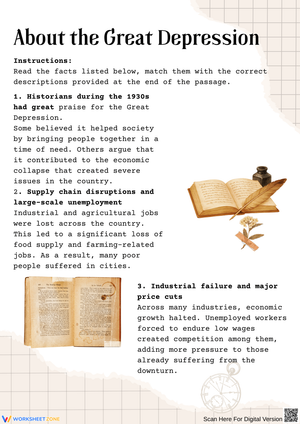
The worksheets move through four broad eras that define most ninth-grade US history curricula. The Gilded Age and Progressive Era materials ask students to read labor union manifestos alongside statements from industrialists, annotate political cartoons by Udo Keppler, and evaluate the effectiveness of Progressive-era reform legislation. World War I and World War II worksheets include map exercises tracing alliance systems and military theaters, home-front analysis activities, and close-reading tasks using soldiers' letters and official government communiqués. The Great Depression unit leans heavily on data—students read unemployment graphs from 1929 through 1941 and compare those figures against the scope of specific New Deal programs. Civil Rights and Cold War worksheets close out the set with timeline construction, policy comparison activities, and case study analysis that requires students to argue with evidence rather than simply restate events.
Skills students practice across the set include:
- Annotating primary source texts and identifying the author's purpose
- Reading historical maps to interpret territorial changes and military strategy
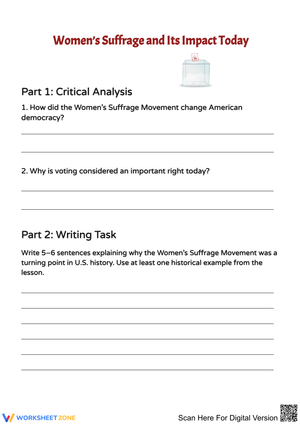
- Writing thesis statements built directly from provided primary source evidence
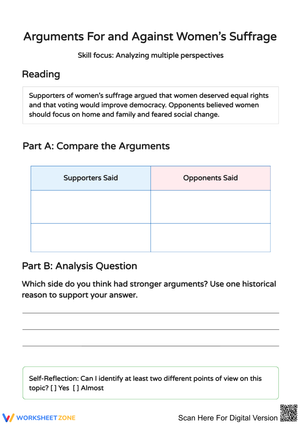
- Comparing perspectives across documents from the same event or period
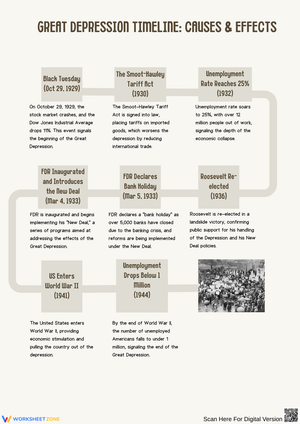
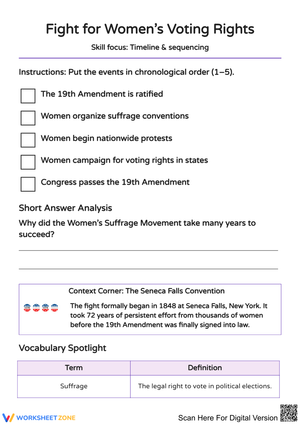
- Constructing timelines that trace cause-and-effect chains across decades
- Evaluating economic data, including Depression-era unemployment statistics and wartime production figures
Primary Source Work at the Center
The single biggest shift between middle school and ninth-grade history is the expectation that students read and reason from original documents rather than from textbook summaries. Each primary source worksheet uses a two-stage question sequence: students first observe and note what they can identify without any contextual information, then work through a deeper set of questions once background context is provided. This sequence reduces the cognitive overload that hits when students encounter nineteenth-century vocabulary cold—a student who has already noticed the visual composition of a Dorothea Lange photograph is far more prepared to engage with the caption text and historical setting than one who received everything at once.
The political cartoon worksheets deserve particular attention. Students who can correctly read a Gilded Age cartoon—identifying the figures, the symbols, and the satirical argument—carry that visual literacy into every subsequent unit. The set includes cartoons from the Progressive Era, the New Deal period, and the Cold War, so the skill compounds across the year. Questions ask students to identify what the cartoonist exaggerates, what the cartoonist assumes the audience already knows, and whether the argument holds up against other evidence from the same unit.
Building Document-Based Question Skills Before the Exams Arrive
DBQ formatting appears on AP exams, many state end-of-course tests, and writing assessments in 10th and 11th grade. Ninth grade is where most students encounter the format for the first time, and this us history worksheets pdf for 9th grade set introduces it deliberately and incrementally. Early DBQ worksheets present two or three short excerpts and ask students to find one thematic connection. Later worksheets increase the document count and require students to write a structured paragraph using explicit sourcing language: "According to [author], writing in [context]…" Teachers get a clear progression to follow rather than dropping students into a full six-document DBQ without prior exposure.
A consistent failure point at this stage is the list essay—students summarize each document in sequence without synthesizing the evidence into an argument. The worksheets address this directly by requiring a written thesis statement before students begin analyzing individual documents. Once the claim is on paper, students have a reason to select evidence rather than just report it.
Putting These Worksheets to Work Across the Week
Map activities work well on Mondays, when the week's content is new and students benefit from a visual anchor before encountering dense reading. Primary source worksheets work better mid-week, after a lecture or discussion has given students enough background to form opinions about what they're reading. DBQ practice fits Friday or the day before an assessment, when the goal is synthesis rather than intake of new information.
Station rotations are worth running during the 1920s unit. Three stations work cleanly: one focused on economic boom-and-bust data from 1919 through 1929, one on cultural shifts of the Harlem Renaissance using photographs and short excerpts from Langston Hughes, and one on political isolationism and foreign policy. Groups of three or four students rotate every twelve minutes. The worksheet guides the work at each station, which frees the teacher to circulate and spend time directly with students who are visibly stuck—targeted, individual support that whole-class instruction cannot easily provide.
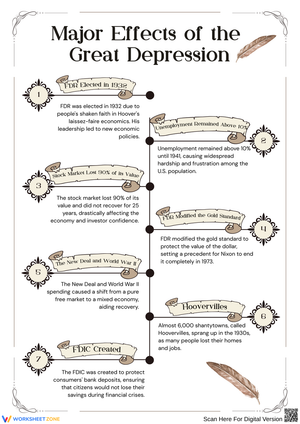
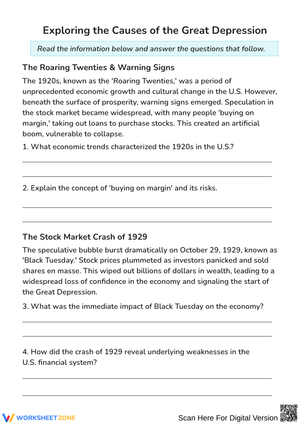
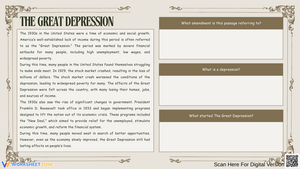
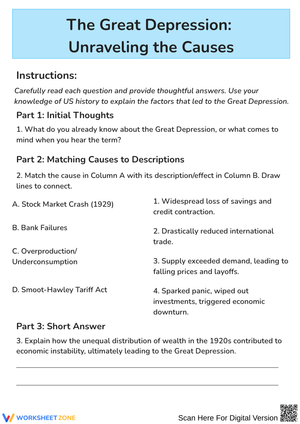
For the Great Depression unit, consider using the unemployment graph worksheet before students encounter any written account of the period. Ninth graders often have a harder time believing the scale of economic collapse when they read about it than when they see the numbers plotted year by year. The data grounds every human account that follows.
Where Ninth Graders Go Wrong in Historical Analysis
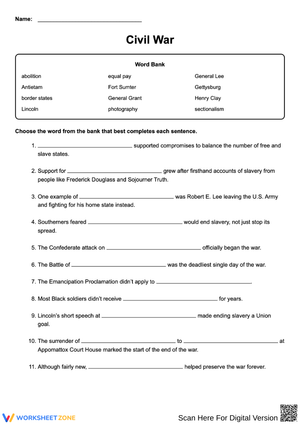
The most persistent error in primary source work at this grade level is treating authorship as irrelevant. Students will quote a document accurately and analyze its content correctly but ignore who wrote it and why. A factory owner's account of labor conditions and a striking worker's account of the same event carry different evidentiary weight, and ninth graders frequently cite both without noting the conflict. Several worksheets include a sourcing box—a compact section that asks students to record the author, date, and purpose before they analyze anything—to build this habit before it becomes a graded problem on a state assessment.
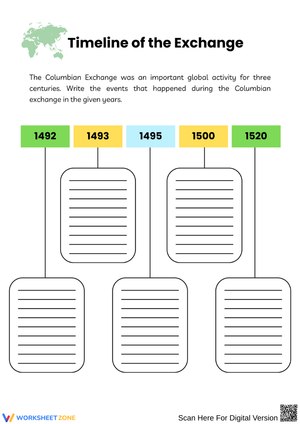
A second recurring issue is periodization. Students confidently write that World War I caused the Great Depression because both events appear in their notes from the same semester. The timeline worksheets interrupt this kind of compression by requiring students to place events at specific years and trace what occurred in the gaps between them. When a student has to write "1918" and "1929" as separate points on a line and account for the intervening decade, the eleven-year distance becomes visible in a way it simply isn't when two textbook units follow each other in the same week.
Standard Alignment
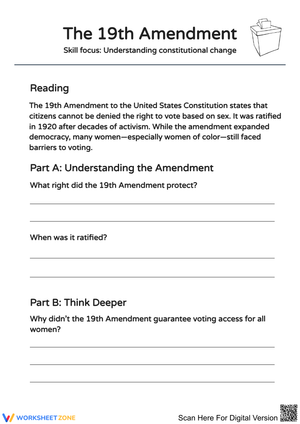
The worksheets in this us history worksheets pdf for 9th grade set align with the College, Career, and Civic Life (C3) Framework for Social Studies, specifically Dimension 2 (Applying Disciplinary Concepts and Tools) and Dimension 3 (Gathering and Evaluating Sources). The primary source and DBQ worksheets directly address D3.1 through D3.4, which cover source identification, contextualization, corroboration, and the construction of evidence-based claims. These standards govern the shift from content recall to historical thinking—a transition that ninth grade formalizes for most students in a US history sequence. Teachers in states using CCSS-aligned social studies frameworks will also find that the reading and writing tasks address CCSS.ELA-LITERACY.RH.9-10.1, RH.9-10.6, and WHST.9-10.1 for literacy in history and social studies.
Frequently Asked Questions
Do these worksheets come with answer keys?
Yes. Each worksheet includes a teacher key. For factual items—map labels, timeline dates, vocabulary definitions—the key gives the correct answer. For open-ended analysis and DBQ writing tasks, the key provides a sample strong response and identifies two or three markers teachers should look for when grading, such as explicit sourcing language or a thesis that moves beyond simple description of what documents say.
Can these be used digitally, or are they print-only?
The PDFs hold together on screen as cleanly as they do on paper. Teachers have uploaded worksheets from this us history worksheets pdf for 9th grade set to Google Classroom, assigned them through learning management systems, and had students annotate them using digital tools. Historical images, maps, and graphs stay at full resolution regardless of device.
How much class time does a typical worksheet take?
Most worksheets run fifteen to twenty minutes for independent work. DBQ worksheets stretch to thirty minutes when students are writing a full paragraph. Map exercises with multiple labeling tasks can reach twenty-five minutes if the teacher pauses mid-activity for whole-class discussion. None require a full class period—each worksheet is one component of a lesson, not the lesson itself.
Are there worksheets focused specifically on the Civil Rights Movement?
Yes. The Civil Rights unit includes close-reading worksheets built around primary sources: excerpts from Martin Luther King Jr.'s "Letter from Birmingham Jail," the text of the Civil Rights Act of 1964, and photographs from sit-ins and marches. A timeline worksheet asks students to sequence events from 1954 through 1968 and annotate each entry with a one-sentence cause-and-effect note. A case study worksheet compares the strategies of SNCC and SCLC and asks students to argue, with textual evidence, which approach produced more durable legislative change.












 Interactive Worksheet Maker
 Quiz Maker
 Word Search Maker
 Crossword Puzzle Maker
 Word Scramble Generator
 Sentence Scramble Generator
 Handwriting Worksheet Generator
 Name Tracing Generator
 Fill In The Blank Generator