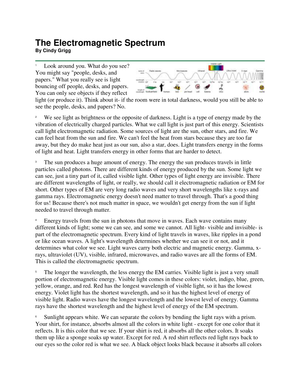
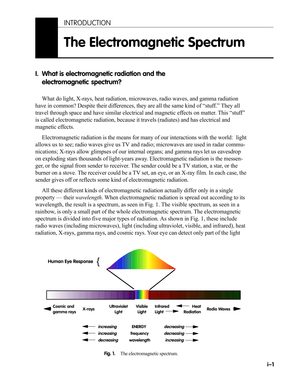
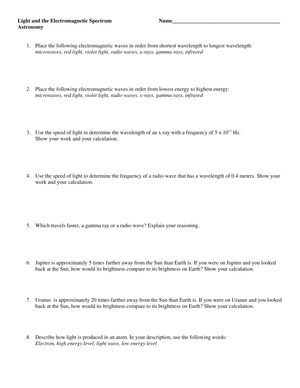
These 9th grade electromagnetic spectrum pdf worksheets give physics and physical science teachers a ready-made structure for moving students from the narrow visible band they already recognize into the full sweep of electromagnetic radiation — from kilometer-long radio waves down to gamma rays shorter than the diameter of an atomic nucleus. Each worksheet targets a specific skill set, which means teachers can use one as guided notes during a lecture, assign another as independent practice after a PhET simulation, and pull a third as a quick formative check before the unit test. The set covers everything the NGSS HS-PS4 cluster asks of 9th graders.
What Students Work Through
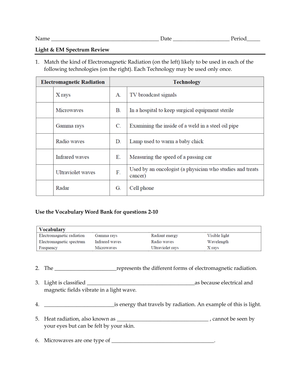
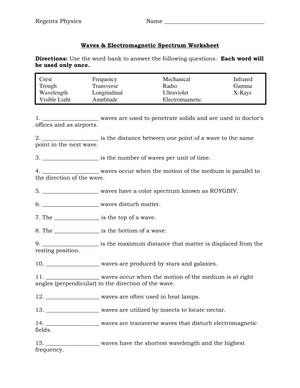
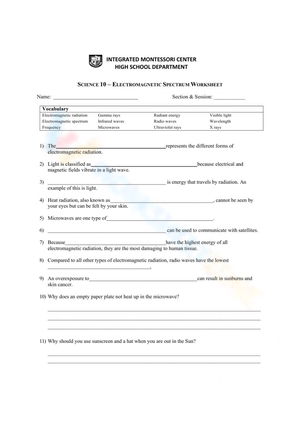
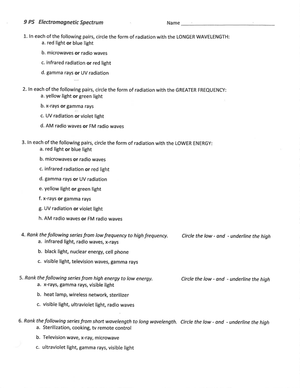
Naming the seven regions — radio waves, microwaves, infrared, visible light, ultraviolet, X-rays, and gamma rays — is where students start, not where they finish. The worksheets also ask them to rank regions by wavelength and by frequency, match each region to at least one real-world application, and explain why some types of radiation damage living tissue while others don't. That last task addresses a genuine conceptual target: most students arrive believing all radiation is hazardous, and shifting that to a reasoning-based position grounded in photon energy values is one of the clearest signs of actual learning in this unit.
The worksheets that place ultraviolet, X-ray, and gamma ray energy values side by side and ask students to explain the biological cutoff are particularly effective at building that precision. A lecture summary rarely accomplishes what a structured data comparison does.
Where Students Hit the Math Wall
The wave equation — v = fλ, with the speed of light constant at approximately 3 × 10^8 m/s — is not difficult algebra. The numbers are what slow students down. A 100 MHz radio station has a wavelength of 3 meters. A diagnostic X-ray at around 3 × 10^18 Hz has a wavelength near 10^-10 meters. Students who struggle to convert cleanly between standard and scientific notation don't fail these problems because they misunderstood the inverse relationship between frequency and wavelength; they fail because they drop an exponent or misplace a decimal. These worksheets pair the wave equation with explicit scientific notation practice so that gap doesn't mask the physics understanding underneath.
Frequent Student Errors Worth Watching For
The most consistent error is directionality confusion despite correct memorization. A student writes "Radio, Microwave, Infrared, Visible, Ultraviolet, X-ray, Gamma" without hesitation — and then, on the next item, places microwaves as higher energy than infrared. The mnemonic gave them a sequence; it did not give them the logic. Worksheets that ask students to derive the ranking from the wave equation, rather than simply recall it, surface that gap.
A second common mistake is assuming higher frequency means higher speed. When students read v = fλ and think about what frequency means — wave cycles per second — it feels intuitive that more oscillations must mean faster travel. Asking students to write the speed of light before solving each calculation, then confirm their answer is consistent with c, turns that misconception into a checkable step rather than a silent error that persists through the unit.
Fitting These Worksheets Into Your Unit Sequence
The most effective placement for 9th grade electromagnetic spectrum pdf worksheets tracks directly with where you are in the instructional cycle. Region-identification and application-matching tasks fit best in the Explore phase — the first two or three days of the unit, before students are expected to produce mathematical work. Pair them with a simulation or short video so students have something to react to rather than just a diagram to label. Wave equation worksheets belong in the Explain and Elaborate phases, after direct instruction on v = fλ. Data-analysis and ionizing radiation comparison tasks work as low-stakes formative checks in the Evaluate phase, three to five days before the unit assessment.
One classroom structure worth trying: a Spectrum Scavenger Hunt. Students receive a worksheet listing all seven regions and identify three items in the school building that use each type of radiation — a wireless router for radio waves, the microwave in the faculty lounge, a motion-sensor light for infrared, a fluorescent fixture for ultraviolet. The task converts passive labeling into active retrieval and gives students a physical sense of scale: the router antenna is longer than the X-ray tube, which maps onto what they've been told about wavelength. Station labs work well alongside this, especially if the math-heavy worksheet runs at a teacher-led station where exponent errors get caught before students repeat them across an entire problem set.
Standard Alignment
NGSS HS-PS4-1 asks students to use mathematical representations to support claims about the relationships among frequency, wavelength, and wave speed. The wave equation tasks in these worksheets address that performance expectation directly. HS-PS4-2 — covering how wave properties enable information transfer in modern technology — connects to the application-matching tasks: radar, GPS, wireless communication, and medical imaging. HS-PS4-5, on the effects of electromagnetic radiation on matter, aligns with the ionizing radiation comparison activities. Across those three standards, a full set of 9th grade electromagnetic spectrum pdf worksheets can anchor the entire HS-PS4 cluster without requiring separate supplementary materials for each performance expectation.
Differentiating Across Ability Levels
For students who need more guided support, the region-identification and application-matching worksheets are the right entry point. The conceptual demand is high enough to be meaningful, but the math load is low enough that students still building scientific notation fluency can demonstrate real understanding without getting blocked. English language learners benefit in particular because the technical vocabulary appears repeatedly across each worksheet in multiple contexts, which builds retention more reliably than a glossary entry.
For students who move quickly, the wave equation worksheets extend naturally: ask them to research the actual frequency bands used in 5G wireless or the specific X-ray energies used in a chest scan, then verify those values using v = fλ. That calls for independent application of the same math without a separate resource. In a station-lab format, assigning the calculation worksheet to a teacher-led station and the conceptual worksheets to independent stations lets you put your attention where errors are densest — which is almost always the math station.
Frequently Asked Questions
Which NGSS standards do these worksheets address?
The worksheets align primarily to HS-PS4-1, which focuses on mathematical representations of the relationships among frequency, wavelength, and wave speed. They also address HS-PS4-2 through the real-world application tasks and HS-PS4-5 through the ionizing radiation comparison activities. All three performance expectations fall within the HS-PS4 cluster.
Can students complete these digitally without printing?
Yes. The PDF format uploads cleanly to Google Classroom and Canvas, and students can annotate using Google Drive, Kami, or Adobe Acrobat on tablets and laptops. For calculation problems, students can type into fillable fields or keep a separate digital notebook for their work. The structure stays intact across devices.
How should I sequence these across a two-week unit?
Use 9th grade electromagnetic spectrum pdf worksheets focused on region identification and applications in days two and three, after an initial lecture or video introduction. Introduce the wave equation worksheets in the middle of the unit once students are working with scientific notation fluently. Save ionizing radiation comparisons and data-analysis tasks for days nine and ten as unit review and formative check. That sequence asks students to build vocabulary before applying it mathematically, keeping the cognitive load manageable at each stage rather than stacking every demand at once.
What is the best way to help students remember the spectrum order?
Mnemonics help with recall but don't build reasoning. "Roman Men Invented Very Unusual X-ray Guns" gives students a sequence they can reproduce on a quiz; it does not explain why microwaves carry less energy than X-rays or why that distinction matters. Pair any mnemonic with a scale analogy — radio waves roughly the size of a building, visible light waves roughly the size of a bacterium, gamma rays roughly the size of an atomic nucleus — and students have both a retrieval cue and a conceptual anchor they can use to check their own reasoning when the mnemonic runs out.












 Interactive Worksheet Maker
 Quiz Maker
 Word Search Maker
 Crossword Puzzle Maker
 Word Scramble Generator
 Sentence Scramble Generator
 Handwriting Worksheet Generator
 Name Tracing Generator
 Fill In The Blank Generator