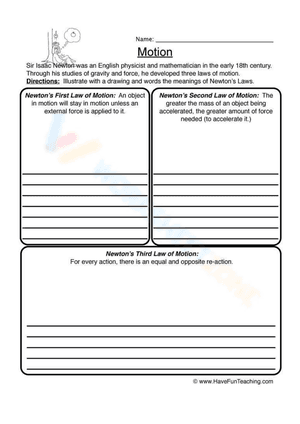
These newtons laws printable worksheets for 9th grade give physics teachers ready-to-use practice on all three of Newton's laws — inertia identification, F=ma calculation, and action-reaction pair analysis. Each worksheet is a standalone resource, so teachers can pull exactly what a lesson calls for without working through a fixed sequence.
What Each Worksheet Targets
The set divides by law, each worksheet focused on one concept rather than surveying all three at once.
First Law worksheets ask students to read short physical scenarios — a hockey puck gliding across frictionless ice, passengers lurching forward when a bus brakes suddenly — and explain what happens using inertia language. Students underline the object, identify its current state of motion, and name the unbalanced force (or its absence) that governs what comes next. Establishing that vocabulary before any formula appears matters: students who cannot articulate inertia in plain terms make compounding errors once F=ma enters the picture.
Second Law worksheets build three distinct skills:
- Extracting knowns and unknowns from word problems before writing any equation
- Keeping SI units consistent — mass in kilograms, force in Newtons, acceleration in m/s²
- Rearranging F=ma to solve for mass or acceleration, not always for force
Several worksheets pair a written scenario with a free-body diagram that students complete before touching the formula. Students who skip the diagram routinely mis-add forces — especially when friction acts opposite to an applied force — and the paired format catches that error before it becomes a habit.
Third Law worksheets require more than listing an action-reaction pair. Students identify both objects in an interaction, write out the force each exerts on the other, and explain in a sentence why equal-and-opposite forces do not produce zero net motion on either object. That written explanation is where most 9th graders reveal whether they understand the law or have only memorized its wording.
Error Patterns That Show Up Across the Three Laws
Second Law errors are usually a unit problem, not a formula problem. A student reads that a person weighs 600 Newtons and plugs that directly into F=ma as if it were mass in kilograms. They know the formula; they are misreading what the problem gave them. A related error: a student correctly identifies mass in kilograms but records acceleration in cm/s² because that was the unit in the problem, producing a force answer off by a factor of 100. These worksheets surface both errors because the problems mix unit types deliberately, giving teachers a clear diagnostic window during guided practice rather than on the unit test.
Third Law misconceptions cluster around one belief: that action and reaction forces cancel because they are equal and opposite. A student will write "the floor pushes up on me with 600 N and I push down on the floor with 600 N, so the net force is zero" — treating forces on two different objects as if they belong on the same free-body diagram. The written-explanation format makes it possible to see exactly where that reasoning breaks down, rather than only marking a final answer wrong.
First Law surfaces a subtler error that no calculation exposes. Students accept that a moving object "stays in motion" but then add qualifiers — "unless it slows down naturally" or "unless it runs out of force." That language reflects a pre-Newtonian intuition that motion requires a continuous cause. Conceptual tasks on these worksheets are the most reliable way to surface that belief early, before it corrupts Second Law work later in the unit.
How to Fit These Into a Two-Week Mechanics Unit
The sequence most teachers find effective: open with First Law conceptual work, spend the majority of instructional time on Second Law calculation, and bring Third Law worksheets in as the synthesis task that requires students to reason carefully about which object each force actually acts on.
First Law worksheets make strong Monday warm-ups in the opening week of the unit. They take 8 to 10 minutes to complete, and the scenario-based format generates class discussion that reveals which students still believe a moving object needs a continuous push to keep going — a conversation worth having before F=ma problems arrive, not after.
Second Law worksheets work best during guided practice, when the teacher can circulate and watch how students set up their work rather than just what answers they write. Requiring students to list m, a, and F with their units before writing any equation — on the left margin, before the formula — catches unit substitution errors before they become habits. For these newtons laws printable worksheets for 9th grade, the free-body diagram tasks assume students have already seen a completed example; teachers who assign them cold should expect most students to draw arrows in the wrong direction and will need to model the format first.
Third Law worksheets work well in pairs. Two students agreeing aloud on the action-reaction pair before writing anything catches the "same-object" error faster than individual work does, because students will argue the point when they disagree — and that argument is exactly what cements understanding.
Standard Alignment
These worksheets address HS-PS2-1, the NGSS performance expectation requiring students to analyze data that supports Newton's Second Law as the mathematical relationship among net force, mass, and acceleration. In classroom terms, students need to do more than recall the formula — they use it to interpret physical situations, which is what the calculation and diagram worksheets require throughout the set.
All three law worksheets connect to disciplinary core idea PS2.A (Forces and Motion), which covers the relationship between net force and acceleration, the nature of inertia, and the symmetry of force pairs between interacting objects. These concepts build in sequence across the unit, which is why the First Law worksheets are strong conceptual openers and the Third Law worksheets serve as the capstone before teachers move into momentum.
How to Adapt These Worksheets When Students Aren't All at the Same Level
Students who struggle with algebra need the formula provided upfront — adding formula-memorization demands on top of physics conceptual work pushes too many things into working memory at once. On Second Law worksheets, having these students underline knowns and unknowns before writing any equation reduces that load without removing the physics thinking. The triangle method helps here: draw a triangle divided horizontally, split the lower half vertically, and place F in the top section with m and a in the two bottom sections. Covering the unknown variable reveals the operation needed. It is a consistent visual reference that removes the rearrangement step entirely for students still developing algebraic fluency.
Students with strong algebra but weak physics intuition typically move through calculation worksheets quickly and stall on conceptual tasks. First Law and Third Law worksheets are harder for this group precisely because there is nothing to calculate. Pairing each worksheet with a brief reading about a physical scenario — a rocket pushing exhaust backward, a skateboarder hitting a crack — gives these students a mental picture to reason from rather than an abstract prompt they tend to skim past.
With newtons laws printable worksheets for 9th grade, the standalone format lets teachers assign by instructional target rather than lock the whole class to the same pace — giving one group extended practice on Second Law calculation while another moves into Third Law synthesis. Students who finish early can extend Third Law worksheets by drawing a complete free-body diagram for each object in the interaction pair, a task that bridges naturally into momentum work without requiring a separate resource.
Frequently Asked Questions
Why do students consistently mix up mass and weight when solving Second Law problems?
The confusion is largely linguistic. Everyday English treats "weight" and "mass" as interchangeable, and 9th graders have used them that way for most of their lives. When a word problem states that a person weighs 700 Newtons, students read "weighs" and extract a mass. These newtons laws printable worksheets for 9th grade address this directly by labeling values explicitly in Newtons or kilograms and requiring students to identify the unit type before setting up any equation — a step that forces the mass-weight distinction in a way vocabulary instruction alone rarely achieves.
Is the triangle method worth teaching for rearranging F=ma?
For most 9th graders, yes. The visual reference removes one working-memory demand from students who are not yet comfortable with algebraic manipulation, leaving more cognitive capacity for the physics reasoning. The caution: some students will rely on it past the point where they should be rearranging equations directly, so it is worth gradually phasing the triangle out once fluency builds rather than treating it as a permanent tool.
Can these worksheets function as formative assessments, or are they only for practice?
Each worksheet works as a formative check when teachers collect and read the written explanations alongside the numerical answers. A student who writes the correct force value on a Third Law problem but explains "the reaction force cancels the action force so nothing moves" has a significant conceptual gap the correct number conceals. The written-response items on the conceptual worksheets are consistently the most diagnostic part of the set — more revealing than any calculation answer on its own.















 Interactive Worksheet Maker
 Quiz Maker
 Word Search Maker
 Crossword Puzzle Maker
 Word Scramble Generator
 Sentence Scramble Generator
 Handwriting Worksheet Generator
 Name Tracing Generator
 Fill In The Blank Generator