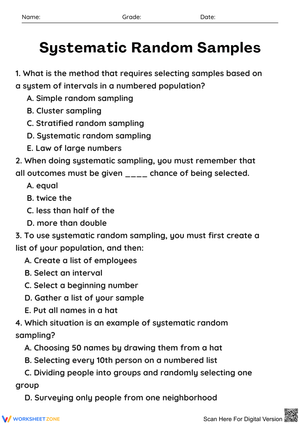
These probability worksheets for 9th grade cover the conceptual territory where high school students first formalize probability notation — the shift from middle-school intuition about "likely" and "unlikely" into structured event analysis using sample spaces, multiplication rules, and restricted conditions. Each worksheet targets one skill cluster, so teachers can match the task to exactly where the class stands in the unit rather than hunting through a mixed packet for three usable problems. The set prints cleanly in black and white and needs no digital access, making it a dependable fit for homework packets, substitute plans, and small-group reteaching folders.
What Each Worksheet Covers
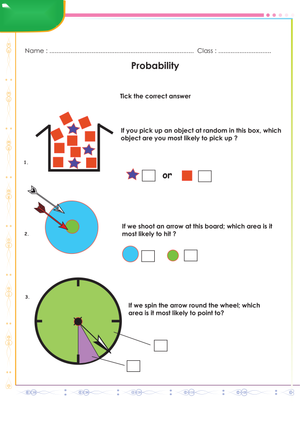
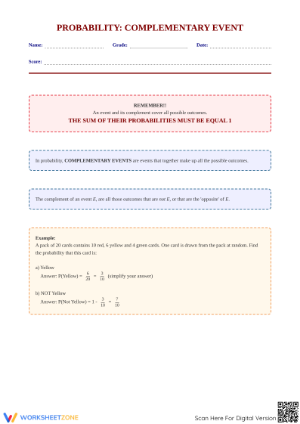
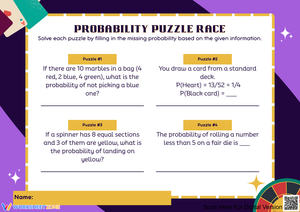
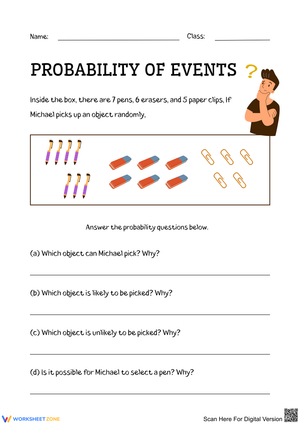
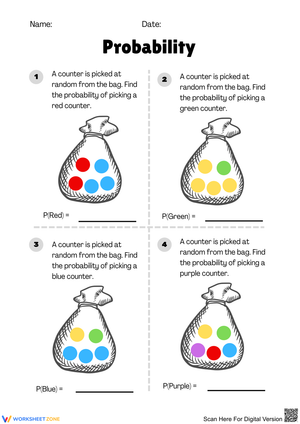
The set moves through the standard high school probability progression, building from single-event calculation into multi-step reasoning. Students work with spinners, standard card decks, numbered cubes, and colored-tile scenarios — multiple contexts so the formula doesn't become mentally fused to one specific image of a die or a bag of marbles.
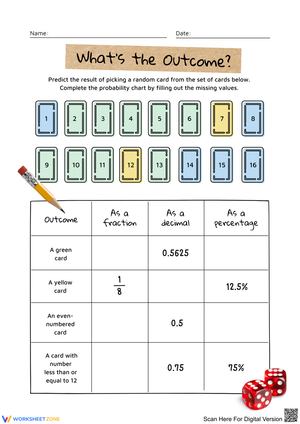
- Simple probability: identifying the sample space, counting favorable outcomes, and expressing the result as a fraction, decimal, and percent.
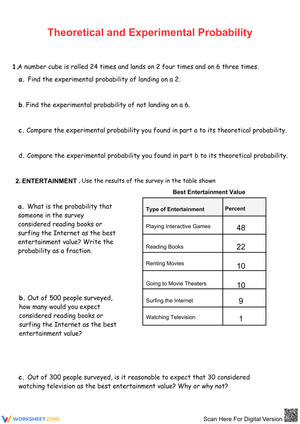
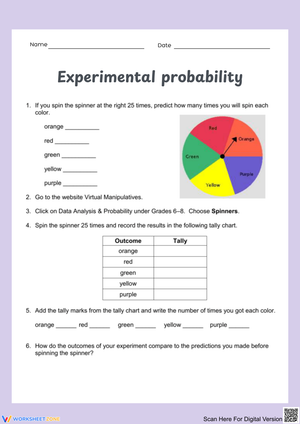
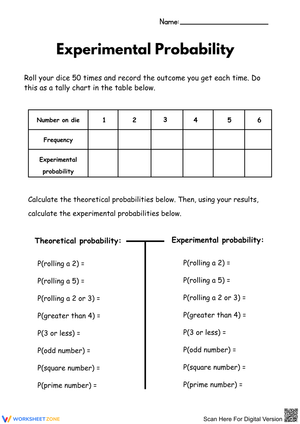
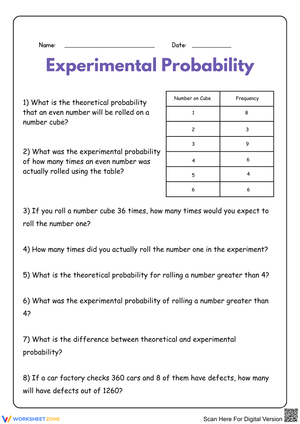
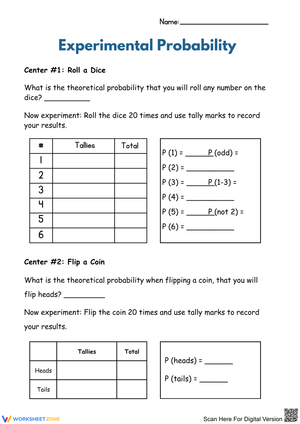
- Experimental vs. theoretical probability: computing expected outcomes, reading trial data, and comparing the two values — with questions that push students to explain why the results differ.
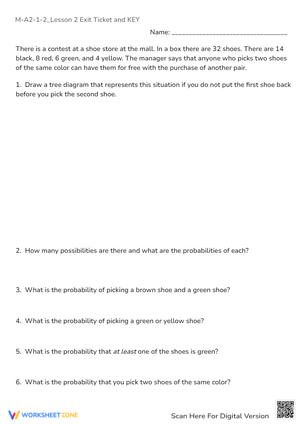
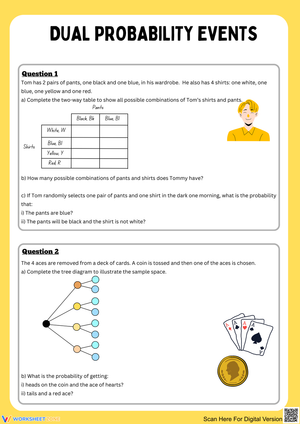
- Compound events: organizing AND and OR situations using lists, tables, and tree diagrams before applying the multiplication or addition rule.
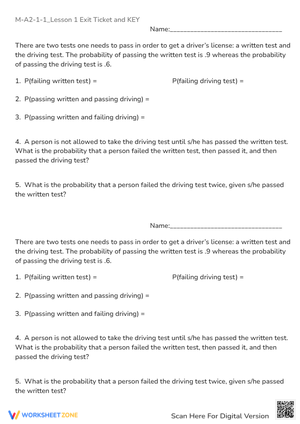
- Independent and dependent events: deciding whether one outcome changes the next, and adjusting the denominator when it does.
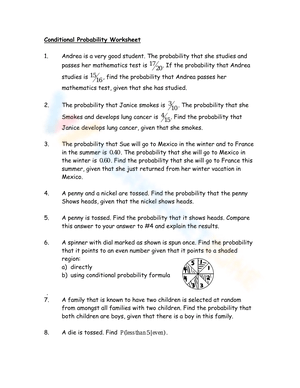
- Conditional probability: reading P(B|A) from two-way frequency tables, correctly identifying the restricted sample space, and distinguishing that restricted value from the full total.
- Applied word problems: sports outcomes, weather predictions, survey results, and simple games — contexts where students must read carefully before setting up any calculation.
Each worksheet also includes a short written-explanation component alongside numerical items. That addition matters: a student who writes the correct fraction but cannot articulate why the denominator changed on the second draw has not fully secured the concept, and the written questions make that gap visible before a quiz does.
Where Student Thinking Breaks Down — and What to Watch For
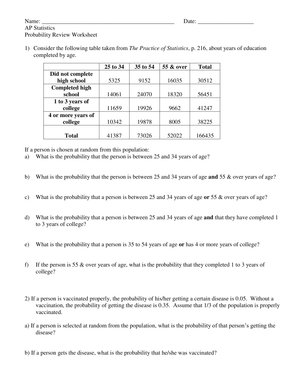
Two-way table problems expose one of the most consistent errors at this level. When students are asked for P(passed the test | studied regularly), many use total class enrollment as the denominator rather than restricting to the "studied regularly" row. The restricted sample space is the entire point of conditional probability, but students who learned in middle school to "count all outcomes in the sample space" apply that rule automatically. Several worksheets in the set build directly around this error — they show a table, ask for the conditional probability, and then ask students to circle which row or column served as their denominator. That annotation step catches the mistake before it calculates its way into a wrong answer.
Dependent events produce a second predictable error. Students drawing two marbles without replacement will write a correct fraction for the first draw, then keep the total unchanged for the second — 3/10 × 2/10 when the denominator should drop to 9. Asking students to cross out one item in a labeled sample-space list before computing the second probability breaks this habit faster than re-explaining the multiplication rule. The dependent-events worksheets leave space for that written tracking rather than jumping straight to a formula line.
A third pattern appears with compound events: students add probabilities for AND situations and multiply for OR situations — the reverse of the correct operation. This is not careless; students who learned "add things together when you combine them" in arithmetic are applying a rule that worked for years. Catching it early, during the compound-events worksheet, prevents that inversion from spreading into multi-step problems later in the unit.
Fitting These Worksheets Into Your Unit Planning
A small bit of front-end organization pays off across the whole unit. Before the first lesson, sort the worksheets into three folders: single-event review, compound and conditional practice, and mixed assessment prep. When a class needs reteaching after a quiz or a substitute is covering for the day, having the right worksheet already separated saves real time.
During instruction, a gradual-release approach works well. Project the first two or three problems from the class worksheet and model the setup — specifically how to define the sample space before computing, not just how to read the final answer. Then release students to finish independently. That short whole-class model reduces the number of students who freeze on the setup while the teacher circulates, which is a different problem than not understanding probability.
Station work opens another use. The compound-events worksheet pairs naturally with a physical deck of cards or a bag of colored tiles: students compute the theoretical probability first, run five trials, record the experimental result, and compare. The gap between the expected and actual outcomes is almost always larger than 9th graders predict, and that gap is the conversation the station is built around. On the probability worksheets for 9th grade that address experimental versus theoretical comparison, there is structured space for recording both values and writing a sentence about why deviation is expected, not evidence that the math is wrong.
Exit tasks drawn from the conditional probability worksheet work at the end of a two-way table lesson. A three-problem strip takes about five minutes and reveals immediately whether students are using the restricted row as the denominator or defaulting to the full table total — information that shapes the next day's opening before a full reteaching detour becomes necessary.
Adjusting the Set for Mixed Readiness Levels
Students who need more support at this level generally struggle not with probability rules but with reading the problem — identifying which event is given and which is being asked for, or recognizing whether two events are connected. For those students, the most useful move is to assign worksheets that use labeled diagrams: sample spaces drawn out as lists, two-way tables with the relevant row pre-highlighted, and tree diagrams partially completed so students are extending structure rather than generating it from scratch. The probability computation itself is often not the barrier.
- For students who need additional support: use worksheets with pre-drawn sample spaces and partially completed tables; have students annotate which outcomes are favorable before writing any fraction.
- For students working at grade level: assign mixed-problem worksheets that require identifying the event type first, then choosing the appropriate procedure.
- For students ready for extension: use the applied word problems and multi-step compound-event items, which ask students to compare two different solution methods and explain which is more efficient.
Task length is a straightforward adjustment that doesn't require creating new material. Some students demonstrate solid command of dependent events in six well-chosen problems; others need a full worksheet of twelve to consolidate the same skill. Because the worksheets print in sets, teachers can assign the core task to the full group while printing a shorter version for students who need tighter, higher-repetition practice on the same concept — without changing the lesson objective for anyone.
Standard Alignment
These worksheets align to the Common Core State Standards for High School Statistics and Probability, specifically the Conditional Probability and Rules of Probability cluster (HSS-CP). The standards most directly addressed are HSS-CP.A.1 (describing events as subsets of a sample space), HSS-CP.A.3 (understanding conditional probability and independence), HSS-CP.A.4 (constructing and interpreting two-way frequency tables), HSS-CP.B.6 (finding conditional probability using its definition), HSS-CP.B.7 (applying the addition rule), and HSS-CP.B.8 (applying the general multiplication rule for compound events). In most 9th-grade courses, these standards land inside a data and statistics unit — often in the second semester, after students have worked through linear and quadratic functions. Placing probability practice at that point means students arrive with stronger algebraic reading fluency, which matters for the multi-step word problems, but the topic still needs dedicated worksheet time before the unit closes and moves on.
Frequently Asked Questions
Do these worksheets include answer keys?
Yes. Each worksheet comes with a complete answer key, including worked solutions for multi-step problems. The worked solutions are especially useful for dependent-events and conditional probability items, where the setup process matters as much as the final fraction. Teachers using these as self-check tools in centers, or as make-up work, can hand the key to students after the worksheet is complete without needing to write out solutions themselves.
At what point in the unit do the conditional probability worksheets fit best?
After students are comfortable with independent compound events and have encountered a two-way table at least once in class. Introducing conditional probability before students can distinguish a full sample space from a restricted one produces the denominator errors described above, and those errors are difficult to correct mid-unit. Most teachers find that two or three class periods on compound events first makes the conditional probability worksheet land more cleanly — students arrive with the multiplication rule already in place and can focus on the restriction concept itself.
Can these be used with students who are slightly below grade level?
The probability worksheets for 9th grade in the set work for students who are one skill level behind if teachers pair the compound-events worksheet with a brief review of fraction operations beforehand. The most common friction point for below-level students is not the probability reasoning but the fraction arithmetic — multiplying non-simplified fractions and reducing the result. A short fluency warm-up before the worksheet removes that obstacle without altering the probability content or the lesson objective.
Are these appropriate for Algebra 1 courses or only for a dedicated statistics course?
Both. The probability worksheets for 9th grade in this set align to high school standards that appear across Algebra 1 courses with a data component, standalone statistics courses, and integrated math sequences. The compound and conditional probability worksheets are most naturally at home in a statistics unit, but the simple probability and experimental-versus-theoretical worksheets fit comfortably inside an Algebra 1 data-analysis chapter. Teachers using an integrated curriculum often draw from this set across two separate units in the same school year.














 Interactive Worksheet Maker
 Quiz Maker
 Word Search Maker
 Crossword Puzzle Maker
 Word Scramble Generator
 Sentence Scramble Generator
 Handwriting Worksheet Generator
 Name Tracing Generator
 Fill In The Blank Generator




 BACK TOSCHOOL