9th Grade Drama Analysis worksheets
These 9th grade drama analysis worksheets resources give freshman ELA teachers a print-ready toolkit for the text-format problem that stops most ninth graders cold — a play looks nothing like what they have been reading since third grade, and that visual unfamiliarity consistently undermines comprehension before the literary analysis even starts. The worksheets move through soliloquies, stage directions, dramatic irony, Freytag's structure, and tragic flaw with enough textual practice that students build habits of analysis rather than just memorizing definitions.
What Each Worksheet Targets
Each worksheet in the set isolates one analytical skill so students aren't managing several tasks at once — a common cause of shallow, perfunctory responses in drama analysis. Having a 9th grade drama analysis worksheets exercise ready for the day students first encounter stage directions keeps the focus tight before they have to integrate multiple skills simultaneously.
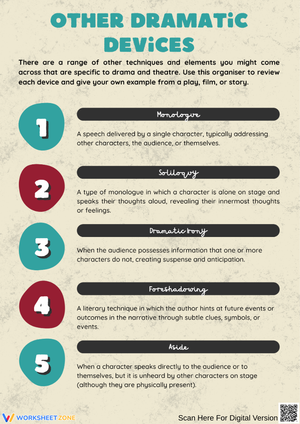
- Speech-type identification: Students read short excerpts and classify the speech as a monologue, soliloquy, or aside, then explain what that speech type reveals about the character's interior state — something that couldn't be communicated through dialogue with others present.
- Stage direction annotation: Students highlight and interpret physical movements, lighting cues, and positioning notes, using them to infer the emotional subtext the playwright communicates without spoken words.
- Structural mapping: A Freytag's Pyramid graphic organizer asks students to place specific scenes at each structural stage and justify the placement with textual evidence.
- Dramatic irony charting: A two-column format tracks what the audience knows versus what the characters know at a pivotal moment, then asks students to explain how that knowledge gap produces tension or shifts reader sympathy.
- Tragic flaw tracking: A character log moves students through successive acts, noting where a protagonist's defining weakness surfaces, escalates, and ultimately produces the play's catastrophe.
- Performance comparison: Students evaluate one specific directorial choice — blocking, lighting, or casting — against the playwright's original stage directions, citing both as textual evidence.
Where Ninth Graders Consistently Stumble in Drama Analysis
The most predictable error is labeling soliloquies as monologues. Students learn early that a long speech by one character counts as a monologue, so when they encounter Hamlet alone on stage they default to that term — missing the critical point that a soliloquy has no onstage audience and functions as unguarded interior thought, not performed speech. A worksheet that places a soliloquy excerpt next to a monologue excerpt and asks students to identify who is listening resolves this confusion more reliably than re-teaching the definitions.
Stage directions are a second persistent blind spot. Students read past them or treat them as mere blocking notes with no analytical value. When asked to explain a character's motivation, they cite only dialogue and completely ignore a direction like (He does not reach for her hand). Making stage direction annotation a separate step — before students engage with the scene's dialogue — breaks this habit early in the unit and tends to produce the most discussion, because students who have only the physical directions often make predictions about the dialogue that the actual script surprises.
Dramatic irony also trips students who conflate it with foreshadowing. Foreshadowing points forward in time; dramatic irony describes an active knowledge gap in the present scene between audience and character. The two-column worksheet format — "What the audience knows | What this character knows" — makes that distinction concrete in a way that restating the definition alone does not. Students who have charted both columns for a specific moment rarely confuse the two terms again.
Standard Alignment
The primary standard these worksheets address is RL.9-10.3 — analyzing how complex characters develop over the course of a text, interact with other characters, and advance the plot or develop the theme. In classroom terms, this is where the tragic flaw tracker and character motivation exercises sit. Students aren't just identifying a trait; they're building a multi-scene argument about how that trait functions structurally inside the play's narrative.
Several worksheets also address RL.9-10.5, which covers how an author's structural choices — act and scene divisions, shifts in setting or time — produce effects such as tension or surprise. The Freytag's Pyramid mapping exercise sits squarely within this standard. For classes incorporating filmed performances alongside the written text, the performance comparison worksheet addresses RL.9-10.7, requiring students to analyze how production choices transform a dramatic text by evaluating specific directorial decisions against the source material.
Lesson-Planning Strategies to Get the Most From This Set
The most effective deployment pattern is scene-paired rather than front-loaded at the start of a unit. Distributing everything on day one almost guarantees that students treat the worksheets as boxes to fill rather than thinking to do. Match each worksheet to the act or scene where its target skill becomes most visible: assign the dramatic irony chart for the act where the gap between audience knowledge and character knowledge is narratively critical, and bring in the tragic flaw tracker when the protagonist's weakness first costs them something concrete.
The stage direction annotation worksheet works particularly well as a pre-reading activity. Before students read the dialogue of a complex scene, give them the stage directions only and ask them to infer the emotional shape of the moment — who holds power, what the physical space communicates, what the playwright refuses to name outright. Students who work through that step read the subsequent dialogue with noticeably sharper interpretive attention. The 9th grade drama analysis worksheets format makes this kind of targeted pre-reading practical, since teachers can select and print just that exercise without distributing the entire set at once.
The scene breakdown template functions well as a group task. Assign different groups different scenes, have them complete the worksheet collaboratively, and jigsaw the findings back to the class. The completed worksheets give teachers a fast formative check on one specific question: can students move from identifying a device to explaining its structural function in the play?
Adjusting These Worksheets for a Range of Learners
For students who struggle with the script format itself, the stage direction annotation worksheet is a better entry point than any exercise built around dialogue. It sidesteps the confusion of tracking multiple speakers and lets students practice analytical thinking on a smaller, more contained unit of text. Once students have made meaning from stage directions, they transfer that close-reading habit to full scenes more readily.
The full 9th grade drama analysis worksheets set spans a noticeable range in cognitive demand, which makes differentiation practical without requiring entirely separate materials. The speech-type identification exercise asks for categorization and brief explanation — appropriate for students still building analytical vocabulary. The dramatic irony chart and the performance comparison worksheet require multi-step reasoning and extended written response, which challenges students who are ready to move beyond identification into interpretation and argument.
For students working toward AP-track expectations or finishing early, the performance comparison worksheet extends naturally into a brief director's note — asking students to defend their own production choices for a specific scene by citing the playwright's stage directions as evidence they are either following or consciously departing from. That shift from analysis into argument is a meaningful increase in rigor that uses materials already in hand.
Frequently Asked Questions
What dramatic elements should ninth graders be able to analyze by the end of a drama unit?
By the end of a freshman drama unit, students should be able to identify and distinguish soliloquies, monologues, and asides and explain what each reveals about character. They should also be able to map a play's structure using Freytag's five stages, trace a protagonist's tragic flaw across acts, interpret stage directions as evidence of subtext, and explain how dramatic irony creates tension or redirects audience sympathy. These are the analytical moves the set builds toward throughout a unit.
How does the worksheet address the monologue versus soliloquy confusion that persists even after direct instruction?
The speech-type identification worksheet addresses it by presenting excerpts side by side and asking a single orienting question: who is listening? A monologue has an onstage audience; a soliloquy does not. Students who answer the listening question correctly almost always land on the right classification. The worksheet then pushes them to explain what the speech type tells us about the character's interior state — which is the analytical move that RL.9-10.3 actually requires, not just correct labeling.
Are these worksheets specific to Shakespeare, or do they transfer to other dramatic texts?
The exercises are built around transferable dramatic elements rather than any single play, so they work with Shakespeare, 20th-century American drama, and contemporary theatrical texts. The Freytag's Pyramid worksheet, dramatic irony chart, and tragic flaw tracker are all built around structural concepts present in most dramatic writing. The performance comparison worksheet assumes access to a filmed version of whatever play the class is studying, which is increasingly practical given the streaming options available to most schools.
How do completed worksheets serve as formative assessments?
The analytical tasks — explaining why a playwright chose a particular speech type, identifying where a character's fatal flaw first becomes consequential, charting what different parties know at a critical moment — all require students to write interpretive claims backed by textual evidence. Teachers get written responses they can scan quickly for comprehension and mark for RL standards progress. The worksheets function as low-stakes checkpoints that reveal whether students are ready for extended analytical essays; they are not meant to replace summative writing tasks, but to show what's missing before those tasks arrive.
Clear All