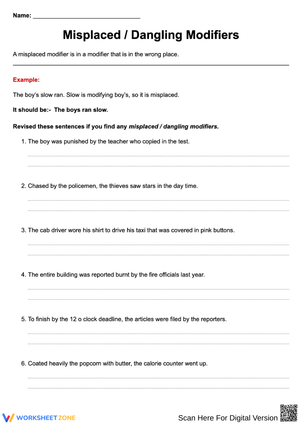
Misplaced and Dangling Modifiers worksheets for 9th Grade
These misplaced and dangling modifiers worksheets for 9th grade give teachers a focused set of practice materials built around the sentence-level errors that surface most consistently in freshman writing. At this stage, students are reaching for more complex syntax — introductory participial phrases, noun appositives, sentences with delayed subjects — and that reach is exactly where modifier errors take root. Each worksheet moves students through identification and revision, the two steps that actually transfer into cleaner essays.
What the Set Targets
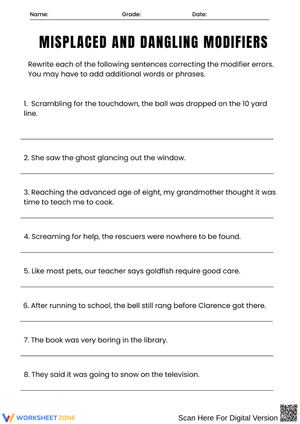
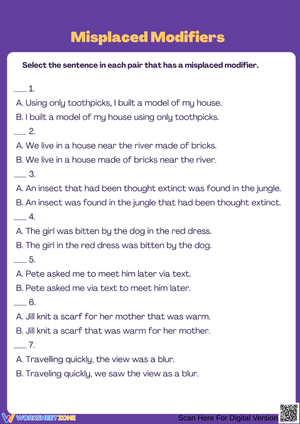
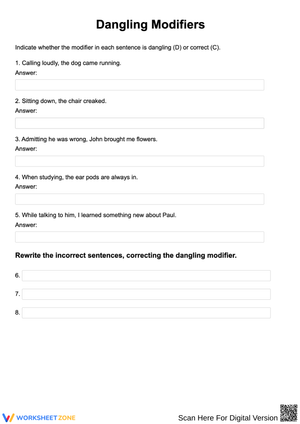
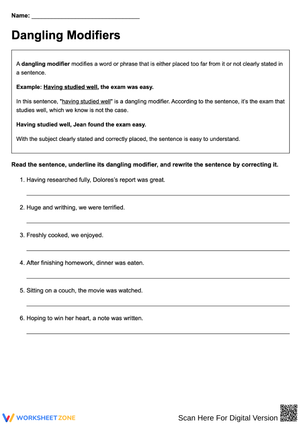
The misplaced and dangling modifiers worksheets for 9th grade address two related but distinct problem types. A misplaced modifier is present in the sentence but attached to the wrong noun — "She served cake to the guests on paper plates" puts the plates under the guests rather than the cake. A dangling modifier has no subject to attach to at all — "Having finished the essay, the TV was turned on" leaves the TV doing the writing. Students work through items of both types across each worksheet, and the set does not isolate them into completely separate drills, because the editing skill students actually need is knowing which kind of error they are looking at before they attempt a fix.
Beyond the two main types, the worksheets include items focused on limiting modifiers — only, almost, nearly, and just. Students practice:
- Identifying the error type in a given sentence before attempting any correction
- Moving misplaced phrases and clauses to the position closest to their intended noun
- Rewriting dangling constructions by inserting the missing subject directly after the introductory phrase
- Converting dangling participial phrases into subordinate clauses with their own explicit subject
- Placing limiting modifiers immediately before the word they are meant to restrict
Each worksheet also includes sentences with modifiers in mid-sentence and end positions, not only at the start. Students who practice only introductory phrases develop a false assumption about where these errors can occur, and the items here counter that directly.
Student Errors Worth Watching For Before the Revision Stage
The most consequential confusion is treating misplaced and dangling modifiers as the same problem. Students who learn the misplaced modifier rule first — move the phrase closer to its noun — will apply that fix to dangling modifiers and produce sentences that are still wrong. "Having studied hard, the exam went well" cannot be corrected by repositioning "having studied hard." The subject is absent, not displaced. Teachers should name this distinction explicitly during the first lesson and return to it when new worksheet items are introduced, because without that reinforcement, students default to the move-it fix even when repositioning changes nothing.
Limiting modifiers produce their own recognizable error pattern. Students routinely write "I only studied for an hour" when they mean "I studied for only an hour," and the difference reads as trivial until a teacher places three or four versions of the same sentence on the board and asks what each one actually claims. Spending five minutes on this before assigning the limiting modifier items makes a measurable difference in accuracy on those sections. A third pattern is over-correction: after learning that an introductory phrase needs an immediate subject, some students add subjects redundantly — "Having studied hard, the student, she passed the exam." Worksheet revision items that require a clean final sentence, not merely a corrected one, surface this tendency before it migrates into actual essays.
Building These Worksheets Into Your Lesson Plans
The most immediate application is the bell-ringer: one sentence projected before class settles, students correct it in their notebooks, brief whole-class discussion. Over two weeks, that routine covers more modifier types than a single grammar lecture, and it does so through spaced retrieval rather than massed exposure. Ninth graders will engage with a genuinely funny modifier error — "The professor explained the theory wearing mismatched socks" — in a way they will not engage with a worksheet assigned cold. The misplaced and dangling modifiers worksheets for 9th grade supply enough varied sentence types to sustain a bell-ringer routine through a full writing unit without repeating problem types.
For a longer diagnostic use, assign one worksheet early in the semester and sort the results into three groups: students who identify the modifier type but do not know how to repair it; students who fix misplaced constructions but not dangling ones; and students who miss both. Those groups require different instructional responses, and the worksheet surfaces them without needing a separate assessment. The peer-review application is particularly effective mid-unit — give students a checklist derived from the worksheet's identification steps and have them apply it to a classmate's draft. Modifier errors become concrete when they appear in a peer's argument about a novel the class just read, not in an invented practice sentence, and that shift in context is usually what makes the underlying rule land.
Standard Alignment
These worksheets address CCSS.ELA-LITERACY.L.9-10.1.B, which requires students to use various types of phrases and clauses to convey specific meanings and add variety to their writing. The standard's underlying premise is that phrase and clause structure should serve meaning — and a dangling or misplaced modifier is the clearest classroom demonstration of what happens when it does not. In practical terms, this standard surfaces during the writing process: students draft complex sentences in their essays, modifier errors appear, and they need a reliable editing skill to catch and fix them before the final draft grade. The worksheets build that skill through repeated low-pressure practice so it is available when it needs to perform under real assignment conditions.
Adjusting the Set for Different Writers in the Room
The misplaced and dangling modifiers worksheets for 9th grade lend themselves to tiered use without requiring separate materials. Students who are still building sentence-level fluency benefit most from the identification-only items — circling the problem phrase and naming the error type — before they attempt revision. Isolating the recognition step is not about removing challenge; it is about reducing cognitive load so students can practice distinguishing the two error types without simultaneously managing sentence production. Once recognition is solid, revision becomes accessible.
Students who move quickly through identification tasks can write sentences that deliberately introduce a specific modifier error, then exchange with a partner for correction. Producing a wrong sentence requires a more precise understanding of the rule than correcting someone else's mistake, and this variation requires no additional materials — it is an instruction shift, not a resource swap. For enrichment, students can examine mentor texts from the current reading unit and identify modifier constructions that work correctly, then explain in writing why each modifier connects logically to its intended noun. That exercise closes the gap between grammar practice and actual writing in a way that correction exercises alone do not.
Frequently Asked Questions
How do I help students reliably tell a misplaced modifier from a dangling one?
One diagnostic question does the work: "Is the subject this phrase is supposed to describe actually present in the sentence?" If it is, and the phrase is simply too far from it, the modifier is misplaced — move the phrase closer to its noun. If the subject is missing entirely, the modifier is dangling — insert the subject after the introductory phrase or rewrite the phrase as a subordinate clause with its own subject. Students who ask that question before attempting a fix self-correct far more reliably than students who have memorized a definition without a procedure attached to it.
What is the cleanest way to fix a dangling modifier without rewriting the whole sentence?
The fastest reliable repair is inserting the missing subject immediately after the introductory phrase. "Hoping to earn extra credit, the assignment was turned in early" becomes "Hoping to earn extra credit, Marcus turned in the assignment early." The participial phrase stays intact; the sentence acquires the subject it was missing. Students find this easier than rewriting from scratch, and it produces fewer awkward over-corrections. Worksheet items that target this specific repair move help students internalize it as a default editing strategy rather than a last resort.
Do the worksheets include items on limiting modifiers like "only" and "almost"?
Yes. Limiting modifiers are included because they represent a high-frequency error that standard grammar instruction often skips. Moving "only" in "She only ate the salad" to "She ate only the salad" is a small positional change with a genuine meaning shift, and ninth graders rarely notice the difference until examples appear side by side. The worksheets include items that ask students to place the limiting modifier correctly and then explain what changes in meaning when its position shifts — which turns a placement exercise into a thinking task about precision and word order.
Are these worksheets useful for grades other than ninth?
The error types addressed here — participial phrases, limiting modifiers, mid-sentence and end-position modifier errors — appear in student writing across grades 8 through 11. The sentence complexity is pitched at a 9th grade level, but the grammar concept does not change across that range. For 8th graders approaching high school writing expectations, the items work as preview practice. For 10th or 11th graders whose drafts still show modifier errors, the set functions as focused review without reading as remedial, because the sentences are written at a level appropriate to early high school.
Clear All