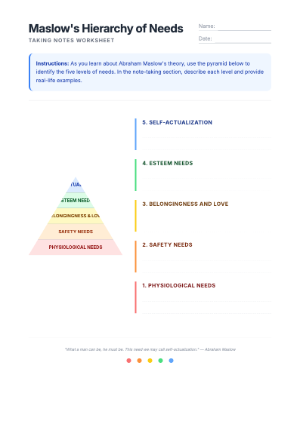
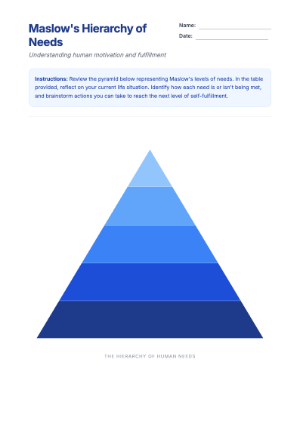
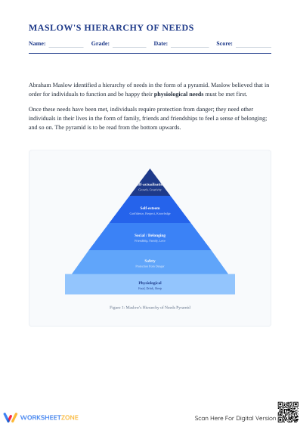
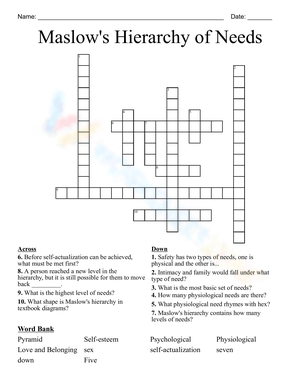
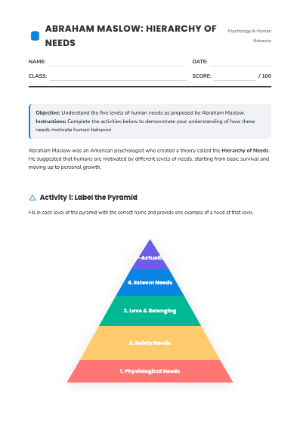
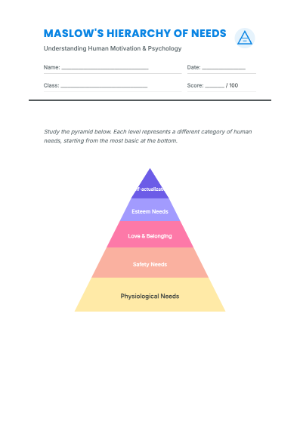
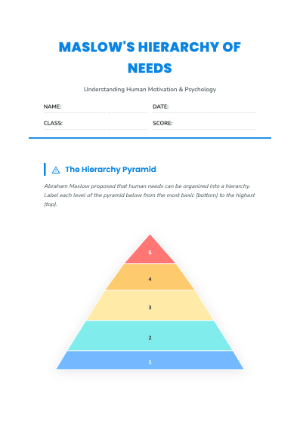
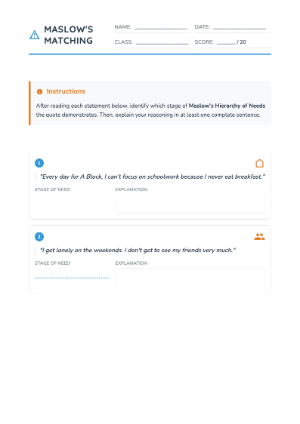
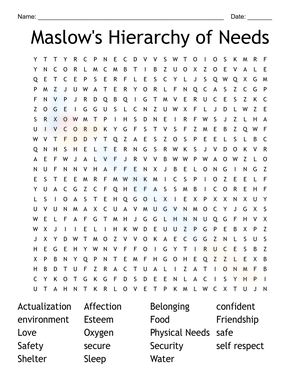
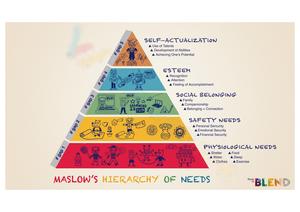
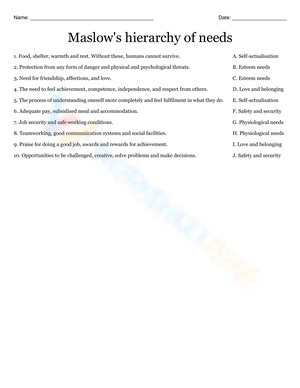
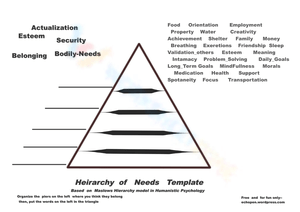
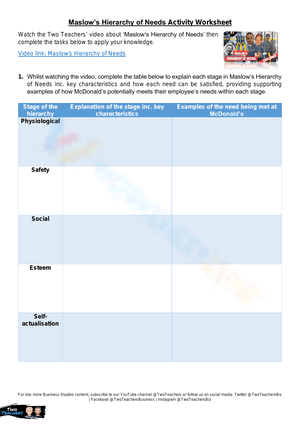
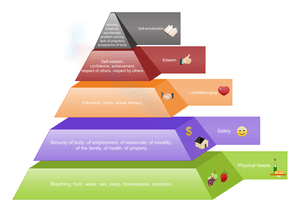
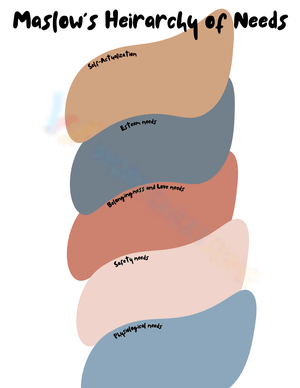
These 9th grade maslows hierarchy of needs worksheets printable give teachers a structured set of tasks that move students beyond pyramid memorization into real analysis of motivation, behavior, and school readiness. Each worksheet pairs brief explanatory content with applied tasks — sorting scenarios, justifying placement decisions, writing short explanations — so students are reasoning about the model from the start. The set works across advisory, health, introductory psychology, and social studies without requiring any prior background in psychological theory.
What Students Actually Do in These Worksheets
Students begin by placing each of Maslow's five levels — physiological, safety, belonging, esteem, and self-actualization — in plain language tied to school contexts rather than textbook definitions. From there, each worksheet raises the cognitive demand. Instead of matching a word to a definition, students read a short scenario and identify the most likely unmet need, then write one or two sentences explaining how that unmet need could affect the student's focus, willingness to participate, or ability to set goals.
- Vocabulary matching that connects each level to a recognizable school-based example
- Scenario sorting: students place eight to ten brief situations under the correct level and defend at least two choices in writing
- A comparison task asking whether a single situation could reflect more than one level, and why that distinction matters
- A reflection prompt tied to a specific classroom behavior — participation avoidance, effort withdrawal, or goal-setting — that students explain through the model
The scenario work is where the genuine learning happens. A student who can sort "feeling hungry during first period" under physiological needs has the basic concept. A student who can explain why that same student might also feel embarrassed about the situation — and how that embarrassment crosses into esteem or safety — is actually reasoning about layered motivation. That second move is the one worth teaching.
Frequent Student Errors Worth Watching For
The most consistent error ninth graders make is conflating belonging and esteem. Both levels involve other people, so students read "wanting to be liked by classmates" and reach for esteem when belonging is the more accurate fit. Esteem, in Maslow's model, refers to respect, recognition, and confidence — not simple peer acceptance. When a scenario describes a new student trying to find where to sit at lunch, that's belonging, even if the student phrases it as "wanting to feel respected." Pushing students to distinguish between the source of the need — social inclusion versus social status — is the move that sharpens the analysis.
A second predictable error is treating self-actualization as a destination someone has already reached rather than an ongoing orientation toward personal growth. Students with strong grades and stable friendships sometimes label themselves self-actualized. A quick clarifying question — "Does self-actualization mean you're done, or does it mean you're actively working toward something that genuinely matters to you?" — resets that misunderstanding fast and opens up better discussion than any amount of re-explaining the definition.
One honest tradeoff: the physiological and safety sections can land differently for students who have experienced real instability — food insecurity, housing disruption, ongoing family conflict. The scenarios are written around broad school situations rather than personal histories, but some students still go quiet during those sections. Having the early-level reflection available as a private written response rather than a public share gives those students room to engage without exposure.
How to Build These Worksheets Into Your Lesson Plans
A two to three day sequence works well with this set. On day one, introduce the model with teacher explanation and two modeled examples — walk through how you would place a scenario and what evidence in the text points to a particular level. On day two, students work in pairs on the scenario sort and comparison task. Day three uses the reflection worksheet as either a class discussion anchor or a private written exit ticket, depending on the course context and how much trust has been established in the room. In advisory settings, where periods run shorter and the tone is more personal, the vocabulary and sorting tasks work best at the start of a unit on community or self-management, with the reflection saved for a later session.
For Monday morning bell work, the scenario sort — five or six items, no writing required — takes about eight minutes and gives students an immediate cognitive task that sidesteps the slow restart most classes experience at the beginning of the week. It also activates prior knowledge cleanly before moving into new content.
- Model two scenario placements together before releasing students to work independently or with a partner
- Reserve the multi-level comparison task for students who finish the sorting early — it functions as natural extension work without requiring a separate handout
- Use the reflection worksheet as a private written exit ticket rather than a public share when the topic touches on stress, belonging, or family stability
- In psychology electives, return to the same worksheets after introducing Herzberg or Erikson — the comparison reveals what Maslow's model explains well and where it oversimplifies
Adjusting the Set for a Range of Learners
Students who struggle with abstract reasoning do best starting with the sorting task — they identify a situation, match it to a level, and name one reason why. That's a manageable entry point that doesn't require extended writing. Students ready for more analytical work can move directly into the multi-level comparison task and write a paragraph explaining how the same behavior might signal different unmet needs depending on context. That range of demand exists within the set, so teachers don't need to build separate assignments for different groups.
For students who are English language learners or who find extended reading taxing, the scenarios are short enough to work through with a bilingual partner or with a quick vocabulary preview. The five level names — physiological, safety, belonging, esteem, self-actualization — are the only terms students need before the first task begins. Writing those five terms on the board with one plain phrase each makes the work accessible without additional modification. The 9th grade maslows hierarchy of needs worksheets printable are also structured so that a student who needs more processing time can complete the set across two shorter sessions rather than one block, without losing the logic of the sequence.
Standard Alignment
In health classes, these worksheets support NHES Standard 1, which requires students to understand health concepts including the behavioral and psychological factors that shape decision-making and self-management. In psychology electives, the content aligns with the College Board's recommended high school psychology curriculum, which includes motivation theory — Maslow's hierarchy specifically — as foundational content in the unit on human behavior and mental processes. For advisory and SEL settings, the CASEL framework's self-awareness and social awareness competencies provide the most direct alignment: both ask students to recognize how internal states and external circumstances shape behavior, which is exactly what the scenario and reflection tasks address. Knowing which alignment applies helps teachers place the worksheets appropriately within a unit sequence rather than treating them as a standalone activity.
Frequently Asked Questions
Can these worksheets work in advisory or homeroom, or are they limited to content classes?
Advisory is one of the most natural settings for this material. The vocabulary and sorting tasks take under 20 minutes, the reflection prompt connects directly to school habits and peer relationships, and the model gives students and teachers a shared language for discussing what makes school harder or easier without singling anyone out. Teachers running community circles or SEL check-ins find the reflection worksheet especially useful early in the year, when ninth graders are still calibrating what high school expects of them.
How do I handle students who push back on Maslow's model or say it doesn't apply to them?
That pushback is productive. Maslow's hierarchy has documented limitations — the original research drew on a narrow sample, and researchers have long argued that the rigid tier structure doesn't hold consistently across cultures or individual circumstances. Acknowledging that honestly sharpens the lesson rather than undermining it: the model is a tool for analyzing motivation patterns, not a law. Asking students to find a case where the tier order breaks down produces better reasoning than asking them to accept the pyramid uncritically.
What do I do when students disagree about where a scenario belongs?
Don't resolve it immediately. Disagreement over scenario placement is where the reasoning actually happens. Ask both students to name the specific need the scenario reflects, then ask which level Maslow's model assigns to that need. The answer usually clarifies itself through the conversation. The 9th grade maslows hierarchy of needs worksheets printable include scenarios written with that productive ambiguity in mind — a few situations genuinely sit at the boundary between two levels, and arguing those cases is the pedagogical point, not a problem to eliminate.
Are these worksheets appropriate for students who may have experienced trauma or housing instability?
The scenarios use broad school situations rather than personal histories, which keeps the activity analytical rather than confessional. That said, the physiological and safety sections can surface uncomfortable recognition for students navigating real difficulty at home. Offering the reflection prompt as a private written response rather than a group share gives those students a way to engage honestly without exposure. When 9th grade maslows hierarchy of needs worksheets printable are used in classes where student circumstances vary widely, treating the reflection section as a private exit ticket rather than a public discussion is the more reliable default.












 Interactive Worksheet Maker
 Quiz Maker
 Word Search Maker
 Crossword Puzzle Maker
 Word Scramble Generator
 Sentence Scramble Generator
 Handwriting Worksheet Generator
 Name Tracing Generator
 Fill In The Blank Generator