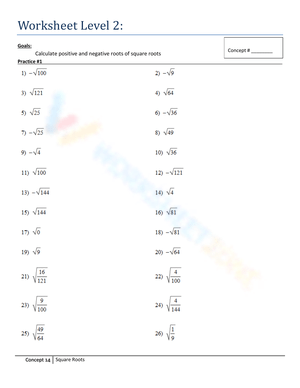
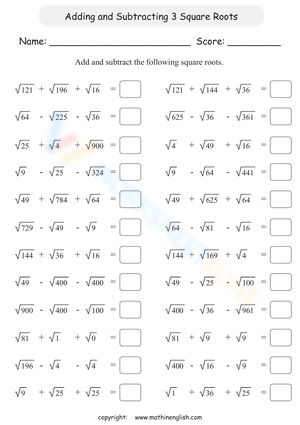
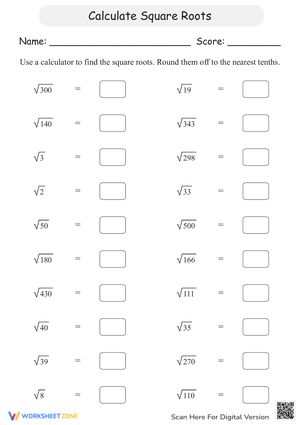
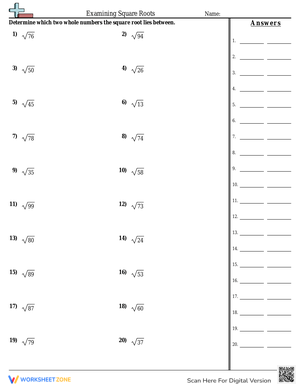
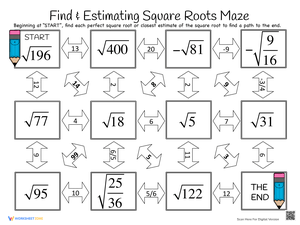
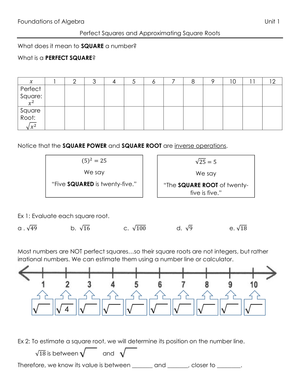
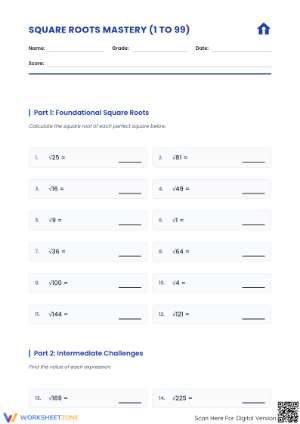
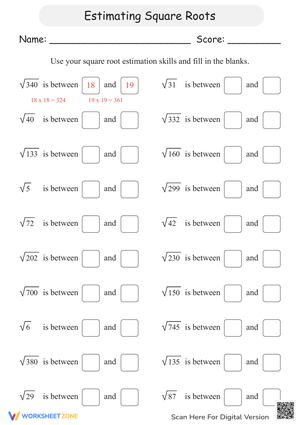
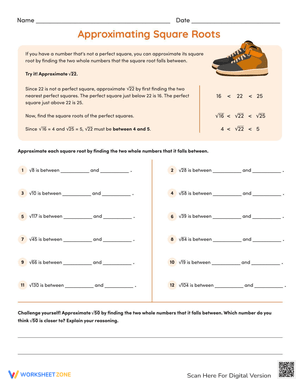
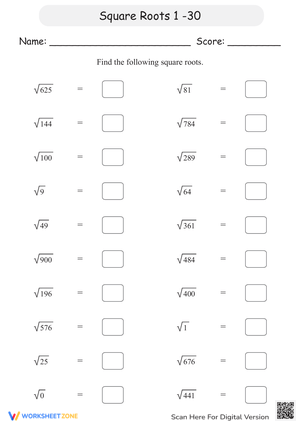
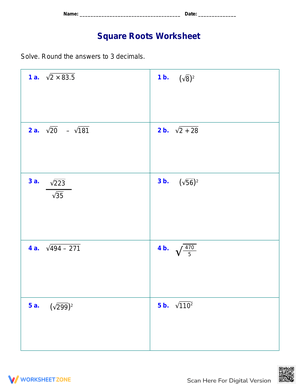
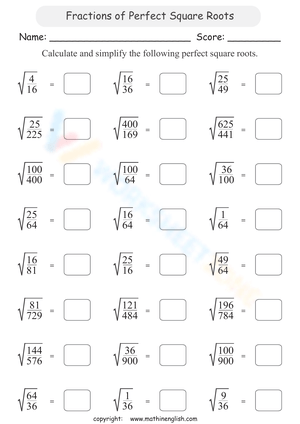
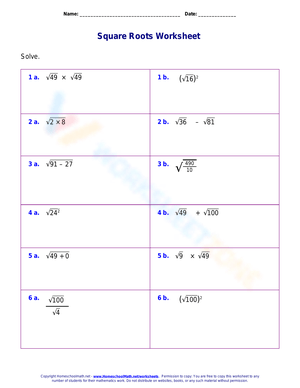
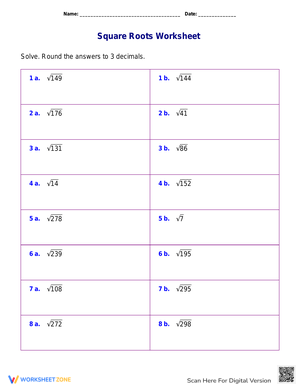
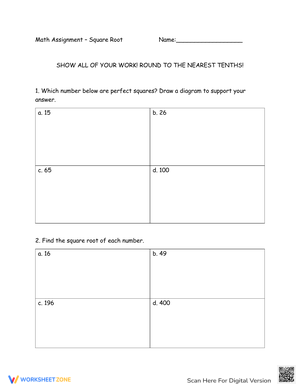
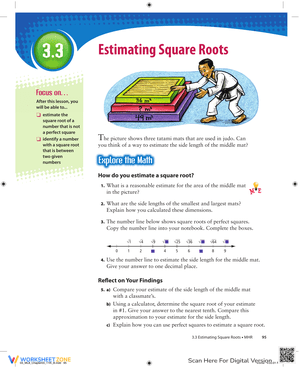
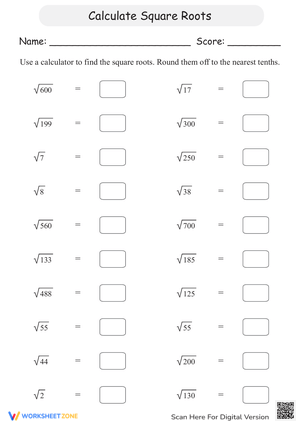
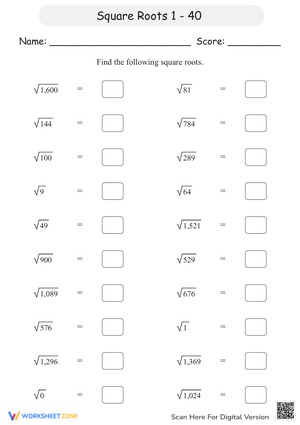
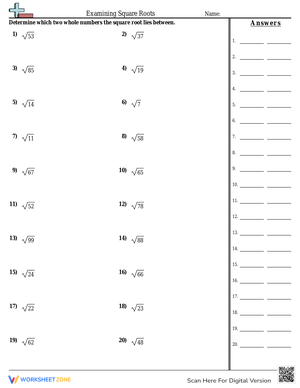
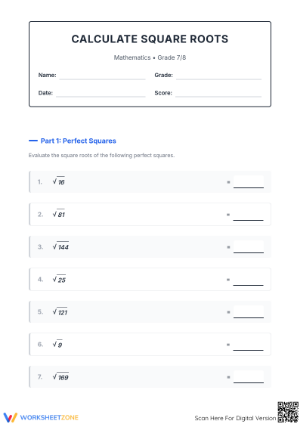
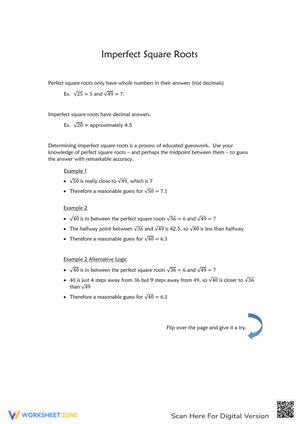
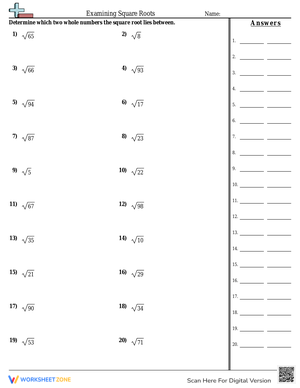
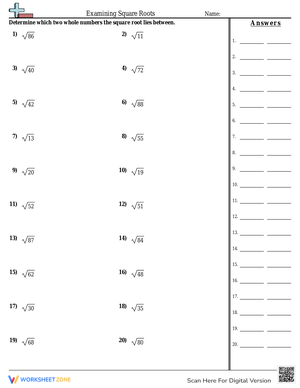
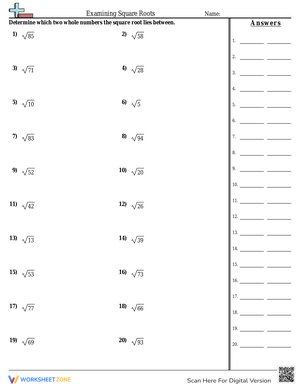
These estimating square roots worksheets for 8th grade give teachers structured, calculator-free practice at the moment in the curriculum when students are first confronting irrational numbers. Each worksheet targets the benchmark reasoning that makes this skill transferable: locate the surrounding perfect squares, name the integer range, then judge proximity. Students who work through this process with pencil and paper build a number sense that holds up later when square roots appear inside geometry formulas and real-number comparisons.
The Specific Skills Targeted
The worksheets move through a tight, deliberate progression. Consistent formats across the set help students internalize the reasoning pattern rather than treating each problem as a novel task.
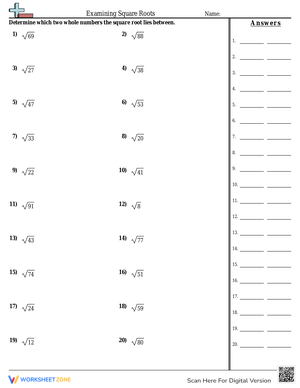
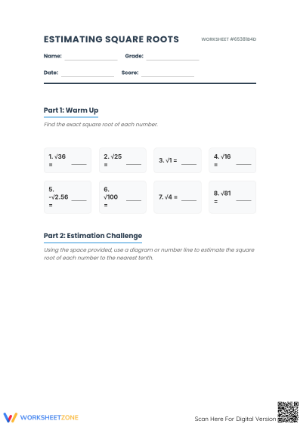
- Bracketing between consecutive integers: Students identify that √38 falls between 6 and 7 because 36 and 49 are the surrounding perfect squares, and they record both bounds before estimating.
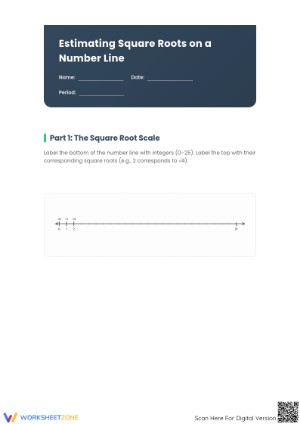
- Number line placement: Students mark approximate positions for values like √20, √55, and √72, judging how close each sits to the integer boundaries on either side.
- Refining estimates to the nearest tenth: Students reason that √50 is closer to 7.1 than 7.5 because 50 sits only 1 unit above 49 but 14 units below 64.
- Comparing and ordering: Students arrange expressions such as √15, √28, and √40 from least to greatest without converting to decimal form.
- Geometry-context application: A few problems connect the skill directly to area—students find approximate side lengths of squares whose areas are not perfect squares.
The number-line problems deserve particular attention in early lessons. Students who can mark √37 accurately—placing it clearly closer to 6 than to 7—carry that visual understanding forward when the number line is later removed.
Frequent Errors Worth Catching Before They Settle In
Two distinct error types dominate student work on this skill, and the problem sets in estimating square roots worksheets for 8th grade surface both quickly, which makes diagnosis easier. Treating them as one issue slows reteaching considerably.
The first is a benchmark selection error. A student estimating √20 writes 9 and 25 as the surrounding perfect squares instead of 16 and 25, which throws the integer range off entirely. That is a perfect-square recall gap, not a misunderstanding of the estimation process itself.
The second is a placement error. The student correctly identifies √50 as falling between 7 and 8 but records approximately 7.5 because 50 "looks like it's in the middle." They are ignoring the actual distances—50 is 1 unit above 49 and 14 units below 64—and defaulting to a visual center guess. These students do not need more perfect-square drilling; they need explicit practice comparing how far a radicand sits from each boundary.
Separating those two error categories during review makes small-group work much faster. Students with benchmark errors can spend time on perfect-square recall activities while students with placement errors work on proximity reasoning problems. They are different instructional needs, and they respond to different approaches.
How to Build These Worksheets Into Your Instructional Week
The most reliable entry point is a five-minute whole-class perfect-square review before students begin the first worksheet. That brief anchor reduces benchmark selection errors and keeps the group moving at a consistent pace without eating into lesson time.
During direct instruction, use one worksheet for guided practice and pause after each problem to narrate the two-step reasoning aloud: bracket first, then place. Students who hear that sequence repeated out loud internalize it as a self-monitoring strategy they can apply independently. For independent work, a worksheet mixing number lines, comparison problems—is √45 greater than or less than 6.8?—and at least one context item gives you cleaner diagnostic data than a worksheet of identical estimation items.
Estimating square roots worksheets for 8th grade slot naturally into the 10-minute warm-up period for the week or two surrounding this unit. Four to six problems—two bracketing, two number-line placement—takes most students about eight minutes and produces informal formative data before the main lesson begins. The final two minutes can be a quick pair-share on one disputed answer.
Standard Alignment
CCSS 8.NS.A.2 asks students to "use rational approximations of irrational numbers to compare the size of irrational numbers, locate them approximately on a number line diagram, and estimate the value of expressions." In classroom terms, that standard maps directly onto what these worksheets ask students to do. The bracketing and placement tasks produce the rational approximations the standard calls for. The number-line problems address the locating requirement explicitly. The comparison and ordering items address the reasoning the standard pairs with approximation—students use their estimates to make mathematical judgments, not just record decimal values.
This standard sits inside the Grade 8 cluster on the number system and precedes work on real numbers, the Pythagorean theorem, and expressions involving square roots. Getting this skill firm before those topics arrive is worth the instructional time.
Adjusting for a Range of Readiness Levels
For students still building perfect-square recall, a printed reference strip listing squares from 1 to 144 lets them focus on the estimation logic without getting stuck on fact retrieval. The strip is a temporary support—something to phase out over two or three lesson cycles as recall improves, not a permanent fixture on the desk.
For students who have the integer-range step firmly in place, the productive challenge is tenths-place precision with a justification requirement. The task is not just to write 7.1 as an estimate for √50, but to explain that 50 is only 1 unit from 49 while it is 14 units from 64, so the estimate must sit very close to 7. That proportional reasoning is within reach for strong 8th graders without introducing new vocabulary or procedures.
Estimating square roots worksheets for 8th grade also work well as pre- and post-assessment tools. Give the same worksheet before instruction and again after a lesson cycle, then compare the error type that appears. If students shift from benchmark errors to placement errors between the two administrations, that change is itself evidence of progress—they now know their perfect squares but need more work with proximity reasoning.
Frequently Asked Questions
Which perfect squares should 8th graders know before starting this skill?
Students need comfortable recall of the squares of 1 through 10 at minimum—that is 1, 4, 9, 16, 25, 36, 49, 64, 81, and 100. Students who also know 121 and 144 can handle a wider range of problems without extra instruction. The 1-through-10 set covers the vast majority of estimation tasks that appear at this grade level.
Should students use calculators when working through these worksheets?
Not during the estimation task itself. The goal is developing a feel for the size of irrational numbers—using a calculator first bypasses that reasoning entirely. The more productive approach is to let students commit to their estimate first, then check with a calculator. Correct estimates build confidence; off estimates prompt a closer look at the proximity reasoning.
How does estimating square roots connect to later 8th grade topics?
Students who internalize the bracket-and-place process handle Pythagorean theorem problems more cleanly. When √(a² + b²) shows up in a geometry context, a student who knows how to locate a square root between integers can judge whether a calculated hypotenuse is a reasonable size. That reasonableness check is exactly the kind of number sense that separates students who understand a procedure from students who can only execute it.
What if students lack the perfect-square recall needed to use these worksheets productively?
A short daily recall drill—four problems, about 60 seconds—run as a warm-up for two weeks before the unit closes most of the gap. Perfect-square fluency and estimation ability develop faster when they run as parallel routines than when teachers wait for complete recall before introducing the estimation process.













 Interactive Worksheet Maker
 Quiz Maker
 Word Search Maker
 Crossword Puzzle Maker
 Word Scramble Generator
 Sentence Scramble Generator
 Handwriting Worksheet Generator
 Name Tracing Generator
 Fill In The Blank Generator