


























1 / 2
0
Views
0
Downloads


0.0
0
Save
0 Likes
Share
Estimating Imperfect Square Roots
0 Views
0 Downloads
Paste this activity's link or code into your existing LMS (Google Classroom, Canvas, Teams, Schoology, Moodle, etc.).
Students can open and work on the activity right away, with no student login required.
You'll still be able to track student progress and results from your teacher account.
Information
Description
What It Is:
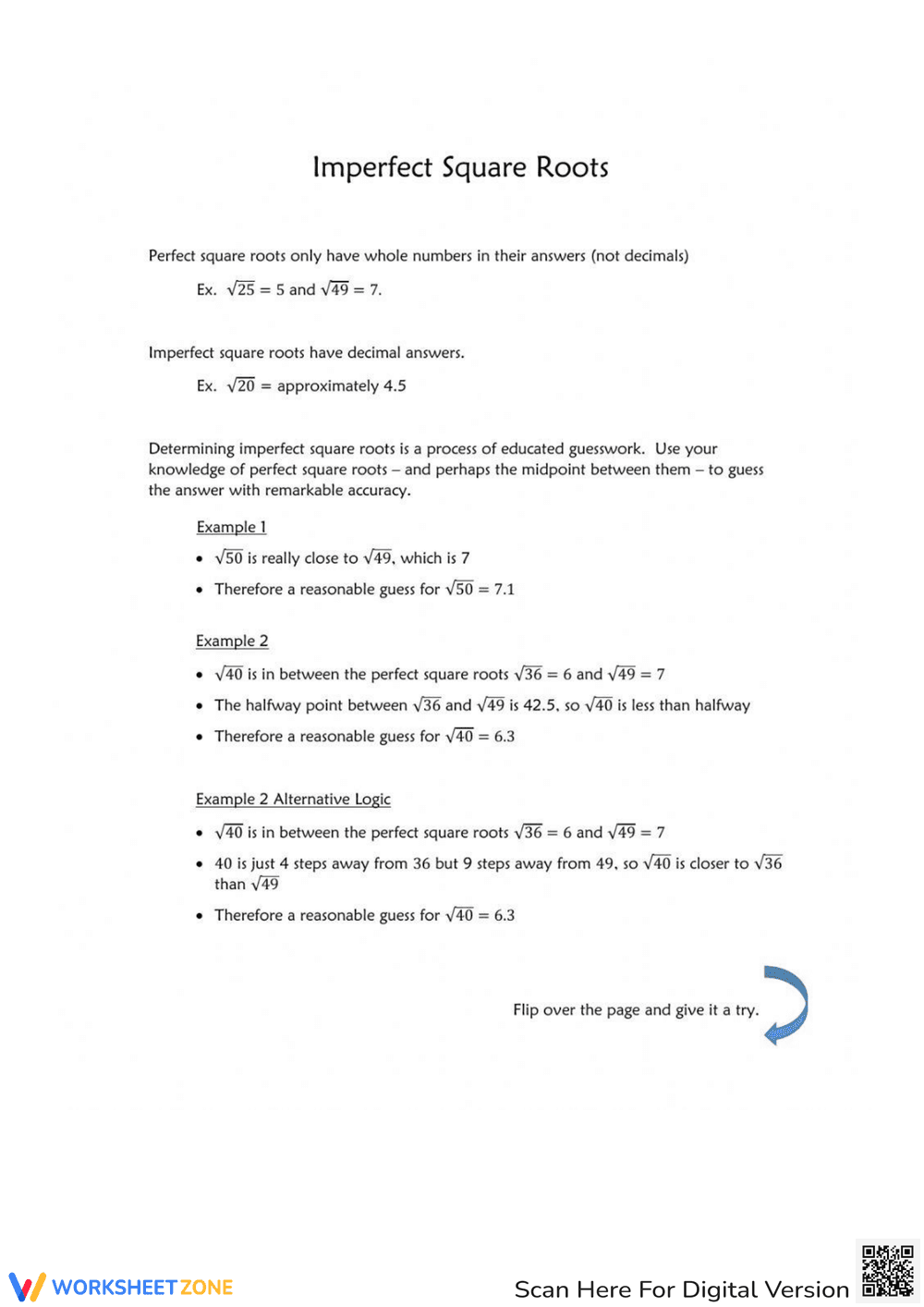
This is an educational worksheet focusing on imperfect square roots. It provides examples of how to estimate the value of square roots that are not perfect squares. The worksheet explains that perfect square roots result in whole numbers, while imperfect square roots have decimal answers. It uses examples like √50 and √40 to demonstrate estimation techniques, including comparing the imperfect square root to nearby perfect square roots and using the midpoint between them.
Grade Level Suitability:
This worksheet is suitable for grades 7-9, particularly those learning about square roots, number sense, and estimation in pre-algebra or algebra courses. The concepts require a basic understanding of perfect squares and number lines.
Why Use It:
This worksheet helps students develop number sense and estimation skills. It provides a practical method for approximating the value of imperfect square roots, reinforcing the relationship between perfect squares and their square roots. It encourages logical thinking and problem-solving skills through educated guesswork.
How to Use It:
The worksheet can be used as an introduction to imperfect square roots or as a review activity. Students should read the explanations and examples carefully, then practice estimating other imperfect square roots using the techniques demonstrated. The instruction to 'Flip over the page and give it a try' suggests there are practice problems on the reverse side.
Target Users:
The target users are students in middle school or early high school learning about square roots and estimation. It is also suitable for students who need extra practice with number sense and approximation skills.
This is an educational worksheet focusing on imperfect square roots. It provides examples of how to estimate the value of square roots that are not perfect squares. The worksheet explains that perfect square roots result in whole numbers, while imperfect square roots have decimal answers. It uses examples like √50 and √40 to demonstrate estimation techniques, including comparing the imperfect square root to nearby perfect square roots and using the midpoint between them.
Grade Level Suitability:
This worksheet is suitable for grades 7-9, particularly those learning about square roots, number sense, and estimation in pre-algebra or algebra courses. The concepts require a basic understanding of perfect squares and number lines.
Why Use It:
This worksheet helps students develop number sense and estimation skills. It provides a practical method for approximating the value of imperfect square roots, reinforcing the relationship between perfect squares and their square roots. It encourages logical thinking and problem-solving skills through educated guesswork.
How to Use It:
The worksheet can be used as an introduction to imperfect square roots or as a review activity. Students should read the explanations and examples carefully, then practice estimating other imperfect square roots using the techniques demonstrated. The instruction to 'Flip over the page and give it a try' suggests there are practice problems on the reverse side.
Target Users:
The target users are students in middle school or early high school learning about square roots and estimation. It is also suitable for students who need extra practice with number sense and approximation skills.


