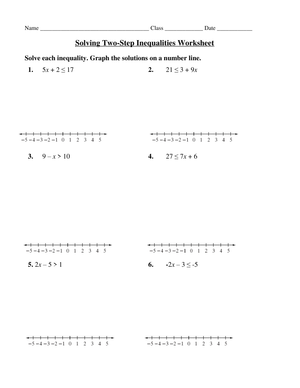
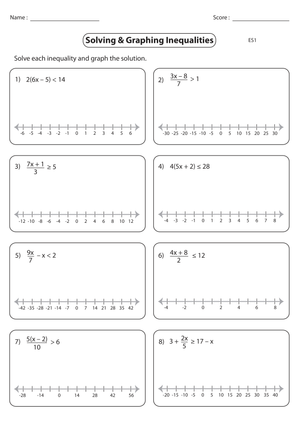
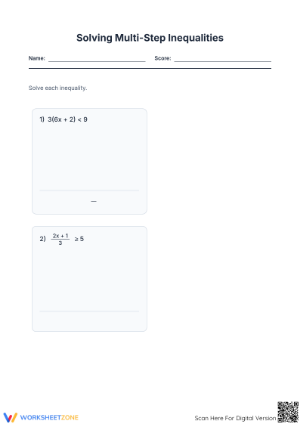
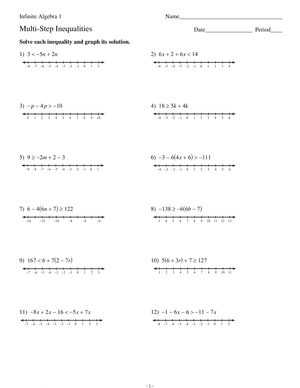
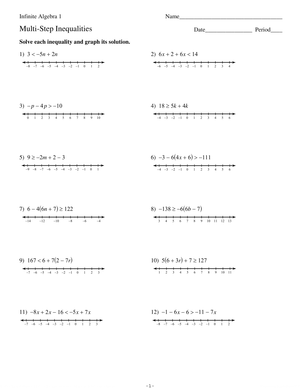
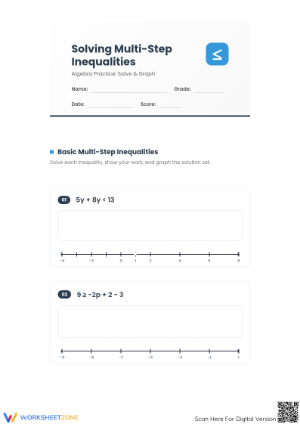
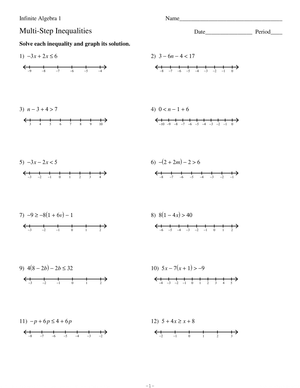
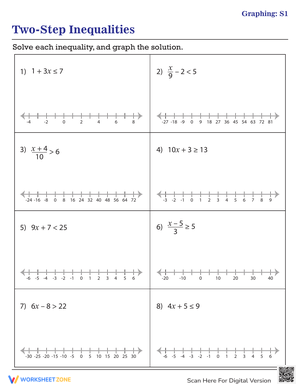
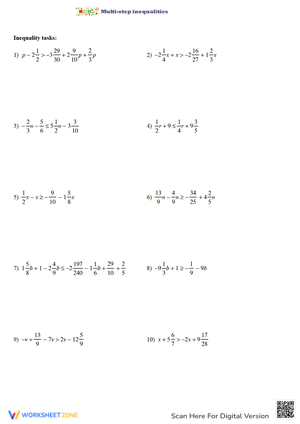
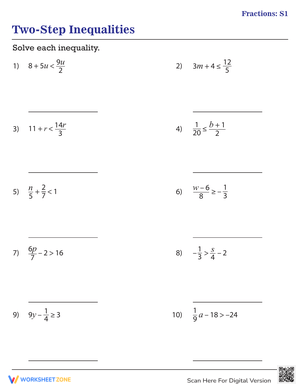
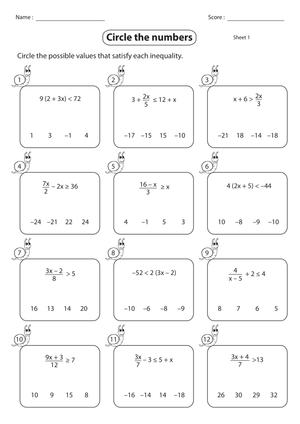
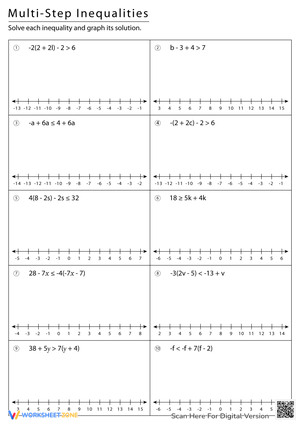
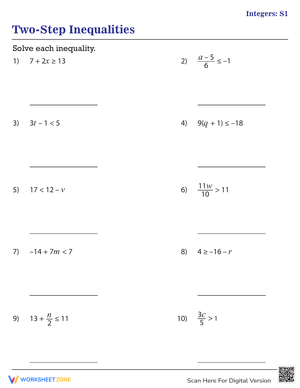
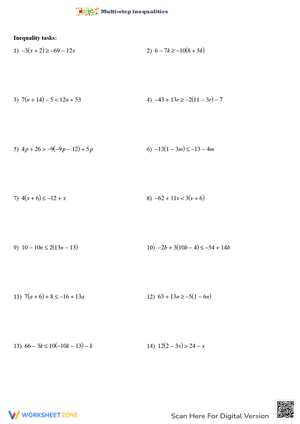
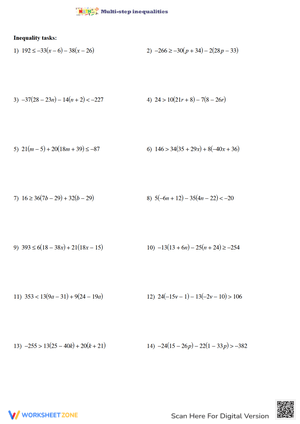
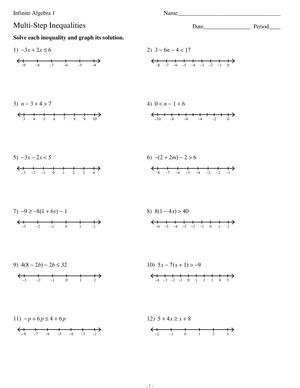
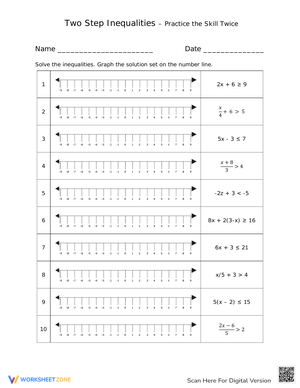
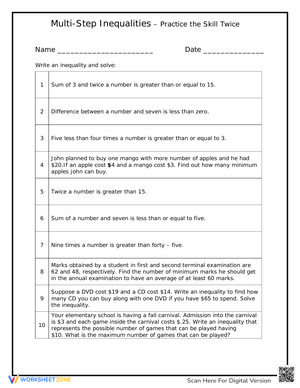
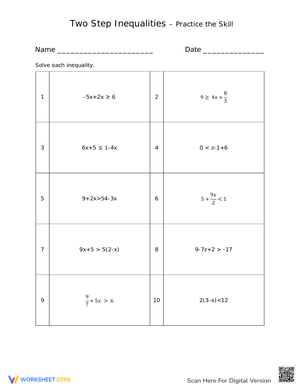
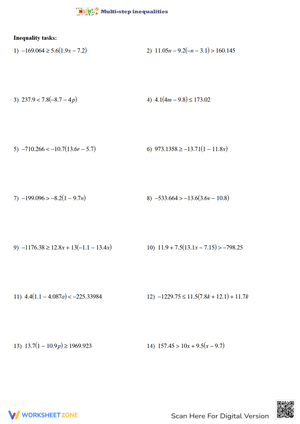
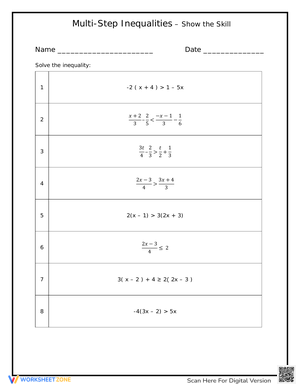
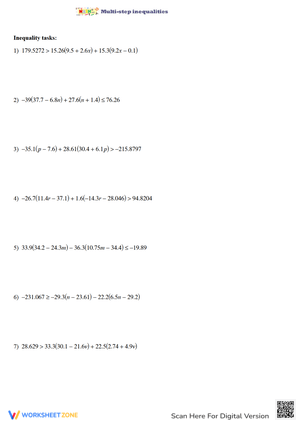
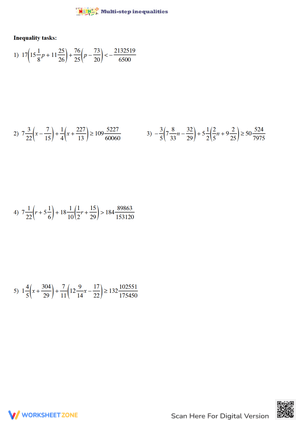
These 8th grade multi step inequalities printable worksheets resources give teachers a focused set of practice materials for one of the more demanding transitions in Grade 8 algebra: moving from solving equations to solving and correctly representing inequalities across multiple algebraic steps. Each worksheet targets a specific stage of that process, from simplifying expressions and distributing across parentheses to catching the sign reversal rule and producing an accurate number line graph. Print-ready with enough workspace for full step-by-step work and backed by a reliable answer key, the set holds up on short-notice lesson days as well as during a carefully planned unit.
Problem Types and Skill Sequence
The skills in these worksheets follow the natural difficulty curve of multi-step inequality instruction. Earlier worksheets address inequalities with integer coefficients and straightforward like-term combining. As the set progresses, students work with rational number coefficients, expressions requiring distribution across parentheses, and inequalities with variables on both sides — the point where most 8th graders begin making procedural errors in earnest.
Every worksheet pairs solving with graphing. Students write the solution in inequality notation and then represent it on a number line with the correct endpoint type and shading direction. That pairing matters because solving and graphing are separate cognitive tasks, and students who handle the algebra accurately often misread their own solution when translating it to a graph. Keeping both tasks on the same worksheet makes that disconnect visible to the teacher immediately rather than surfacing only on a quiz.
A well-constructed 8th grade multi step inequalities printable worksheets set also includes some equation-versus-inequality comparison problems. When students solve the same coefficients structured as both an equation and an inequality, side by side, they have to think deliberately about what makes the answers different: one produces a single value, the other a solution range. That contrast exercise closes a gap that pure inequality practice alone tends to leave open.
Where the Algebra Goes Wrong and When to Catch It
The sign reversal rule generates the most errors in this unit, but the most reliable fix is not simply reminding students about it. Students who forget to flip the symbol usually treat it as a memorized step rather than a reasoned one. When a student divides both sides by negative four and writes x greater than 6 instead of x less than 6, the useful correction is asking them to substitute 7 into the original inequality and check whether it holds. Building a verification step into the worksheet — even a small "test a value" box — catches more of these errors than repeated rule reminders will.
Graphing errors are the second pattern, and the source is usually incomplete reading. Students identify the solution and stop before checking whether the boundary value is included in the set. A student who solved for x greater than or equal to negative 3 will shade the correct side of the number line but mark an open circle, because they finished reading at the inequality symbol and missed the "equal to" component. A handful of targeted problems that deliberately mix open and closed endpoints near the end of a worksheet trains students to finish the full reading step before drawing.
A third pattern surfaces when variables appear on both sides. Students move the smaller variable term across the inequality but lose track of the operation used to move it, introducing a sign error that invalidates every remaining step. These errors compound quietly — the algebra looks plausible until a test value fails to satisfy the original inequality. Worksheets that include labeled step boxes for variables-on-both-sides problems force students to articulate each move rather than collapsing multiple operations into a rushed single line.
Tiering the Practice for Mixed-Skill Groups
For students still uncertain about integer operations or sign rules from earlier in the year, the integer-coefficient worksheets serve as the starting point. Assigning only those problems first — before anything involving fractions or variables on both sides — lets those students practice the core sequence (simplify, isolate, check the inequality direction, graph) without the added friction of rational number arithmetic muddying the process.
For students who move through the procedural steps accurately but without real understanding, error analysis tasks provide better challenge than simply assigning more problems. Present a worked solution containing a deliberate mistake — say, a student correctly isolates the variable but shades the wrong half of the number line — and ask them to identify and correct it. That task requires more careful reasoning than solving from scratch, and it reveals whether a student understands what the graph represents or is just following a sequence of steps.
When the 8th grade multi step inequalities printable worksheets set includes word problems, students who are already fluent with the procedure benefit from writing the inequality themselves before solving, rather than receiving it pre-formatted. That single added step reveals whether they understand what the inequality models or are processing symbols without connecting them to a real situation.
Building These Worksheets Into Your Week
The most natural sequence is two days on the same problem type: a solving-only worksheet on day one so students practice the algebraic steps without the simultaneous demand of producing a graph, then graphing required on day two with the same problem structure. Students who graph incorrectly on day two have already shown whether the issue is algebraic or representational — the teacher gets clean diagnostic information without a separate assessment instrument.
For warm-up use, two or three problems pulled from an earlier worksheet work well during the 8 to 10 minutes before direct instruction begins. The problems should be ones students have already encountered — retrieval rather than introduction. Practicing previously learned steps before new instruction reduces working memory demand during the lesson itself, which matters here because multi-step inequality instruction layers new concepts onto algebra moves students are still automating.
- Classwork follow-up: A focused worksheet immediately after direct instruction, moving through one problem type at a time with full step-by-step workspace
- Station rotation: One center solves inequalities, a second center graphs pre-solved inequalities, a third center works error analysis problems
- Intervention block: A single worksheet targeting the specific breakdown — sign reversal, endpoint type, or sign errors from variables on both sides
- Friday review: A mixed worksheet cycling through integer, rational, and variables-on-both-sides problems, all requiring graphing
- Test prep: A worksheet that mirrors the quiz format, including at least one word problem and one equation-versus-inequality comparison
Standard Alignment
These worksheets address the Grade 8 Expressions and Equations domain, with the closest anchor being 8.EE.C.7, which asks students to solve linear equations in one variable with rational number coefficients using the distributive property and by collecting like terms. Multi-step inequality instruction applies the same algebraic reasoning in an inequality context — the procedural moves are parallel, but the solution set interpretation is fundamentally different. The CCSS foundation for one-variable inequality solving is built in 7.EE.B.4b, and Grade 8 instruction extends that work into more complex expressions, rational coefficients, and the expectation that students represent solution sets graphically as a standard part of the answer, not an optional add-on.
In most Grade 8 pacing guides, multi-step inequalities fall after multi-step equation instruction, which makes this a natural moment for a side-by-side comparison lesson. Teachers who have already covered 8.EE.C.7 can use these worksheets to extend the same algebraic skills while shifting students' attention toward solution interpretation — a conceptual deepening, not just a procedural extension of what they already know.
Frequently Asked Questions
Do students need to know how to solve multi-step equations before starting these worksheets?
Yes, and that prerequisite matters more than it sometimes gets treated. Students who are uncertain about combining like terms or applying inverse operations carry those same weaknesses into inequality problems, plus the added layers of sign reversal and graphing. The worksheets that begin with integer-coefficient problems assume students can already handle basic multi-step equation moves. If they cannot, one day of equation practice with the same coefficient types makes the inequality transition considerably smoother.
How many problems should appear on a worksheet for this topic?
For worksheets where students show full algebraic steps and graph each answer, 8 to 12 problems is the practical range for a 15- to 20-minute block. More than that produces rushed work and incomplete graphs, especially on multi-step problems where students need vertical space to organize their steps. Fewer well-chosen problems consistently produce better evidence of student understanding than crowded worksheets where students cut corners to finish.
What's the most effective approach for students who solved correctly but graphed wrong?
Separate the two tasks. Give those students a worksheet where the symbolic answer is already printed and they only need to produce the graph — endpoint type and shading direction. That isolates the graphing decision from the algebraic process so the teacher can see exactly where the breakdown is happening. Once students graph pre-solved inequalities accurately, reintroduce the full solving-plus-graphing worksheet. The 8th grade multi step inequalities printable worksheets format makes this kind of targeted reteaching practical because each worksheet in the set addresses a distinct piece of the skill rather than bundling everything into one undifferentiated exercise.
Can these worksheets work as homework?
They can, with some selection. A worksheet built around 8 to 10 integer-based problems with generous workspace and an example problem at the top makes reasonable independent practice. Avoid sending home worksheets heavy on rational number coefficients or word problems until students have had sufficient in-class exposure to those types. The answer key also matters: students who check their work immediately retain the correction better than those who wait until the following class period to find out what went wrong.













 Interactive Worksheet Maker
 Quiz Maker
 Word Search Maker
 Crossword Puzzle Maker
 Word Scramble Generator
 Sentence Scramble Generator
 Handwriting Worksheet Generator
 Name Tracing Generator
 Fill In The Blank Generator